Showing posts with label Herbalogy. Show all posts

Thursday, October 1, 2015

The Spirit of Plants

The Spirit of Plants

Our August plants apprenticeship weekend took us deeper into some questions we had dipped into in previous months, questions on engaging with the spiritual aspects of the plant world, and exploring how we could tune into understanding the gifts that plants bring to us with our hearts and intuitions, as well as our minds and hands.

The energy of the weekend was quiet and receptive, quite different from our previous weekends of adventurous exploring, meeting plants in new locations, researching species, and working with ethically-harvested wild plants and farmed plants in medicinal and culinary ways. This time we stayed on site at the home of Earth Tracks and Rebel Roots Herb Farm, and spent much of our two days under a large black walnut tree that sheltered us against the bright August sun.

The weekend was primarily composed of a series of deepening meditations that worked on our abilities to open up to intuition and deeply listen to the energies of the living beings all around us. We were encouraged to keep our minds and hearts open to visualize, imagine, dream, find metaphors, listen to our inner voices, and engage in the unseen world in whatever way worked for each of us. We made space to speak of our personal experiences of the sacred, and a container of trust and respect was created that honoured each participant’s individual beliefs and experiences.
 
To set the tone and bring us into a quieter frame of awareness and connection, we wove in elements of ceremony and ritual into the weekend.  Alexis incorporated some good context on the lineage of the rituals we were using, and we had opportunities for questions and dialogue on how to incorporate ceremony into our own lives in ways that felt authentic to each of us.

Along with group meditations, we had time to sit individually with plants and trees on the landscape to deepen our relationships with them, as well as to practice meditation and visualization techniques on our own. We spoke of dreams and how to find meaning in them – in a personal, intuitive, non-formulaic way - to help guide us in waking life, and we learned a useful word-association exercise for dream recall and interpretation. We also did a number of playful paired and group exercises on reading energy from each other, from plants, and from objects that we were deeply connected to.

The atmosphere of the weekend was open, exploratory, curious and connecting.
It was also nourishing and relaxed. And above all, it introduced us to a set of approaches, tools and possibilities for engaging with the natural world through spirit, and engaging with spirit through the natural world.


Written By: Malgosia Halliop - 2nd Year Plants Apprentice


Tuesday, August 11, 2015

Thistles, Bitters and Life's Simple Pleasures


Saturday July 18 2015 - Varney, Ontario

It was a beautiful mid-summer morning in July, and we plant apprentices were getting ready to learn about medicinal plants. Weaving a thread through from last weekend of stewardship though, we started by going out to sit with some of the amazing medicinal plants that we had planted over a month ago. The changes were staggering, as I went to sit by a beautiful milk thistle that grown over four feet since I had last seen it. With white and green spotted leaves that spiralled where attaching to the stem, and a bright purple blossom facing this sky - the milk thistle was a sight to behold. Some others sat with astragalus or hops or calendula, reflecting upon the growth of plants, the bounty of summer, and the beauty of sitting still. After some time, we gathered together to share a few quick reflections before jumping into a session with special guest - Laura Gilmour!
 
Crafting a bitters formula to help with digestion, we discussed all the cultural food practices that would allow for invisible bitters, like eating bitter salad greens or certain pickles to prime our digestive tracts in advance of meals.  True bitters are the best way to "tell digestion to take up the challenge of the food we are about to eat".  There are even sneaky ways to incorporate bitters into meals like having a bitter aperitif to toast with before a holiday meal! 
We followed a rough formula to blend our own special bitters formula
Bitters
- 10% Super bitter (ex. gentian root)
- 30-50% Mild to medium bitters (ex. chamomile)
- 30% Aromatic (ex. cardamom)
- 10% Harmonizer or catalyst (ex. licorice root)

After blending our own unique bitters formula that included some great plant tinctures like angelica, tulsi basil and dandelion root, we were all excited and ready for lunch and a fruit full picnic on the lawn commenced!

After lunch, we split our group of 17 into two rotations of some tasting and making activities. Alexis led us through the process of making a healing oil which was infused with St John's Wort and then a cold and flu tincture made with yarrow, elderflower and peppermint. It's hard to imagine on a hot summer's day that in the deep of winter, you may have a rattling cough that needs that tincture - o the changing seasons!

After looking into St John's Wort more mythical properties - like it can help guard your soul from phantasms! - we made some plant journals on the SJW.

Leaving our semi-finished homework behind, we worked with Laura Gilmour, an amazing community herbalist, naturalist and small business owner of Wild Muskoka Botanicals, to learn about flavours and tastes and how that can tell us about the properties of the herbs. We tasted hot horseradish, and yummy, sweet astragalus and salty nettles. Depending on your body's inclinations and the type of condition you may have, we played around with the types of flavours and remedies that could help. The highlight was definitely nibbling on Schisandra berries - the five-flavoured fruit! So wild to have every flavour in your mouth!

As the more official workshops wound down, we celebrated our medicinal plants weekend by sharing a delicious potluck meal with salads, meats, cheeses and so much more - only to top off the evening with a cocktail party! Although cocktail tinctures really are for fun rather than medicine, everyone definitely felt great!


Written by:  Lee Earl 2nd Year Wild Plants Apprentice

Friday, July 24, 2015

A taste of plant medicine, meetings with trees, and a small surprise


The themes of caretaking and stewardship wove through our June weekend. Our second morning, like our first day, was grounded at Alexis and Bobbi’s place, home of Earth Tracks Outdoor School and Rebel Roots Herb Farm.  

We spent the morning in two groups alternating between two herbal medicine-making activities using common wild plants.  Alexis took a group through the process of harvesting plantain and making an infused oil, to use on its own or as a later base for medicinal salve. Lee and I led a second activity, harvesting some of the abundant wild thyme whose fragrance wafted around our tents, and creating a thyme-infused medicinal apple cider vinegar.  Alex joined in at Alexis’s station to strain off and share the lemon balm cold infusion she had made the previous day: a welcome refresher to the morning’s heat. Each group researched the plants while working with them, using field guides and each other’s knowledge to understand the medicinal properties of the plants we harvested with our hands.  

Our afternoon location was a short drive away: the forested property where Earth Tracks had been based until recently.  The brightness of sun and openness of the agricultural landscape where we had started the weekend was transformed into the coolness and cover of dense trees; the industriousness of the morning’s activities into a grounded and aware exploration of this new place and its energy. 

We began the afternoon identifying trees on the property; but quickly moved into several activities that shifted our awareness to more subtle information around us.  A paired blindfolded “meet a tree” exercise gave each person the opportunity to use their less dominant senses – including intuition – to get to know an individual tree and then find it again with the blindfold removed.  We followed this with a focused sit spot, each of us tuning in to the space around us and asking the questions “what can I do to help?” or “how can I give back to this land?” and listening to the possible answers: moving branches, lifting up weight, pruning.  It was in introduction to listening deeply to the land as an expression of caretaking.

To close the afternoon, we worked on one more caretaking project, a deer trail that the apprenticeship group of three years ago had begun clearing.  Alexis spoke of his connection to the deer on this property, where he had hunted as well as stewarded the land. We moved on to the trail, thinking through the mind of a deer which obstacles would hinder our progress, especially at low energy and hungry times of year.  As we moved branches, our intention was also to create brush piles, as we had the day before, to provide shelter for small mammals and other creatures. 

As I stood on a trail clearing branches onto a pile beside me, I did not expect what happened next.  I lifted a particularly long branch and dropped it to my right with a small crash.  The crash was followed by several more, the rustling of leaves and the crashing of small panicked feet.  I looked up to see a small dappled fawn dashing fleetly away from me, looking for its mother, who would not have been far away.  I was astonished at how well this small creature had been camouflaged two feet beside me, and shaken to have found myself scaring it in this way.  A few people around me working on the same trail gathered together to look at the spot where the fawn had been – a tiny kidney-shaped spot in the earth still warm to the touch.  It was a gift to see this fawn, to know that there were young here needing shelter, and to see that the brush piles we made would be used exactly as we intended.  It was a powerful experience to walk away with while reflecting on caretaking as one of the gifts and responsibilities of humans to the Earth.


Written By: Malgosia Halliop - 2nd year Earth Tracks Wild Plants Apprentice

Caretaking and Land Stewardship for Future Generations

Friday was a day of stewardship and caretaking on the new Earth Tracks land. 

Getting our hands into the dirt was the priority for the morning.  We each researched a herb that had been brought up in the Rebel Roots greenhouse to learn about its medicinal qualities and where it might grow best.  With flats of classics like nettle, calendula and chamomile we put a lot of seedlings into the ground. There were also some heritage tobacco plants and a strong vermifuge called wormwood. We learned a few growing techniques, like scratching up astragalus seeds to help them sprout. We will check back on our newly planted medicinals next weekend to see how they’re doing.

We worked on some stewardship projects after lunch.  The sugar maple trees that we had potted last weekend were ready to go into the ground.  We planted them along the driveway into the house.  The location we selected was in between the row of pines that shadow the southern edge of the road into the property.  When the red pines have past their peak, these sugar maples will hopefully take on the role of snow and windbreak, provide shelter for the gardens, lawn and thicket on the other side and encourage animal habitat. 

Building animal den/cover sites was another after-lunch project. We made these structures to encourage small mammals like voles, mice, rabbits and hares to live on the property.  These included spheres we made called “mouse houses” or “vole domes”.  Made of tree branches and shrub bows, these homes have a soft, grassy interior and would be a welcome place for any small mammal on a winter’s night! Even a chipmunk or red squirrel might want to move in.  More small mammals means more diversity in the ecosystem and can attract predators like foxes, hawks and coyotes to visit the farm.  We also built brush piles, a collection of sticks and shrubs that can serve the same purpose. 

A walk around the Earth Tracks property helped to animate our work. We looked at the various permaculture and ecosystem restoration projects that are in store for the land. As we dropped off the vole domes and built brush piles along the way, we were inspired by the many ways that humans can work to improve a landscape.  By being true “caretakers” of a land, we can increase the diversity of species that live there and enhance the richness of life for all the species nearby. 

Several folks took a turn at using the bow drills and Basia got a coal that lit our dinner fire. As we built up the fire, we got ready for the evening and our meal.  We harvested some wild edible leaves for our dinner and finished up our projects. Ox eye daisy, red clovers, lamb’s quarters and more went into our wild salad for the evening. Before we ate, we shared some gratitude and reflected on all of the work, learnings and stewardship that had made up our time together.  We looked forward to tomorrow as we ate.  As night fell, we settled into our tents and listened to the bull frog droning on, calling out each time he saw a mosquito fly by… or so it seemed. J.


Written By: Alex Thomson - 2nd year Earth Tracks Wild Plants Apprentice


Thursday, July 2, 2015

Trillions of trilliums and other adventures in the understory

Story of the Day for Sunday May 17

 After a beautiful Saturday night potluck full of wild foods, and a beautiful fire, our plants group got up on Sunday morning with a transplanting mission. In the long grasses under some pine trees, tiny sugar maple seedlings were trying to grow. Before the mower could reach them, it was our plan to plant some of these maples elsewhere.
Mixing the native soil with some of the potting soil so that the young plants would not be shocked, we each took turns digging out two seedlings and potting them up for our trees and stewardship weekend in June.

We then got into vehicles, and headed to an established hardwood forest on the Niagara Escarpment. Moments after being on the trail, there were little bunches of white flowers and single magenta-pink blossoms lining the way. What were some of the differences between the various types of native cherry we wondered? Choke, Pin and Black Cherry. . . and what (if anything) can be done with their blossoms?

Past honeysuckles, wild strawberries and endless amounts of deer browse, we climbed. Stopping at a Hop Hornbeam, a member of the Birch family, we found out that it has edible seeds that hang in a cluster similar to hops. The maple and ash trees nearby also have edible seeds, which are more palatable before maturing, as the older, the more bitter they seem to get.

Hiking up the slope, we encountered many, many trilliums, varying in colour from bright white to dark maroon, some with a distinctive ripe smell that attracts some of the pollinators (tricked into thinking they will get a carrion meal). There were also some examples of both false and true Solomon's seal, which can be differentiated by the way they flower.

Many spectacular orchids were found, including the Yellow Lady Slipper, whose flower smelled of mango! , and a beautiful patch of pink and white Showy Orchis. After a lunch atop the mountain, we listened to birds and even saw a beautiful Rose-Breasted Grosbeak.

Traversing down the slope, on our way to refill our water bottles from a natural aquifer, we passed the Coffee Plant - a cool find with plenty of further research about how to get that delectable brew from it!

Visiting the "supermarket" of the lowlands, a name Euell Gibbons imparted upon Cattail, we tasted some young shoots and discussed survival uses and foods from all seasons that could be made from this plant. Even the mucous/slime that lines the inner cattail can be useful as a bit of natural topical painkiller.


As we headed back to our starting point, before closing our circle with porcupine browsed poplar buds, we encountered our final member of the Solomon Seal family - Star flowered - with some very young and delectably edible shoots. Our last edible find - a morel! To more  adventures next time!

Written by:  Lee Earl - 2nd Year Plants Apprentice

Friday, May 22, 2015

Of spring flowers, forest nibbles and an edible feast…


Of spring flowers, forest nibbles and an edible feast…

Our May plants apprenticeship weekend got off to an early start for those of us who were able to camp out at Alexis and Bobbi’s place on Friday evening.  Falling asleep to the sound of spring peepers and the pattering of rain on our tents and waking up to the sounds and smells of a glorious spring morning in the country was a great way to get into the groove of the weekend.  Saturday morning, woken by a chorus of birds, cows and frogs, we had a relaxed outdoor breakfast and waited for the rest of the group to assemble.  After a quick welcome and opening, and a chance to meet a couple of new participants to the course, we were on our way to a beautiful Grey County forest.  

Our first encounter was with a patch of wild ginger, which prompted some good words from Alexis to add to our ongoing conversation about ethical harvesting.  Wild ginger has some powerful medicinal properties to help with fever, respiratory ailments and indigestion, but it is a plant to be treated sensitively.  With ongoing habitat encroachment, we learned that it is best to harvest wild ginger very lightly or not at all.  Sometimes using a cultivated equivalent or a more common wild substitute is the best medicine!  We also noticed that the ginger, normally a hardwood species, was growing among pines, and that other hardwood flowers were also present here.  A fascinating example of tracking the human effect on the landscape: this colony is a remnant of a former maple forest that was logged for many years. We could see that the ginger was not as happy in the acidic soil of the pines as it would have been nestled among the maples that once covered this area.

We moved on to some more widespread and common species with large edible roots: dandelion and burdock. Again, Alexis prefaced the harvest with some wisdom on caretaking and ethics. Harvesting roots means taking a plant’s life, and so even more than taking other plant parts requires sensitivity and reciprocity: tuning in to the health of the plant and listening to whether it is ready to be harvested; and giving thanks, as is the time-honored practice of all cultures living close to the land.

Roots are best harvested before or after flowering: usually in fall, but potentially in spring.  Dandelion is a liver and kidney tonic and a diuretic, meaning it helps move fluid through the body.  It is particularly valued for this purpose because while it moves urine out of the body it also replenishes potassium.  The bitter flavour of the leaves is also great for the body, stimulating digestion, and adding nutrients often lacking in a modern western diet high in sugar and salt.  Burdock similarly has very bitter leaves, and its deep taproots are high in food energy, ideal for adding calories in any survival situation.

We moved along the trail and stopped to harvest some of the tiniest leaves of a basswood tree, and noted its multiple trunks and heart-shaped leaves.  In the same area, we selectively picked some tender bright-green spruce tips to infuse in apple cider vinegar.  At the foot of the basswood was a patch of daylilies, not yet flowering, adding another landscape tracking clue to the former homestead that was once tucked into this forest.  We talked about the edible parts of the daylily and the importance of distinguishing them from non-edible species.
 
We moved out the forest into a small clearing, which held the crumbled stone foundation of another old homestead surrounded by more useful plants.  As Lee and I slipped off to make a small fire, the others harvested catnip to brew for an after-lunch tea.  Nestled among a grove of cedars, we ate a companionable lunch and later sipped the musky-smelling and relaxing tea. 

Refreshed, we packed up and continued on our way, stopping to spend time with some bloodroot along the way – another beautiful native spring plant. We cut off the trail to find our way into a hardwood forest, and stumbled upon a small but incredibly diverse patch of native spring plants: blue cohosh, wild leeks, red and white trilliums, wild ginger, baneberry, Solomon’s seal, Canada mayflower.  A group of us spent some time with our Newcomb’s guides and an interesting plant with its stem growing straight through its leaves, and a dangling yellow flower missing some of its petals: quite a challenge since the number of petals is integral to the book’s classification key!  But with some persistence and intuition, we stumbled upon the identity of our mystery plant: bellwort.  Other sub-groups spent time carefully harvesting some plants for our dinner, as well as checking out a patch of poison ivy, for future avoidance!  Slightly down the trail, we found another beautiful plant with a white flower and spent more time with our Newcomb’s guides to discover that the plant was toothwort.  We read about the plants’ delicious and pungent roots and dug up a few to add to our dinner.  One of the roots was passed around for sampling, and was generally agreed to taste a lot like horseradish, with many exclamations of “so spicy!  But so delicious!”
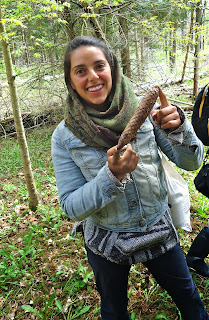
 
As we headed back to our cars, we had one final stop at a red elder to discuss the differences between this species and sambucus Canadensis, the edible black variety, which was not yet in flower.  The name sambucus racimosa refers to the shape of the flower clusters on the red elder, which grow in rounded racemes instead of the flatter clusters of the Canadensis species. 

We were done our time in the field, but our day wasn’t over yet!  We headed back to Alexis’ place with our edible treasures, and spent a lovely evening together preparing and eating food, connecting, chatting about plants, and singing around the fire under a star-studded sky before heading off to our tents to rest up for what promised to be another full and exciting day on Sunday.

Written By:  Malgosia Halliop - 2nd year Plants Apprentice


Thursday, April 21, 2011

The Wandering Herbalist

Well, it is with my pleasure to unveil the first few products that we will be introducing in the 'Sacred Waters Herbal Products' Line-up. I have been very excited to create and offer these amazing herbals once again. Today we just finished the first few medicinal salves and lip balms that will be on sale at the Guelph Farmers Market and Creemore Easter Market this Saturday. There is a general All-Purpose Salve as well as a Burn Salve. For lip balms we have a St. John's-Wort/Peppermint as well as a Calendula/Lemongrass. I'm hoping to bottle a couple tinctures as well for this weekend. Most likely an Echinacea/Goldenseal Immune System support and a Red Clover 'Blood Purifier' Tonic. Come by the market to check out and purchase these amazing Herbal Remedies. Our products will be available all year at these two farmers markets.
Once our new shipment of glass bottles and jars come in we will be slowly introducing more and more herbal products to our line up. I'm also excited to offer herbal teas come summer time. We have many new herbs that will be planted in the garden this coming season and we can't wait to begin this journey through the seasons as we work with our green friends.

Happy Gardening