Showing posts with label classes. Show all posts

Monday, December 7, 2015

How Do You Like Them Apples?


 Approaching our meeting location for the day, the veil of fog I had been driving in for an hour seemed to be lifting with the rising sun that had began peaking through the clouds, just up over the treeline in the horizon. I was taken by the beauty of the first rays of light hitting the frosty landscape of rolling hills and tree lines. The fine layer of ice that had developed overnight, covering the autumn vegetation, was reflecting the rays of the rising sun in a way that makes you really feel grateful to be alive. Everything on the landscape was glistening sunlight.
Deer Track in debris

We met up on the side of the dirt road and promptly decided we should tuck into the other side of the Cedars to escape the chill of the wind. This brought a first lesson in starting to think more like an animal, seeking natural forms of cover to conserve energy and help provide cover. The winds were strong and blowing from the North-West so we made a plan to head over to the eastern edge of the cliffs and along southward so our scent would be blowing away from our target destination as we approached.

We were focusing on trailing today so we needed to be especially quiet. We agreed to travel in scout formation, travelling as quietly as possible and communicating with hand signals.
As we began, the morning frost was just starting to thaw, making the deer trails stand out with an amazing clarity. The leaf litter was moist, helping to soften the sound of our footsteps, and the winds blowing the melting ice of the trees provided gusts of dripping sounds that help muffle our noise. Alexis got us started on the first trail, pointing out various tracks, lays, scrapings, browse and fresh scat. We switched leads, and I began following whatever trails seemed to stand out most to me. I felt in a different mode following a trail silently and focused. At some point I heard the snap of a branch to the East of me, and I remembered that I was in a group. Two small deer scampered out in front of me and took off ahead as Tamara, the eastern wing, emerged from the ridge just behind them.

We circled up to share and make a plan of action. We continued to follow the trails southward to the edge of the habitat and we began feeling like the deer were Eastward. We switched leads again and headed East and within minutes, I knew something was up as the lead froze and slowly lowered. Miriam had spotted a group of 5-6 deer heading South-East. We waited before following the trails along silently for some time, until we came to a sunny spot just along the ridge that a few deer trails passed near and we thought, “this would be a sweet spot to bed down and soak up the warmth of the sun, if we were deer.” Naturally, we decided to break there.

Porcupine Den Site
After sitting in the sun for a while, I realized the leaves were no longer damp, the frost had melted and the sun had begun to dry out the leaf litter of the forest floor. It would be a lot harder to travel as quietly now. Alexis reminded us to try to think like a deer. How we walk is important. When deer break a branch as they are walking, they freeze and check their surroundings before they take another step. Although we couldn't be completely silent, we could change the rhythm of our footsteps to be more like the deer, careful, with intermittent pauses.
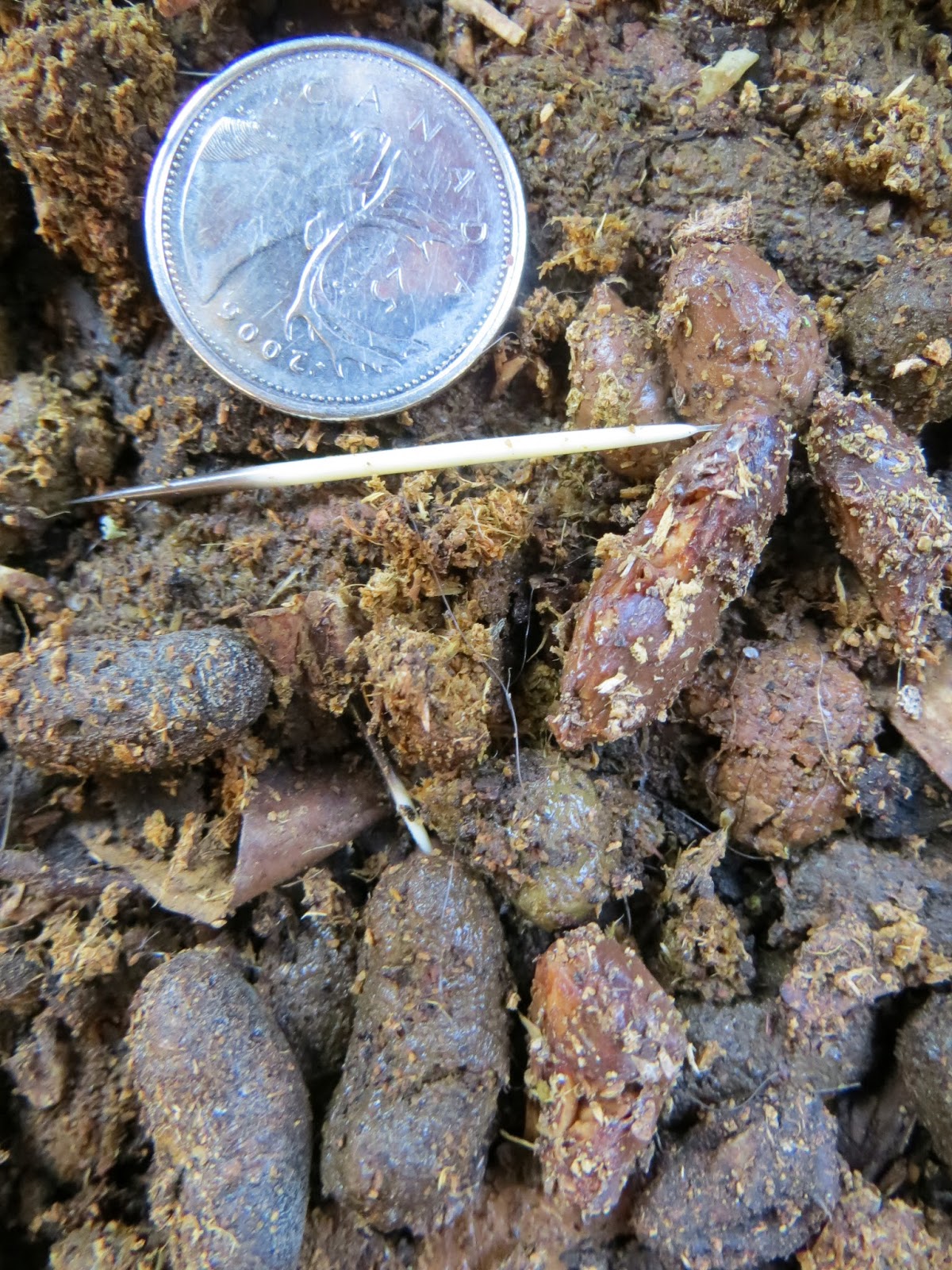
Porcupine scat and quill

Following the trails, we found an old porcupine den, piles of fresh raccoon scat, signs from various woodpeckers, flying squirrel scat, and half-eaten apples stashed up in tree limbs. As we worked our way to the apple trees, we saw various animals had been feeding on the huge abundance of fruit. We compared measurements of the incisor marks on some apples, discussed what was possibly eating them and debated what was likely the creature(s) that had left the marks on the specimens in our hands.

Red Squirrel incisor marks
As the day came to an end, we headed back North, slowly, along the Western edge of the field as the sun was beginning to make it's was to the other horizon. Once again, I am filled with gratitude and appreciation for the natural world, and the abundance of gifts, lessons and experiences Nature has to offer.


Always asking questions
Written By:  Lianna Vargas - 2nd Year Wildlife Tracking Apprentice

Tuesday, December 1, 2015

The winds of fall, the silence of the forest, and getting to the root of things


The first weekend in October we met near Orangeville to focus our learning on roots. The nights had grown longer and the temperature had dropped considerably since our still summery meeting in early September. With these seasonal changes, we knew that the energy of the plants was moving downwards, under the soil.  As we gathered Saturday morning, we were jolted by strong winds that battered around us and blew through the many layers we each wore.  Since we were on a private property, a home and horse farmed owned by good friends of Alexis, we ducked into the barn to circle together and start our day.

Back out in the fields, the wind was fierce.  We dug up plantain roots along our way, then found a sheltered hollow in tall grass which shielded us from the wind.  From this we made forays out to dig and gather plants such as nettle and catnip, and pulled out some field guides to help us answer pressing questions.  We moved through the property, finding plants along the way, but the winds pushed us on.  Eventually we decided to cross the road and tuck ourselves into a forested area off the Boyne Valley.  We were grateful for the shelter and ate some lunch to refuel.  After lunch we took advantage of the relative warmth to each sit with a plant and learn something from it. 

I found myself sitting under a maple focusing on a tiny Herb Robert plant, feeling questions and anxieties of the previous week slipping away from me in the space and silence of the forest, admiring both the delicacy and the resilience of the intricately-leafed plant. As we came back together, we shared stories of what we had learned sitting with the plants, what spaces the forest had opened up in us. We spent some more time focusing on digging: milkweed, burdock, dandelion, and – very conscientiously – a couple of blue cohosh plants. We marveled at how different each of the roots was, wondered what that told us about each plant, and speculated about how fascinating it would be to try to identify the different plants by only looking at their roots.

We finished our day back in the barn, washing the earthy roots in basins of warm and cold water, warming ourselves up, and tincturing the roots of our choice to take home.  We were grateful for shelter and the promise of our warm homes that night!

The second day of our roots weekend was spent in a forest in Dufferin County, an area we had not previously explored.  Much of the morning we spent very close to where our cars were parked, exploring and digging in the richness of the forest soil.  We carved some digging sticks out of a small maple sapling to help us in our efforts. We traced the long rhizomes of sarsaparilla, which link whole colonies of plants together; examined the segmented appearance of the roots of false Solomon’s seal; and admired the incredible tenacity of the deep taproots of burdock, which tested the limits of our own perseverance and digging tools.

Seeds of Wild Leeks
Lunch was spent around a fire, resting and sharing songs together; our afternoon was spent exploring, wandering and digging more roots.  A strange and unexpected moment was finding an ancient Volkswagen rusting and decomposing in the middle of the woods – this find inspired much speculation and many stories!  We also spent time digging up spruce roots, useful for basket making and other traditional crafts, with Judy pulling out an impressively long rope of root; and took some time to rest and talk about our plant-related projects and research.


Spruce Roots
It was great to be out exploring the woods again, feeling joy in the new challenges of the elements as the season changed, and digging under the surface of the earth to deepen further our relationship with the plants.

Written by: Malgosia Halliop - 2nd year Plants A


pprentice

A Boyne River Valley Scat Rap


Sunday September 13, 2015
Written by Tamara Anderson
(With help from the Scat Rap, by A. Bennett, M. Keebler, R. Pemble, D. Elliott, and B. Jonas)
It starts with an “s” and it ends with a “t”. It comes out of you and it comes out of me. I know what you’re thinking, don’t call it that. Let’s be scientific and call it scat.
The tracking group met at an old dam and Grist Mill known as Ponton Mills in the Boyne river valley. We set a course northward to a big hill where a fisher’s tracks had been found the previous winter.  Ten degree weather and a forecast of rain added a chill to the morning.  Autumn had arrived in south-western Ontario.

Pausing to observe cedar roots wrapped around limestone, and crayfish under rocks, we clambered along the shore of the Boyne River.  The fragrant smell of mint filled our nostrils and we brushed by groves of horsetails. Old beaver chews and deer trails caught our attention. 

Left by the dozen in piles on the ground; Lots of little pellets are what you’ve found. They look like little chocolates so it is clear. This is the scat of a white tailed deer.

A deer popped up from her day bed while we admired fawn pellets.  She bounded across the river to our East.  We continued up the hill, discovering deer bones and following the course of a spring to its source.  Refreshing, cold water flowed out from the hillside. 

Animal-made switchback trails helped us climb up the steep valley slope.  At the top, there was a scat underneath a Black Cherry tree.    

Up on the hill, under a Black Cherry; Scat full of apple and purple berries. Late last night he was out with the moon; foraging in the forest, it was Mr. Raccoon.

The spruce plantation at the top of the hill revealed porcupine chews and more deer bones.  A logging trail led us to a rolling topography of maple trees.  A wood thrush sat on the forest floor watching us.  Alexis found an interesting limestone rock that had been hollowed out.  Had it been hollowed out by water or maybe by a human?
Tracks showed where a raccoon and a coyote had explored a muddy flat near the edge of the forest.  The forest opened into a clearing.  Deer beds were scattered around the open field.  Lianna found deer hair in one of the beds.  We hiked up to a lookout.  Northern Flickers had probed for ants on the steep hill.  We found an opened apple covered in ants in the middle of the trail.  Iwonder if the flicker placed the apple to attract a buffet of ants?

The hilltop overlooked the Boyne Valley.  Sharp-shinned hawks, Turkey Vultures, a Swan, Blue Jays and Northern Flickers performed aerial feats as we discussed the landscape, noting colourful pockets of different tree species.  On the way back to the car, we encountered a muskrat making trails in the marsh and dinner out of cattails.  

In closing,
Down the trail something’s lying on the ground; Nature’s Tootsie Roll all long and brown. Don’t wrinkle your nose, don’t lose your lunch. Break it apart, you might learn a bunch
:)

Written by Tamara Anderson - 2nd Year Earth Tracks Tracking Apprentice


Thursday, October 1, 2015

Tracking Algonquin Wildlife

Saturday, August 29, 2015
Written by Tamara Anderson - 2nd Year Tracking Apprentice


 There are forty seven species of mammals that call Algonquin Park “home”.  The world-renowned park includes 7,725 square km of mixed coniferous and deciduous forest.  On our latest tracking weekend, we observed the tracks and sign of Algonquin wildlife living along the shores of Lake Sasejewun near the Wildlife Research Centre.


Saturday morning was overcast as we made our way to the canoe launch.  A stop near the dam revealed Northern Flicker tracks in pursuit of ants along the dusty road.  A pile of black bear scat presented our first mystery.  There were large seeds in the bear scat.  What was the bear eating?  The answer would reveal itself (with Alexis’ help) the next day. 

We followed the bear’s trail to the edge of the lake and noted that the bear had grazed on sedges along the course of his/her travels.  Being the Park’s largest mammal, male black bears generally weigh between 70 and 150kg and females weigh between 45 and 70kg.
Bear feeding on sedges

We boarded the canoes and headed west across the lake.  The group paused along the opposite shore as Tamara and Rhonda made a quick dash across the lake to return a leaky vessel.  These sink-chronistic circumstances proved serendipitous as the shoreline revealed a formidable bear bite on a pine tree, a bear trail through soft moss, grouse scat (fibrous and cecal), snowshoe hare sign and a myriad of moose and white-tailed deer trails. 

After lunch in the boats, we journeyed to the Northwest corner of the lake where Luke and Sue had seen a moose named “Misty” the night before.  Along this shoreline, we discovered wolf tracks and a beaver lodge that had been marked with skunky urine by a fox.  Nearby, Lianna and Tamara noticed that a red squirrel had cached piles of balsam fir cones beside purple mushrooms.  Prepare yourself for a challenging tongue twister; Did the squirrel purposefully place the purple-coloured cones beside the purple mushroom?  Did she intend to camouflage the cones or perhaps organize a “balanced mushroom and cone on the cob” meal for another day?

Bear Cub Track
Other highlights of the afternoon included seeing a bear cub track beside a beaver-chewed birch tree.  A mama bear track was nearby. Everyone had a chance to jump on a fresh bear or moose trail or take time for a sit spot.  Alexis pointed out Rattlesnake plantain, one of Ontario’s orchids.  Rhonda found the bottom of a beaver skull.  A mystery brown snake appeared and went down a hole.  What are the ID characteristics of a red-bellied snake versus a brown snake without seeing the belly?  Or could it be a young Garter Snake?
On the paddle back to the station, we found the bones of a moose calf on the shore and signs of wolf feeding and rolling.  We learned that the wolves took five days to find the dead moose calf and two days to eat it.  This led to questions about how many wolves are in the park and where is the nearest rendezvous site?

Rattlesnake Plantain
The next day, Alexis showed us a chokecherry tree near the bear scat that had been pulled down.  Bear claw marks were evident on the bark.  Most of the chokecherries had been eaten, except for a few left on the branches.  We opened one up and found the matching mystery seed that had been in the bear scat.  It was a berry good find.  Bear with me as I close this story of the day with one more pun; I hope that you found this write-up amoosingJ


The Spirit of Plants

The Spirit of Plants

Our August plants apprenticeship weekend took us deeper into some questions we had dipped into in previous months, questions on engaging with the spiritual aspects of the plant world, and exploring how we could tune into understanding the gifts that plants bring to us with our hearts and intuitions, as well as our minds and hands.

The energy of the weekend was quiet and receptive, quite different from our previous weekends of adventurous exploring, meeting plants in new locations, researching species, and working with ethically-harvested wild plants and farmed plants in medicinal and culinary ways. This time we stayed on site at the home of Earth Tracks and Rebel Roots Herb Farm, and spent much of our two days under a large black walnut tree that sheltered us against the bright August sun.

The weekend was primarily composed of a series of deepening meditations that worked on our abilities to open up to intuition and deeply listen to the energies of the living beings all around us. We were encouraged to keep our minds and hearts open to visualize, imagine, dream, find metaphors, listen to our inner voices, and engage in the unseen world in whatever way worked for each of us. We made space to speak of our personal experiences of the sacred, and a container of trust and respect was created that honoured each participant’s individual beliefs and experiences.
 
To set the tone and bring us into a quieter frame of awareness and connection, we wove in elements of ceremony and ritual into the weekend.  Alexis incorporated some good context on the lineage of the rituals we were using, and we had opportunities for questions and dialogue on how to incorporate ceremony into our own lives in ways that felt authentic to each of us.

Along with group meditations, we had time to sit individually with plants and trees on the landscape to deepen our relationships with them, as well as to practice meditation and visualization techniques on our own. We spoke of dreams and how to find meaning in them – in a personal, intuitive, non-formulaic way - to help guide us in waking life, and we learned a useful word-association exercise for dream recall and interpretation. We also did a number of playful paired and group exercises on reading energy from each other, from plants, and from objects that we were deeply connected to.

The atmosphere of the weekend was open, exploratory, curious and connecting.
It was also nourishing and relaxed. And above all, it introduced us to a set of approaches, tools and possibilities for engaging with the natural world through spirit, and engaging with spirit through the natural world.


Written By: Malgosia Halliop - 2nd Year Plants Apprentice


Sunday, August 16, 2015

Medicinal Plants Walk with Laura and Alexis –and a special plant!

 On Sunday July 19th, we left the Rebel Roots Herb Farm land and headed
to the Krug Forest, a beautifully preserved tract of land near
Dornoch, Ontario.
Introducing us to the many medicinal plants we saw today was Alexis
Burnett, head instructor of Earth Tracks and guest instructor, Laura
Gilmour of Wild Muskoka Botanicals.

We stopped along the edge of a wetland and found many plants and
creatures along the way. Blue Flag Iris and Boneset grew near the
marsh along with many Cattails.  As we discussed harvesting the pollen
of the cattails we spotted a frog. This wasn’t just a regular frog but
was two-toned! The frog was half blue and half grey-brown and was
patient with us and let us photograph and look at kin.

We found a rarer Skullcap flower and learned about it’s medicinal
properties and then found both False and True Solomon’s Seal right
next to each other.  We had a thoughtful discussion about these two
plants, including their roots, young shoots and their berries-a
grizzly bear’s favourite fruit.

Another wetland along the trail had bright red Cardinal Flowers, so
tall and stately and the brightest, deep red you have ever seen.  One
of the most beautiful of our local wildflowers, at least according to
this apprentice!  You can also see a picture of White Snakeroot, a
plant that has many healing properties but is also quite toxic.  It
can affect humans who eat the plant, but is also transmitted from the
milk of cows that consume the plant!

After a lunch off-trail, we changed gears.  We did a quiet walk
through the forest in fox walk and owl eyes.  Walking separately but
in a line, we had a neat experience of feeling the forest with our
feet, hearing the sounds, and smelling all the scents on the breeze.
After the walk we each found quiet spot and did a sit spot with a
particular plant. We connected with the plant while at our quiet spot,
with the intention of learning what we can from kin. We each harvested
a few leaves from our plant and put them in a cup with some boiling
water to make a tea.  We spent quiet time with our tea as we drank it,
and then gathered together to share our experience.

Walking back, we caught sight of a baby raccoon in a tree that we had
passed in the morning.  This time, ki was having an afternoon nap and
didn’t even notice us pass underneath kin!

*As per Robin Wall Kimmerer’s article, the pronouns for animals have
been changed, instead of “he” or “she” I’ve used “ki” and instead of
“him” or “her” I’ve used “kin”.
http://www.theecologist.org/blogs_and_comments/commentators/2842875/living_beings_as_our_kith_and_kin_we_need_a_new_pronoun_for_nature.html


Written by:  Alex Thomson - 2nd year Wild Plants Apprentice

Tuesday, August 11, 2015

The Wisdom of the Marks

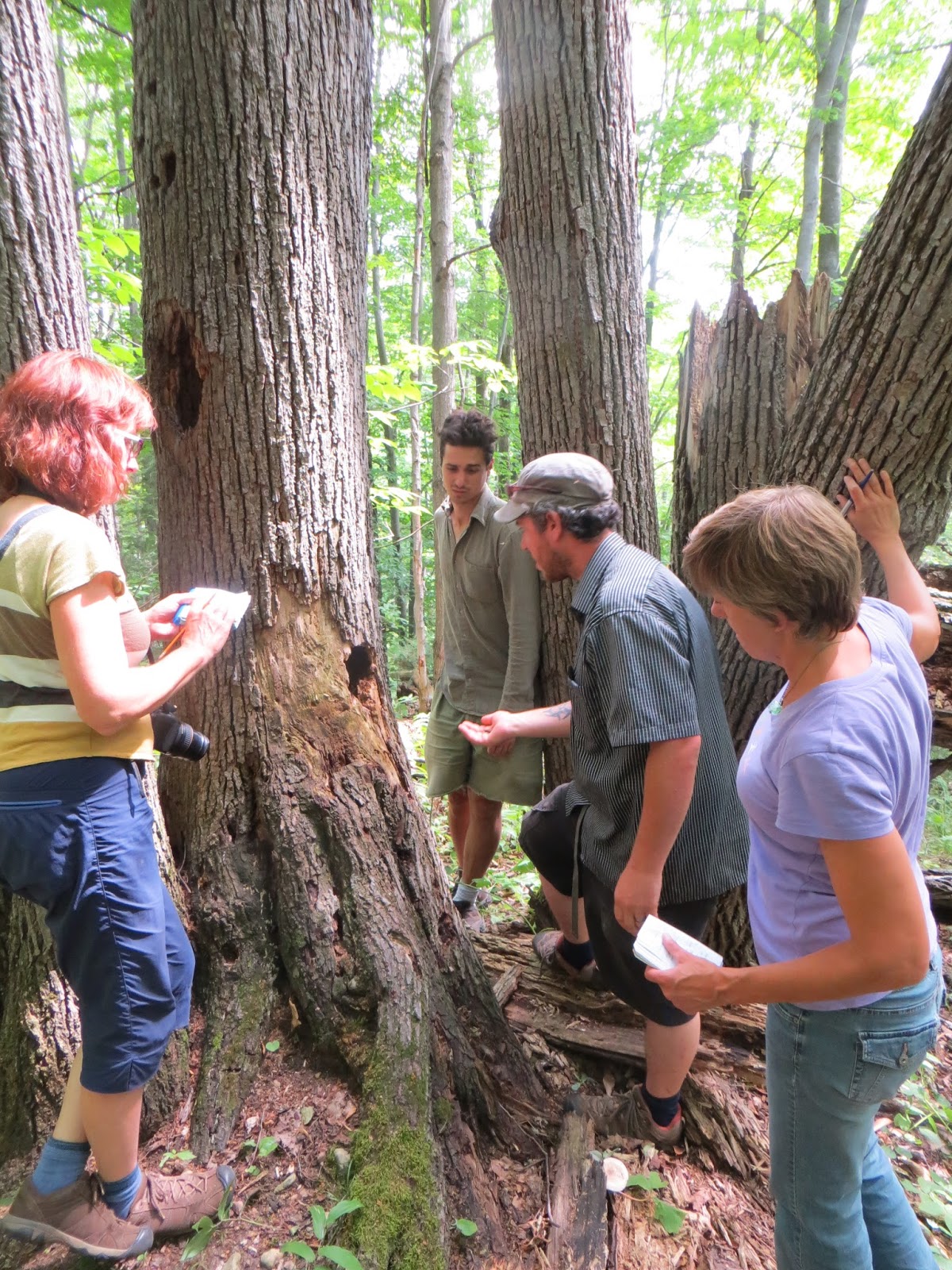
The site of a porcupine, raccoon and flying squirrel holes in this big old Basswood tree


Saturday and Sunday, July 26th, 2015
Written by Tamara Anderson - 2nd year Tracking Apprentice

In his book Nature Observation and Tracking, Tom Brown Jr. writes; “The earth tries to be flat.” He was referring to how weather and gravity “conspire to erase tracks”.  This past July, the tracking apprentices observed the subtle traces of summer tracks at Allan Park near Durham. We also created tracks and signs at Alexis’ house and watched how they changed over two days.  Lately, I have been tracking the landscape just as much as I have been following the footprints of animals.  Approximately 10,000 years ago, a receding glacier scraped the surface of the land that is now Allan Park and deposited material from the Canadian Shield.  Some of the material was ground into sand, silt and clay. A huge chunk of ice from the glacier dropped onto the landscape and a kettle lake was formed.  Allan Park is part of the Horseshoe Moraine. It includes a trail system that reaches an elevation of 30 metres in some places. 

Fawn Tracks
On Saturday, we wandered the rolling, forested pine, spruce and cedar hills beside the glacier-made trout pond.  The sandy edge of the pond revealed the opened shells of snapping turtle eggs.  This prompted a few questions:  How does temperature affect turtle egg incubation? Do predators leave different signs when they predate turtle nests?  I learned that the “J” shape of the Jack pine cone is a helpful way to remember the cone-makers identity.  Sue asked about whether any local species of rats are native to North America and which snakes have live birth?

Watching Tracks Age
On Sunday morning we were enchanted by the purling rattle of a Sandhill crane in a field near Alexis and Bobbi’s place.  Sandhill Cranes beckon my attention in an ancient way. After reading about Sandhill cranes, I discovered that they are the oldest known surviving North American bird species.  That morning, we returned to Allan Park and found a trail on a steep hill that led to different interpretations.  It is amazing how the track of a sliding deer can look similar to the five toes of a barefoot, feral child;)  After following a doe and her fawn’s tracks along a sun-baked, sandy trail, we ventured into a cool, deciduous forest of Hickory, Basswood and Maple.  The tracking apprentices used tracking sticks to track each other in leafy debris.  Luke and Miriam discovered a vole tunnel and burrow network at the forest edge.  We lightheartedly discussed how best to classify this trail.  If vole trails under the snow are called “subnivean” then would this trail under the leaf-litter be called sub-humusean?  We also wondered whether the trail was from a red-backed or a meadow vole.  Do meadow voles occasionally lives in forests?  What is the range of the red-backed vole? Alexis located a flying squirrel latrine in a basswood tree. Flying squirrel scat accumulates in areas where the squirrels nest and cache food. The scat often flows out of tree cavities, low to the ground. 

I will end this post with a continuation of Tom Brown’s tracker wisdom; “There is hardly a square foot of ground that is absolutely flat. Every depression, every bump, every fissure, and every scratch on the landscape was made by something. Whether it was made by a rabbit, mouse, bulldozer, fish, frog, or volcano, it is the tracker’s job to notice and interpret it.” (Tom Brown Jr., Nature Observation and Tracking)

Friday, July 24, 2015

A taste of plant medicine, meetings with trees, and a small surprise


The themes of caretaking and stewardship wove through our June weekend. Our second morning, like our first day, was grounded at Alexis and Bobbi’s place, home of Earth Tracks Outdoor School and Rebel Roots Herb Farm.  

We spent the morning in two groups alternating between two herbal medicine-making activities using common wild plants.  Alexis took a group through the process of harvesting plantain and making an infused oil, to use on its own or as a later base for medicinal salve. Lee and I led a second activity, harvesting some of the abundant wild thyme whose fragrance wafted around our tents, and creating a thyme-infused medicinal apple cider vinegar.  Alex joined in at Alexis’s station to strain off and share the lemon balm cold infusion she had made the previous day: a welcome refresher to the morning’s heat. Each group researched the plants while working with them, using field guides and each other’s knowledge to understand the medicinal properties of the plants we harvested with our hands.  

Our afternoon location was a short drive away: the forested property where Earth Tracks had been based until recently.  The brightness of sun and openness of the agricultural landscape where we had started the weekend was transformed into the coolness and cover of dense trees; the industriousness of the morning’s activities into a grounded and aware exploration of this new place and its energy. 

We began the afternoon identifying trees on the property; but quickly moved into several activities that shifted our awareness to more subtle information around us.  A paired blindfolded “meet a tree” exercise gave each person the opportunity to use their less dominant senses – including intuition – to get to know an individual tree and then find it again with the blindfold removed.  We followed this with a focused sit spot, each of us tuning in to the space around us and asking the questions “what can I do to help?” or “how can I give back to this land?” and listening to the possible answers: moving branches, lifting up weight, pruning.  It was in introduction to listening deeply to the land as an expression of caretaking.

To close the afternoon, we worked on one more caretaking project, a deer trail that the apprenticeship group of three years ago had begun clearing.  Alexis spoke of his connection to the deer on this property, where he had hunted as well as stewarded the land. We moved on to the trail, thinking through the mind of a deer which obstacles would hinder our progress, especially at low energy and hungry times of year.  As we moved branches, our intention was also to create brush piles, as we had the day before, to provide shelter for small mammals and other creatures. 

As I stood on a trail clearing branches onto a pile beside me, I did not expect what happened next.  I lifted a particularly long branch and dropped it to my right with a small crash.  The crash was followed by several more, the rustling of leaves and the crashing of small panicked feet.  I looked up to see a small dappled fawn dashing fleetly away from me, looking for its mother, who would not have been far away.  I was astonished at how well this small creature had been camouflaged two feet beside me, and shaken to have found myself scaring it in this way.  A few people around me working on the same trail gathered together to look at the spot where the fawn had been – a tiny kidney-shaped spot in the earth still warm to the touch.  It was a gift to see this fawn, to know that there were young here needing shelter, and to see that the brush piles we made would be used exactly as we intended.  It was a powerful experience to walk away with while reflecting on caretaking as one of the gifts and responsibilities of humans to the Earth.


Written By: Malgosia Halliop - 2nd year Earth Tracks Wild Plants Apprentice

Thursday, July 2, 2015

Tracking in the Sauble Beach Area


Saturday, June 13th, 2015 - Story of the Day

Congregating at Alexis’s place before starting our drive to Sauble, we travellers arrived with stories of our adventures.  Sue, Aster and Luke had stopped to investigate some road kill, get hair samples and pull the bodies to a more peaceful resting place. Miriam shared her experience watching the fireflies come out the night before and was grateful for the peaceful misty morning drive. Following a quick tour of the beautiful place we’d call home for the weekend, we set out.
Arriving at our destination we headed to the sandy areas to look for tracks.  We passed some yellow lady slippers that grew just off the path – a cheery welcome. A chance meeting with a grandfather and his grandson concerned about the debris being dumped in the area made us mindful of how important stewardship is to our interaction with this land.
How rewarding it is to find an animal at the end of the track you are following…and so it was with one of our first finds….a millipede (North American maybe?) A close look afforded a view of the tiny leg tracks. Close by was a curious raised line that when uncovered exposed a wee round tunnel a mere 1/8th of an inch in diameter.  Clearly the makings of a creature much smaller than the millipede.

Off at the edge of the wooded area Luke and Sue located what they suspected might be lagomorph signs. Investigating further we discovered more clues including prints, a small enchanting opening into the cedars we crouched to look through, and some intriguing scat. Lagomorphs are “coprophagous” which means they eat their first scat to glean nutrients from the undigested material contained therein. By comparing two scat samples we think we might have found some uneaten first scats. Is there a story behind this? Might the nearby fox scat, though older, be a clue?
Back onto the sand we found more lagomorph tracks. Cottontail or  Snowshoe Hare? Careful measurement of trail width, track size and stride length helped us to place our bets on cottontail. Drawn by the activity of the egrets and crows in the distance we set off to see what we might find of bird tracks, and of course anything else of interest…bear tracks were on all of our wish lists.
Lunch at the point was a lovely time of spectacular views, ideal weather (Alexis wished he’d brought his bathing suit), and happy companionship. After lunch Luke went to look for frogs, Miriam and Aster investigated the area barefooted in the cool water, and Sue and Alexis went looking for the nest of the killdeer we’d sighted. Though the nest was never located, when we all joined up again to move inland we suspected we must have come pretty close to the nest because the killdeer performed its characteristic broken wing diversion trick. A female redstart sighting led us on a journey into the woods in search of more bird sightings…male redstarts? and if we were lucky maybe a redstart nest. Alexis drew our attention to a tree rising proud above its neighbours, spreading its almost leaf-bare arm-like branches out to the side. An attractive perch for large birds? Binoculars allowed us to see the worn bark in places and confirmed our suspicions. The base of the tree beckoned…what treasures might be found? Luke found a skull that remained a mystery even after consulting the skull book later on. Lots of white wash. A green feather! Heading back came across a few egg shells – of a similar mottled colouring but of a much smaller bird than the killdeer eggshell we found earlier.
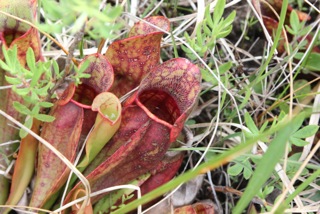
Out in the open again we encountered clusters of pitcher plants. Like all carnivorous plants, pitcher plants grow in locations where the soil is too poor in minerals, especially nitrogen and phosphorous, and/or too acidic for most plants to survive. The digested insects, and sometimes larger creatures like mice and frogs! provide the pitcher plants their needed mineral nutrition. More bird prints. Having encountered a number of prints throughout our journey we were able to compare and contrast our findings and use these comparisons and our resource guides to help us distinguish, in particular, sandhill crane and great egret tracks. Noting the toe positioning was helpful identifying some smaller prints as likely corvid tracks. What a treat to then come across some turtle tracks! A fun experience trying to identify them…the penny dropped for all of us when Alexis gave us the hint that he didn’t think they were mammal tracks.  The drag marks and ambling gait finally made sense if it was a turtle!  While inspecting the turtle track we encountered tiny frog and vole tracks too. What day filled with richness.  From the tiny millipede tracks to the grand wingspan of the great egret in flight passing overhead. From the close inspections of the finest details of our finds to the expansive vistas out over the land and water.

Back at Alexis’ place we enjoyed a potluck dinner of delicious food and story sharing. Under a starlit sky we ended the day spending time together around the campfire before heading to sleep to the sound of the night creatures.


Written by Miriam Snell - 1st year Tracking Apprentice

Tracking on the Sauble River


Sunday June 14th, 2015 - Story of the Day
 Written by Tamara Anderson


Bob Marley wrote, “Some people feel the rain and others just get wet.”  The rain reminds us of mindfulness - to live in the moment and welcome whatever it brings.  We were immersed in rain and mindfulness for most of Sunday’s outing to the Sauble River.  The Sauble River flows through Bruce and Grey County into Lake Huron.  The river was named “Rivière aux Saubles” or Sandy River by the French explorers in 1759.  I wonder if the local Saugeen First Nation has a different name for this river?

The maple forest revealed a few gems, like a brave garter snake.  The snake patiently let us hold him/her.  Beaver, coyote, raccoon and muskrat tracks were also spotted along the silty shoreline of the river.  Nearby, Alexis found an otter latrine site with a freshly killed garter snake.  Had the garter snake fallen out of the grasping talons of a bird of prey?  The otter scat contained scales from fish and the rusty-coloured remains of crayfish.  A Red-Eyed Vireo serenaded us once again while we ate lunch beside the river.  After lunch, we found Giant Hogweed, an invasive plant whose sap can cause intense blistering and even blindness.  Strangely enough, we noted deer browse on the tips of the Hogweed. Deer never cease to amaze me with their ability to eat noxious plants.  My impression of them as adrenaline-seeking risk takers continues to evolve. 


We were soon on a quest for Kingfisher holes after seeing a steep, sandy river bank on the south shoreline.  Success!  A square-looking hole was found near the top of the bluff.      The Belted Kingfisher excavates a nesting burrow that is two to three metres long in a vertical sand bank.  The blue and white lightning bird digs the tunnel with its beak and feet.  We wandered south towards a colourful, alvar-looking landscape.  Sandy trails revealed coyote scat and mystery tracks.   We debated the track-maker’s identity and finally resolved to call the animal a fox-walking raccoon.  A short drive to Sauble beach on Lake Huron completed the day.  In our closing circle, each person shared their focal species for the next 8 months.  Aster chose the beaver.  Sue is learning more about deer.  Miriam is also studying deer.  Luke is thinking about lagomorphs.  Alexis is going to learn more about the European hare.  I am choosing to focus on the black coyotes that live around my place.  Strangely, no one chose the fox-walking raccoon?