Showing posts with label mammals. Show all posts

Monday, December 7, 2015

How Do You Like Them Apples?


 Approaching our meeting location for the day, the veil of fog I had been driving in for an hour seemed to be lifting with the rising sun that had began peaking through the clouds, just up over the treeline in the horizon. I was taken by the beauty of the first rays of light hitting the frosty landscape of rolling hills and tree lines. The fine layer of ice that had developed overnight, covering the autumn vegetation, was reflecting the rays of the rising sun in a way that makes you really feel grateful to be alive. Everything on the landscape was glistening sunlight.
Deer Track in debris

We met up on the side of the dirt road and promptly decided we should tuck into the other side of the Cedars to escape the chill of the wind. This brought a first lesson in starting to think more like an animal, seeking natural forms of cover to conserve energy and help provide cover. The winds were strong and blowing from the North-West so we made a plan to head over to the eastern edge of the cliffs and along southward so our scent would be blowing away from our target destination as we approached.

We were focusing on trailing today so we needed to be especially quiet. We agreed to travel in scout formation, travelling as quietly as possible and communicating with hand signals.
As we began, the morning frost was just starting to thaw, making the deer trails stand out with an amazing clarity. The leaf litter was moist, helping to soften the sound of our footsteps, and the winds blowing the melting ice of the trees provided gusts of dripping sounds that help muffle our noise. Alexis got us started on the first trail, pointing out various tracks, lays, scrapings, browse and fresh scat. We switched leads, and I began following whatever trails seemed to stand out most to me. I felt in a different mode following a trail silently and focused. At some point I heard the snap of a branch to the East of me, and I remembered that I was in a group. Two small deer scampered out in front of me and took off ahead as Tamara, the eastern wing, emerged from the ridge just behind them.

We circled up to share and make a plan of action. We continued to follow the trails southward to the edge of the habitat and we began feeling like the deer were Eastward. We switched leads again and headed East and within minutes, I knew something was up as the lead froze and slowly lowered. Miriam had spotted a group of 5-6 deer heading South-East. We waited before following the trails along silently for some time, until we came to a sunny spot just along the ridge that a few deer trails passed near and we thought, “this would be a sweet spot to bed down and soak up the warmth of the sun, if we were deer.” Naturally, we decided to break there.

Porcupine Den Site
After sitting in the sun for a while, I realized the leaves were no longer damp, the frost had melted and the sun had begun to dry out the leaf litter of the forest floor. It would be a lot harder to travel as quietly now. Alexis reminded us to try to think like a deer. How we walk is important. When deer break a branch as they are walking, they freeze and check their surroundings before they take another step. Although we couldn't be completely silent, we could change the rhythm of our footsteps to be more like the deer, careful, with intermittent pauses.
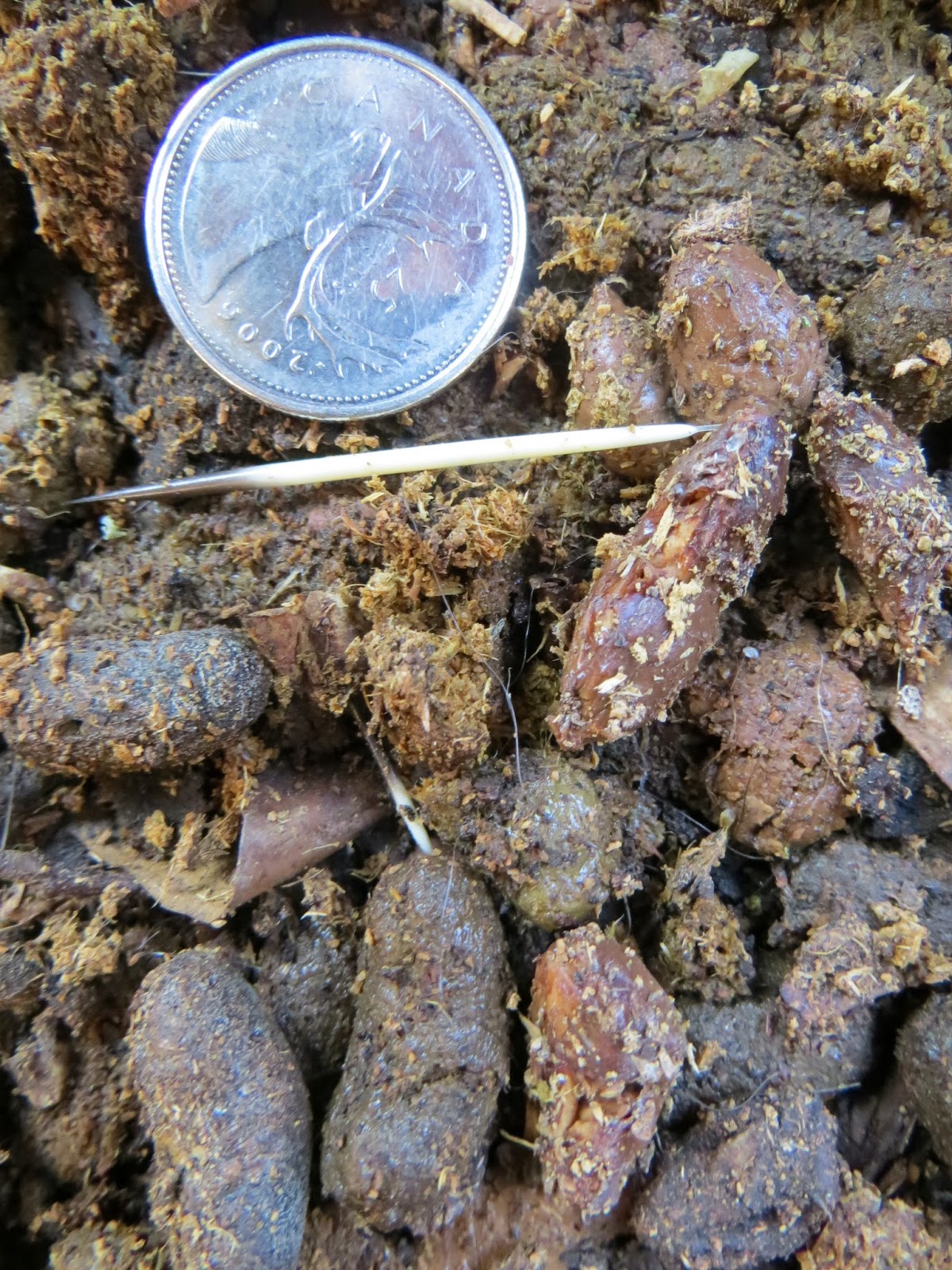
Porcupine scat and quill

Following the trails, we found an old porcupine den, piles of fresh raccoon scat, signs from various woodpeckers, flying squirrel scat, and half-eaten apples stashed up in tree limbs. As we worked our way to the apple trees, we saw various animals had been feeding on the huge abundance of fruit. We compared measurements of the incisor marks on some apples, discussed what was possibly eating them and debated what was likely the creature(s) that had left the marks on the specimens in our hands.

Red Squirrel incisor marks
As the day came to an end, we headed back North, slowly, along the Western edge of the field as the sun was beginning to make it's was to the other horizon. Once again, I am filled with gratitude and appreciation for the natural world, and the abundance of gifts, lessons and experiences Nature has to offer.


Always asking questions
Written By:  Lianna Vargas - 2nd Year Wildlife Tracking Apprentice

Thursday, October 1, 2015

Tracking in Algonquin - Part 2


First thing in the morning, we recapped on the harvest of yesterday's exploration, reviewing on a map where we had come across some of our favourite discoveries.

We headed out for the day and stopped at a bent and broken chokecherry tree that Alexis pointed out, asking us what we noticed about this tree. We saw all the cherries had been picked off the tree and following some looking around, we noticed bear claw marks on the trunk of the tree, and how the branches had been broken. We had suspected the pits in the bear scat from yesterday, had possibly been cherries, but now we had proof!

The remains of a calf moose
We then headed down to the water and canoed out to a point of interest where half of the group had come across the remains of a moose calf the following evening on our return back to camp. We checked out the site, finding many chewed up bones scattered around the area. The area was filled with tons of wolf activity, mossy ground and the trail of a mourning mother moose. We scouted around and spent most of the day following bear trails, looking, feeling and measuring the tracks we were following.
Wolf Chew
Later we cracked open a bone to investigate what had been going on with the moose calf through assessing it's bone marrow– had it starved to death? had it died of disease? It was a little too late to tell, but the inside of the bone did have a surprise for us!

Maggot feeding on Marrow!
Bear Bite marks
Alexis then had us try an awareness exercise – envisioning the animals through sensory touch of the tracks, which proved a potent experience to many in the group. We shared our experience as we canoed back. Once back at the rendezvous site, we checked out some moose bones the park researchers had gathered, a good opportunity for comparing them with the ones of the calf we had seen earlier. After checking out some signs of porcupines eating plywood and taking a look at some fresh territorial bear markings on a hydro pole, we finished the day with a quiet sit spot out on the land.

Feeling the Tracks

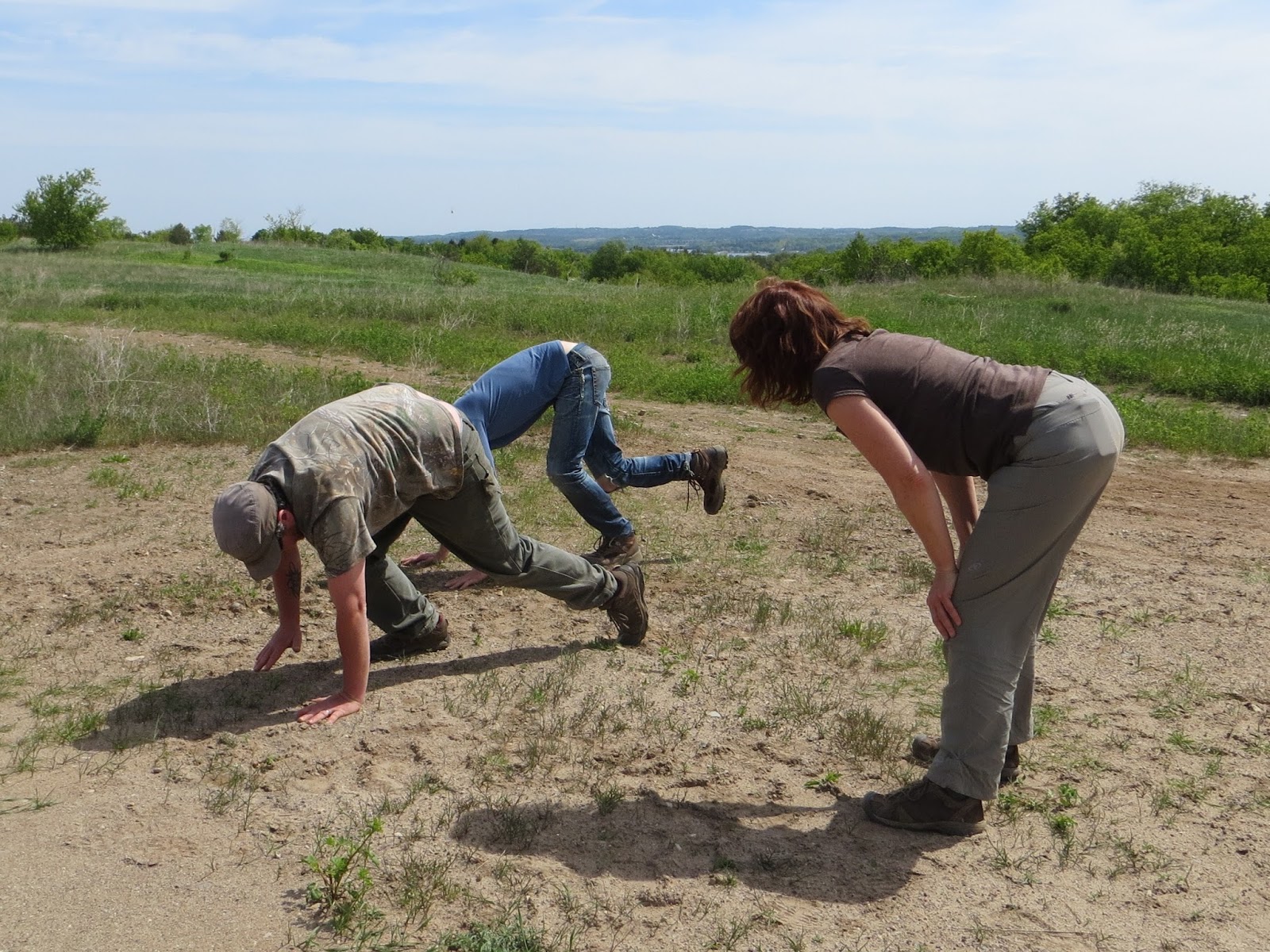
Getting down on a bear trail!


 At the end of the weekend, I was filled with a whole new pile of information to let sink in and a deep sense of amazement and gratitude for the depth and experience of life.

Sunday, August 30, 2015 - Written by:  Lianna Vargas - 2nd year Tracking Apprentice

Tracking Algonquin Wildlife

Saturday, August 29, 2015
Written by Tamara Anderson - 2nd Year Tracking Apprentice


 There are forty seven species of mammals that call Algonquin Park “home”.  The world-renowned park includes 7,725 square km of mixed coniferous and deciduous forest.  On our latest tracking weekend, we observed the tracks and sign of Algonquin wildlife living along the shores of Lake Sasejewun near the Wildlife Research Centre.


Saturday morning was overcast as we made our way to the canoe launch.  A stop near the dam revealed Northern Flicker tracks in pursuit of ants along the dusty road.  A pile of black bear scat presented our first mystery.  There were large seeds in the bear scat.  What was the bear eating?  The answer would reveal itself (with Alexis’ help) the next day. 

We followed the bear’s trail to the edge of the lake and noted that the bear had grazed on sedges along the course of his/her travels.  Being the Park’s largest mammal, male black bears generally weigh between 70 and 150kg and females weigh between 45 and 70kg.
Bear feeding on sedges

We boarded the canoes and headed west across the lake.  The group paused along the opposite shore as Tamara and Rhonda made a quick dash across the lake to return a leaky vessel.  These sink-chronistic circumstances proved serendipitous as the shoreline revealed a formidable bear bite on a pine tree, a bear trail through soft moss, grouse scat (fibrous and cecal), snowshoe hare sign and a myriad of moose and white-tailed deer trails. 

After lunch in the boats, we journeyed to the Northwest corner of the lake where Luke and Sue had seen a moose named “Misty” the night before.  Along this shoreline, we discovered wolf tracks and a beaver lodge that had been marked with skunky urine by a fox.  Nearby, Lianna and Tamara noticed that a red squirrel had cached piles of balsam fir cones beside purple mushrooms.  Prepare yourself for a challenging tongue twister; Did the squirrel purposefully place the purple-coloured cones beside the purple mushroom?  Did she intend to camouflage the cones or perhaps organize a “balanced mushroom and cone on the cob” meal for another day?

Bear Cub Track
Other highlights of the afternoon included seeing a bear cub track beside a beaver-chewed birch tree.  A mama bear track was nearby. Everyone had a chance to jump on a fresh bear or moose trail or take time for a sit spot.  Alexis pointed out Rattlesnake plantain, one of Ontario’s orchids.  Rhonda found the bottom of a beaver skull.  A mystery brown snake appeared and went down a hole.  What are the ID characteristics of a red-bellied snake versus a brown snake without seeing the belly?  Or could it be a young Garter Snake?
On the paddle back to the station, we found the bones of a moose calf on the shore and signs of wolf feeding and rolling.  We learned that the wolves took five days to find the dead moose calf and two days to eat it.  This led to questions about how many wolves are in the park and where is the nearest rendezvous site?

Rattlesnake Plantain
The next day, Alexis showed us a chokecherry tree near the bear scat that had been pulled down.  Bear claw marks were evident on the bark.  Most of the chokecherries had been eaten, except for a few left on the branches.  We opened one up and found the matching mystery seed that had been in the bear scat.  It was a berry good find.  Bear with me as I close this story of the day with one more pun; I hope that you found this write-up amoosingJ


Tuesday, August 11, 2015

The Wisdom of the Marks

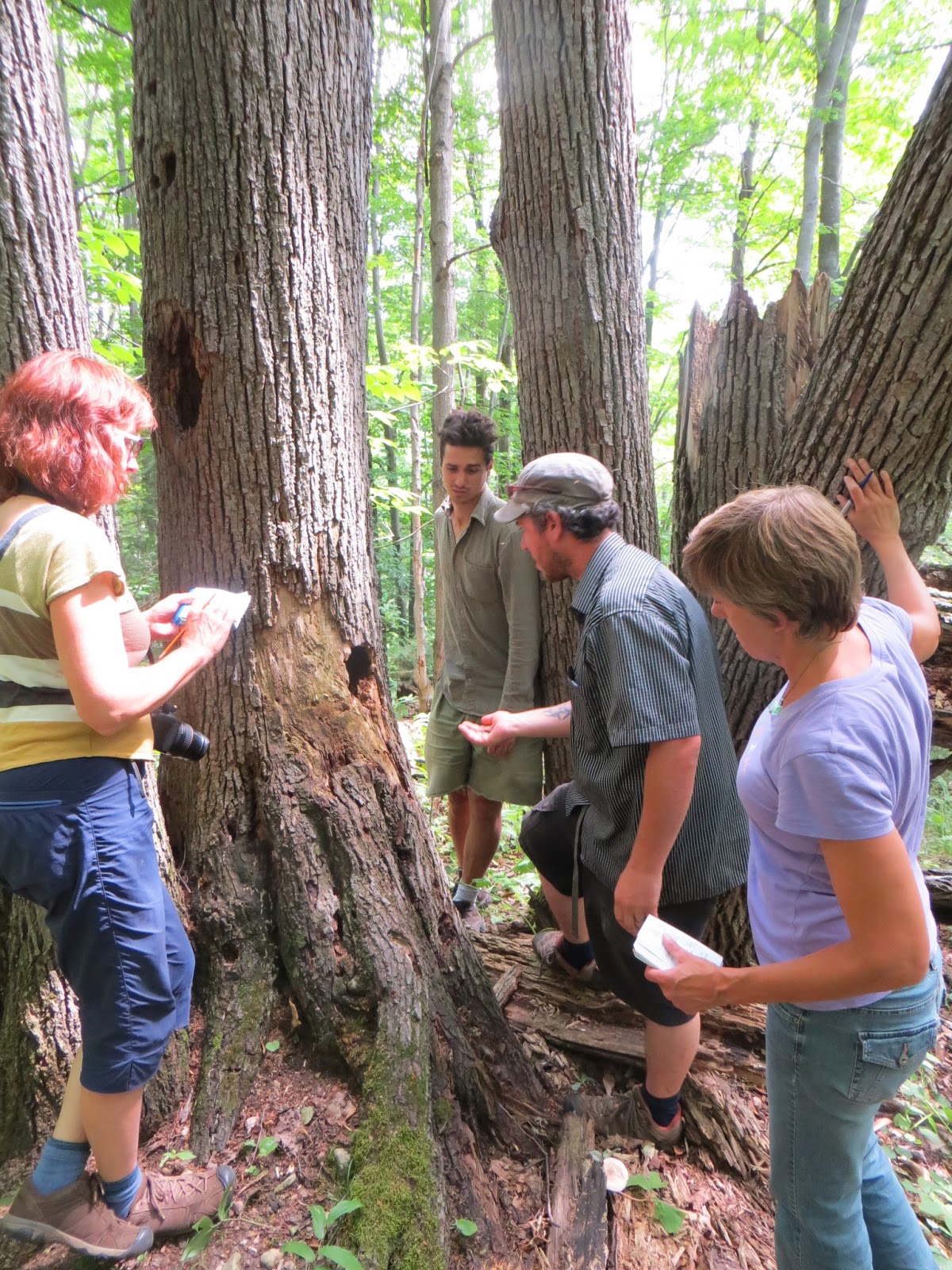
The site of a porcupine, raccoon and flying squirrel holes in this big old Basswood tree


Saturday and Sunday, July 26th, 2015
Written by Tamara Anderson - 2nd year Tracking Apprentice

In his book Nature Observation and Tracking, Tom Brown Jr. writes; “The earth tries to be flat.” He was referring to how weather and gravity “conspire to erase tracks”.  This past July, the tracking apprentices observed the subtle traces of summer tracks at Allan Park near Durham. We also created tracks and signs at Alexis’ house and watched how they changed over two days.  Lately, I have been tracking the landscape just as much as I have been following the footprints of animals.  Approximately 10,000 years ago, a receding glacier scraped the surface of the land that is now Allan Park and deposited material from the Canadian Shield.  Some of the material was ground into sand, silt and clay. A huge chunk of ice from the glacier dropped onto the landscape and a kettle lake was formed.  Allan Park is part of the Horseshoe Moraine. It includes a trail system that reaches an elevation of 30 metres in some places. 

Fawn Tracks
On Saturday, we wandered the rolling, forested pine, spruce and cedar hills beside the glacier-made trout pond.  The sandy edge of the pond revealed the opened shells of snapping turtle eggs.  This prompted a few questions:  How does temperature affect turtle egg incubation? Do predators leave different signs when they predate turtle nests?  I learned that the “J” shape of the Jack pine cone is a helpful way to remember the cone-makers identity.  Sue asked about whether any local species of rats are native to North America and which snakes have live birth?

Watching Tracks Age
On Sunday morning we were enchanted by the purling rattle of a Sandhill crane in a field near Alexis and Bobbi’s place.  Sandhill Cranes beckon my attention in an ancient way. After reading about Sandhill cranes, I discovered that they are the oldest known surviving North American bird species.  That morning, we returned to Allan Park and found a trail on a steep hill that led to different interpretations.  It is amazing how the track of a sliding deer can look similar to the five toes of a barefoot, feral child;)  After following a doe and her fawn’s tracks along a sun-baked, sandy trail, we ventured into a cool, deciduous forest of Hickory, Basswood and Maple.  The tracking apprentices used tracking sticks to track each other in leafy debris.  Luke and Miriam discovered a vole tunnel and burrow network at the forest edge.  We lightheartedly discussed how best to classify this trail.  If vole trails under the snow are called “subnivean” then would this trail under the leaf-litter be called sub-humusean?  We also wondered whether the trail was from a red-backed or a meadow vole.  Do meadow voles occasionally lives in forests?  What is the range of the red-backed vole? Alexis located a flying squirrel latrine in a basswood tree. Flying squirrel scat accumulates in areas where the squirrels nest and cache food. The scat often flows out of tree cavities, low to the ground. 

I will end this post with a continuation of Tom Brown’s tracker wisdom; “There is hardly a square foot of ground that is absolutely flat. Every depression, every bump, every fissure, and every scratch on the landscape was made by something. Whether it was made by a rabbit, mouse, bulldozer, fish, frog, or volcano, it is the tracker’s job to notice and interpret it.” (Tom Brown Jr., Nature Observation and Tracking)

Friday, July 24, 2015

A taste of plant medicine, meetings with trees, and a small surprise


The themes of caretaking and stewardship wove through our June weekend. Our second morning, like our first day, was grounded at Alexis and Bobbi’s place, home of Earth Tracks Outdoor School and Rebel Roots Herb Farm.  

We spent the morning in two groups alternating between two herbal medicine-making activities using common wild plants.  Alexis took a group through the process of harvesting plantain and making an infused oil, to use on its own or as a later base for medicinal salve. Lee and I led a second activity, harvesting some of the abundant wild thyme whose fragrance wafted around our tents, and creating a thyme-infused medicinal apple cider vinegar.  Alex joined in at Alexis’s station to strain off and share the lemon balm cold infusion she had made the previous day: a welcome refresher to the morning’s heat. Each group researched the plants while working with them, using field guides and each other’s knowledge to understand the medicinal properties of the plants we harvested with our hands.  

Our afternoon location was a short drive away: the forested property where Earth Tracks had been based until recently.  The brightness of sun and openness of the agricultural landscape where we had started the weekend was transformed into the coolness and cover of dense trees; the industriousness of the morning’s activities into a grounded and aware exploration of this new place and its energy. 

We began the afternoon identifying trees on the property; but quickly moved into several activities that shifted our awareness to more subtle information around us.  A paired blindfolded “meet a tree” exercise gave each person the opportunity to use their less dominant senses – including intuition – to get to know an individual tree and then find it again with the blindfold removed.  We followed this with a focused sit spot, each of us tuning in to the space around us and asking the questions “what can I do to help?” or “how can I give back to this land?” and listening to the possible answers: moving branches, lifting up weight, pruning.  It was in introduction to listening deeply to the land as an expression of caretaking.

To close the afternoon, we worked on one more caretaking project, a deer trail that the apprenticeship group of three years ago had begun clearing.  Alexis spoke of his connection to the deer on this property, where he had hunted as well as stewarded the land. We moved on to the trail, thinking through the mind of a deer which obstacles would hinder our progress, especially at low energy and hungry times of year.  As we moved branches, our intention was also to create brush piles, as we had the day before, to provide shelter for small mammals and other creatures. 

As I stood on a trail clearing branches onto a pile beside me, I did not expect what happened next.  I lifted a particularly long branch and dropped it to my right with a small crash.  The crash was followed by several more, the rustling of leaves and the crashing of small panicked feet.  I looked up to see a small dappled fawn dashing fleetly away from me, looking for its mother, who would not have been far away.  I was astonished at how well this small creature had been camouflaged two feet beside me, and shaken to have found myself scaring it in this way.  A few people around me working on the same trail gathered together to look at the spot where the fawn had been – a tiny kidney-shaped spot in the earth still warm to the touch.  It was a gift to see this fawn, to know that there were young here needing shelter, and to see that the brush piles we made would be used exactly as we intended.  It was a powerful experience to walk away with while reflecting on caretaking as one of the gifts and responsibilities of humans to the Earth.


Written By: Malgosia Halliop - 2nd year Earth Tracks Wild Plants Apprentice

Caretaking and Land Stewardship for Future Generations

Friday was a day of stewardship and caretaking on the new Earth Tracks land. 

Getting our hands into the dirt was the priority for the morning.  We each researched a herb that had been brought up in the Rebel Roots greenhouse to learn about its medicinal qualities and where it might grow best.  With flats of classics like nettle, calendula and chamomile we put a lot of seedlings into the ground. There were also some heritage tobacco plants and a strong vermifuge called wormwood. We learned a few growing techniques, like scratching up astragalus seeds to help them sprout. We will check back on our newly planted medicinals next weekend to see how they’re doing.

We worked on some stewardship projects after lunch.  The sugar maple trees that we had potted last weekend were ready to go into the ground.  We planted them along the driveway into the house.  The location we selected was in between the row of pines that shadow the southern edge of the road into the property.  When the red pines have past their peak, these sugar maples will hopefully take on the role of snow and windbreak, provide shelter for the gardens, lawn and thicket on the other side and encourage animal habitat. 

Building animal den/cover sites was another after-lunch project. We made these structures to encourage small mammals like voles, mice, rabbits and hares to live on the property.  These included spheres we made called “mouse houses” or “vole domes”.  Made of tree branches and shrub bows, these homes have a soft, grassy interior and would be a welcome place for any small mammal on a winter’s night! Even a chipmunk or red squirrel might want to move in.  More small mammals means more diversity in the ecosystem and can attract predators like foxes, hawks and coyotes to visit the farm.  We also built brush piles, a collection of sticks and shrubs that can serve the same purpose. 

A walk around the Earth Tracks property helped to animate our work. We looked at the various permaculture and ecosystem restoration projects that are in store for the land. As we dropped off the vole domes and built brush piles along the way, we were inspired by the many ways that humans can work to improve a landscape.  By being true “caretakers” of a land, we can increase the diversity of species that live there and enhance the richness of life for all the species nearby. 

Several folks took a turn at using the bow drills and Basia got a coal that lit our dinner fire. As we built up the fire, we got ready for the evening and our meal.  We harvested some wild edible leaves for our dinner and finished up our projects. Ox eye daisy, red clovers, lamb’s quarters and more went into our wild salad for the evening. Before we ate, we shared some gratitude and reflected on all of the work, learnings and stewardship that had made up our time together.  We looked forward to tomorrow as we ate.  As night fell, we settled into our tents and listened to the bull frog droning on, calling out each time he saw a mosquito fly by… or so it seemed. J.


Written By: Alex Thomson - 2nd year Earth Tracks Wild Plants Apprentice


Thursday, July 2, 2015

Tracking in the Sauble Beach Area


Saturday, June 13th, 2015 - Story of the Day

Congregating at Alexis’s place before starting our drive to Sauble, we travellers arrived with stories of our adventures.  Sue, Aster and Luke had stopped to investigate some road kill, get hair samples and pull the bodies to a more peaceful resting place. Miriam shared her experience watching the fireflies come out the night before and was grateful for the peaceful misty morning drive. Following a quick tour of the beautiful place we’d call home for the weekend, we set out.
Arriving at our destination we headed to the sandy areas to look for tracks.  We passed some yellow lady slippers that grew just off the path – a cheery welcome. A chance meeting with a grandfather and his grandson concerned about the debris being dumped in the area made us mindful of how important stewardship is to our interaction with this land.
How rewarding it is to find an animal at the end of the track you are following…and so it was with one of our first finds….a millipede (North American maybe?) A close look afforded a view of the tiny leg tracks. Close by was a curious raised line that when uncovered exposed a wee round tunnel a mere 1/8th of an inch in diameter.  Clearly the makings of a creature much smaller than the millipede.

Off at the edge of the wooded area Luke and Sue located what they suspected might be lagomorph signs. Investigating further we discovered more clues including prints, a small enchanting opening into the cedars we crouched to look through, and some intriguing scat. Lagomorphs are “coprophagous” which means they eat their first scat to glean nutrients from the undigested material contained therein. By comparing two scat samples we think we might have found some uneaten first scats. Is there a story behind this? Might the nearby fox scat, though older, be a clue?
Back onto the sand we found more lagomorph tracks. Cottontail or  Snowshoe Hare? Careful measurement of trail width, track size and stride length helped us to place our bets on cottontail. Drawn by the activity of the egrets and crows in the distance we set off to see what we might find of bird tracks, and of course anything else of interest…bear tracks were on all of our wish lists.
Lunch at the point was a lovely time of spectacular views, ideal weather (Alexis wished he’d brought his bathing suit), and happy companionship. After lunch Luke went to look for frogs, Miriam and Aster investigated the area barefooted in the cool water, and Sue and Alexis went looking for the nest of the killdeer we’d sighted. Though the nest was never located, when we all joined up again to move inland we suspected we must have come pretty close to the nest because the killdeer performed its characteristic broken wing diversion trick. A female redstart sighting led us on a journey into the woods in search of more bird sightings…male redstarts? and if we were lucky maybe a redstart nest. Alexis drew our attention to a tree rising proud above its neighbours, spreading its almost leaf-bare arm-like branches out to the side. An attractive perch for large birds? Binoculars allowed us to see the worn bark in places and confirmed our suspicions. The base of the tree beckoned…what treasures might be found? Luke found a skull that remained a mystery even after consulting the skull book later on. Lots of white wash. A green feather! Heading back came across a few egg shells – of a similar mottled colouring but of a much smaller bird than the killdeer eggshell we found earlier.
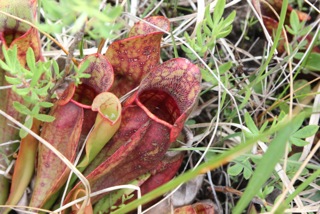
Out in the open again we encountered clusters of pitcher plants. Like all carnivorous plants, pitcher plants grow in locations where the soil is too poor in minerals, especially nitrogen and phosphorous, and/or too acidic for most plants to survive. The digested insects, and sometimes larger creatures like mice and frogs! provide the pitcher plants their needed mineral nutrition. More bird prints. Having encountered a number of prints throughout our journey we were able to compare and contrast our findings and use these comparisons and our resource guides to help us distinguish, in particular, sandhill crane and great egret tracks. Noting the toe positioning was helpful identifying some smaller prints as likely corvid tracks. What a treat to then come across some turtle tracks! A fun experience trying to identify them…the penny dropped for all of us when Alexis gave us the hint that he didn’t think they were mammal tracks.  The drag marks and ambling gait finally made sense if it was a turtle!  While inspecting the turtle track we encountered tiny frog and vole tracks too. What day filled with richness.  From the tiny millipede tracks to the grand wingspan of the great egret in flight passing overhead. From the close inspections of the finest details of our finds to the expansive vistas out over the land and water.

Back at Alexis’ place we enjoyed a potluck dinner of delicious food and story sharing. Under a starlit sky we ended the day spending time together around the campfire before heading to sleep to the sound of the night creatures.


Written by Miriam Snell - 1st year Tracking Apprentice

Wednesday, June 10, 2015

Sign Tracking and an Intro to Wildlife Tracking


Written by Tamara Anderson
Sunday, May 24, 2015
Lockyer Pits, Orangeville

It was sunny and 26°C at the Lockyer Pits in Orangeville.  We began the day by tracking the weather. Wispy cirrus clouds moved across the sky.  Alexis shared his knowledge that cirrus clouds forecast a change in the weather within about 24 hours.  The first set of tracks that we found belonged to a raccoon.  We noted the placement of the front foot beside the rear foot as the procyon lotor ambled south towards the nearby subdivision.  We discussed the various forms of locomotion used by terrestrial mammals; Plantigrade (walking with toes flat on the ground like humans and raccoons), Digitigrade(walking on the toes or digits like dogs and cats), Unguligrade (walking on the nails of the toes (or hoof) like deer).
Next, we observed crow tracks.  We discussed bird foot morphology and how the most common arrangement for birds is anisodactyl, with three toes pointed forward and one backward. The toe that points back is called the hallux.  Ornithologists number the toes of each foot from 1 to 4. Toe 1 is the hallux and the other toes are numbered in sequence, beginning with the inside of the foot and circling out.*  Alexis shared a cool tracking tip for corvids (Crows, Ravens, Jays etc.). In Corvids, toe 2 and 3 are close together. In comparison, toe 3 and 4 are close together for members of the Blackbird family (Cowbirds, Grackles, Blackbirds etc.).
After observing some mystery scat which we later decided was most likely fox, Sue was curious about how to identify different fur-bearing rodents from scat contents.  Do rodents come in different colours? Are certain rodents more delicious than others?  Alexis suggested looking up shrews and voles in Peterson’s Guide to Mammals.  Much of the morning was spent measuring tracks and stride lengths for wild turkey, white-tailed deer, coyote, and skunk.  Aster, Sue and Alexis practiced diagonal walking and moving like the animals that we were tracking.  Aster and Sue were interested in the differences between domestic dog and coyote tracks.  Alexis shared that dog tracks are more splayed than coyote tracks due to a difference in physical fitness.  Dog tracks tend to wander whereas coyote tracks tend to have a straighter trail.  Dogs have kibble waiting for them at the end of the day.  Coyotes do not. 
The sandy, sun-baked, four-runner trails began to feel like a desert.  We ventured down towards the river and found reprieve and lunch in the shade of a cedar forest.  En route, we noticed an ant attempting to carry away a butterfly that was not quite dead yet.  Can ants use their formic acid to predate other insects? 
The afternoon was spent exploring sand pits, locating tracks and comparing the characteristics of coyote and fox tracks.  The question of which would be more valuable, gold or water in a desert came to mind as the contents of my water bottle dwindled in the hot sun.  We began to wonder if Alexis might soon demonstrate one of his revered survival skills and magically find us some water.  Alternatively, I pondered whether I might be able to devine where water was by picking up two sticks in front of me. Aster wondered if there might be water beneath the sandy ground where we could see dogwood growing.  Is dogwood an indicator species for water?  Solitary bees flew into sand tunnels all around us. One 6 mm tunnel had plant debris glued together in a silky turret at the entrance.  I later learned that this tunnel was likely made by a burrowing wolf spider.
One solitary bee made a burrow in a deer track.  What are the bees doing in the burrows?  Are they laying eggs?


Tamara kept a bird list for the day: Red-Eyed Vireo, Savannah Sparrow, Meadowlark, Great Crested Flycatcher, Chickadee, Grasshopper Sparrow, Song Sparrow, Northern Flicker, Northern Cardinal, Red-Winged Blackbirds, American Crows, Red-Tailed Hawk, Rose-Breasted Grosbeak, Blue Jay, Tree Swallow, Cliff Swallow.
It was great to be out tracking in the sandy trails of Lockyer Pits.  Next time, I will remember to bring more waterJ

Written by: Tamara Anderson - 2nd year Tracking Apprentice


*Elbroch, M. & Marks, E. 2001, Bird Tracks and Sign, Stackpole Books, Mechanicsburg, PA.

Spring Time Tracking at Mono Cliffs

Saturday, May 23, 2015 - Day 1

Mono Cliffs Provincial Park

Our group gathered into a circle under the shade of an old Sugar Maple at the edge of an open sunny field. We shared our goals, intentions and gratitude as we watched the wind blowing through the landscape, passing over the tall grasses and through the aspen/poplar leaves in a playful fashion. We watched a couple of Northern Harriers fly over the field, triggering a discussion on sexual dimorphism and hawk ID features, followed later by a Wild Turkey hen cautiously wandering out from her nest to feed.

After our sharing, we got up to prepare to head out into the field for our first day of tracking but right beside where we had been sitting, we noticed some really neat tent caterpillar webs on some young cherry trees! What type of cherry where they; black, choke or pin? We spoke a bit on how to tell cherry species from the shape, size and spacing of their flower clusters.

As we headed into the field, we looked back to our shady spot and saw just how much our own impressions on the land (where we had sat) resembled deer beds.
We didn't get more than 15 or 20 meters into the field before we stopped to look at some of our first animal sign. Alexis crouched down and pushed some grass aside, revealing a tiny trail carved into the ground underneath the tall grasses. He showed us a tiny piece of grass stalk cut on a 45 degree angle, indicating vole feeding sign. We spent the next while unveiling the intricate network of vole trails through the field. We wondered how large the territory range was for these tiny creatures, which according to Mark Elbroch, is 1/10 to 1 acre!
We saw plenty of large holes scattered over the field around some of the vole holes going down into the ground. Had someone like a fox or coyote been digging here to feed on the voles?

We stopped around a rock cropping looking for signs of weasel activity and talked about defining features of various local members of the weasel family.

Then we pushed towards the edge of the field along the tree line where we found some huge scars on the younger aspens from past deer antler rubbing. We stepped into the wooded area and began to travel along a deer trail that ran South, just a few feet into the forest. We took a look at some of the claw and teeth marks on various trees. Showing signs of porcupine and raccoons who had climbed these trees in the past.

We soon came to a spot where we noticed someone had been eating the trout lily greens. Who was the culprit, turkey, deer, rabbit? We took note that the greens were cut flat and sometimes slightly frayed. Then we found another clue, a hair that kinks when it is bent, indicating the eater's hair had a hollow core. A clear track then confirmed our suspicions.  White-Tail Deer.

We found some holes carved out of dead wood, triggering a lesson on how to differentiate between local woodpecker species from the signs. We were really able to bring home this lesson as theory was confirmed as we found examples in the field of signs from nearly each type of woodpecker throughout the course of the day!
In the afternoon, we made our way along some beautiful cliff ridges carved out around 11 000 years ago by some great glacier melts, providing breathtaking views of the valley below. We sat watching and listening to the birds together,  sighting some rose-breasted grosbeaks, red-eyed vireos, chickadees, turkey vultures, ravens and a few different warblers. We split up for some grounding sit-spot time long the cliffs before embarking on the descent back down towards our meeting point.

Throughout the remainder of the day, we wandered through the woods, talking about trees and plant ID, deer rutting behaviour, predators of ant hills, grouse vs wild turkey dust baths, what the deer have been eating and how to assess the age of forests based on the plants and trees growing there. It was truly a day full of many lessons, tying academic information in beautifully with experiential learning in the field.


Written by:  Lianna Vargas - 2nd year Tracking Apprentice