Showing posts with label training. Show all posts

Monday, December 7, 2015

How Do You Like Them Apples?


 Approaching our meeting location for the day, the veil of fog I had been driving in for an hour seemed to be lifting with the rising sun that had began peaking through the clouds, just up over the treeline in the horizon. I was taken by the beauty of the first rays of light hitting the frosty landscape of rolling hills and tree lines. The fine layer of ice that had developed overnight, covering the autumn vegetation, was reflecting the rays of the rising sun in a way that makes you really feel grateful to be alive. Everything on the landscape was glistening sunlight.
Deer Track in debris

We met up on the side of the dirt road and promptly decided we should tuck into the other side of the Cedars to escape the chill of the wind. This brought a first lesson in starting to think more like an animal, seeking natural forms of cover to conserve energy and help provide cover. The winds were strong and blowing from the North-West so we made a plan to head over to the eastern edge of the cliffs and along southward so our scent would be blowing away from our target destination as we approached.

We were focusing on trailing today so we needed to be especially quiet. We agreed to travel in scout formation, travelling as quietly as possible and communicating with hand signals.
As we began, the morning frost was just starting to thaw, making the deer trails stand out with an amazing clarity. The leaf litter was moist, helping to soften the sound of our footsteps, and the winds blowing the melting ice of the trees provided gusts of dripping sounds that help muffle our noise. Alexis got us started on the first trail, pointing out various tracks, lays, scrapings, browse and fresh scat. We switched leads, and I began following whatever trails seemed to stand out most to me. I felt in a different mode following a trail silently and focused. At some point I heard the snap of a branch to the East of me, and I remembered that I was in a group. Two small deer scampered out in front of me and took off ahead as Tamara, the eastern wing, emerged from the ridge just behind them.

We circled up to share and make a plan of action. We continued to follow the trails southward to the edge of the habitat and we began feeling like the deer were Eastward. We switched leads again and headed East and within minutes, I knew something was up as the lead froze and slowly lowered. Miriam had spotted a group of 5-6 deer heading South-East. We waited before following the trails along silently for some time, until we came to a sunny spot just along the ridge that a few deer trails passed near and we thought, “this would be a sweet spot to bed down and soak up the warmth of the sun, if we were deer.” Naturally, we decided to break there.

Porcupine Den Site
After sitting in the sun for a while, I realized the leaves were no longer damp, the frost had melted and the sun had begun to dry out the leaf litter of the forest floor. It would be a lot harder to travel as quietly now. Alexis reminded us to try to think like a deer. How we walk is important. When deer break a branch as they are walking, they freeze and check their surroundings before they take another step. Although we couldn't be completely silent, we could change the rhythm of our footsteps to be more like the deer, careful, with intermittent pauses.
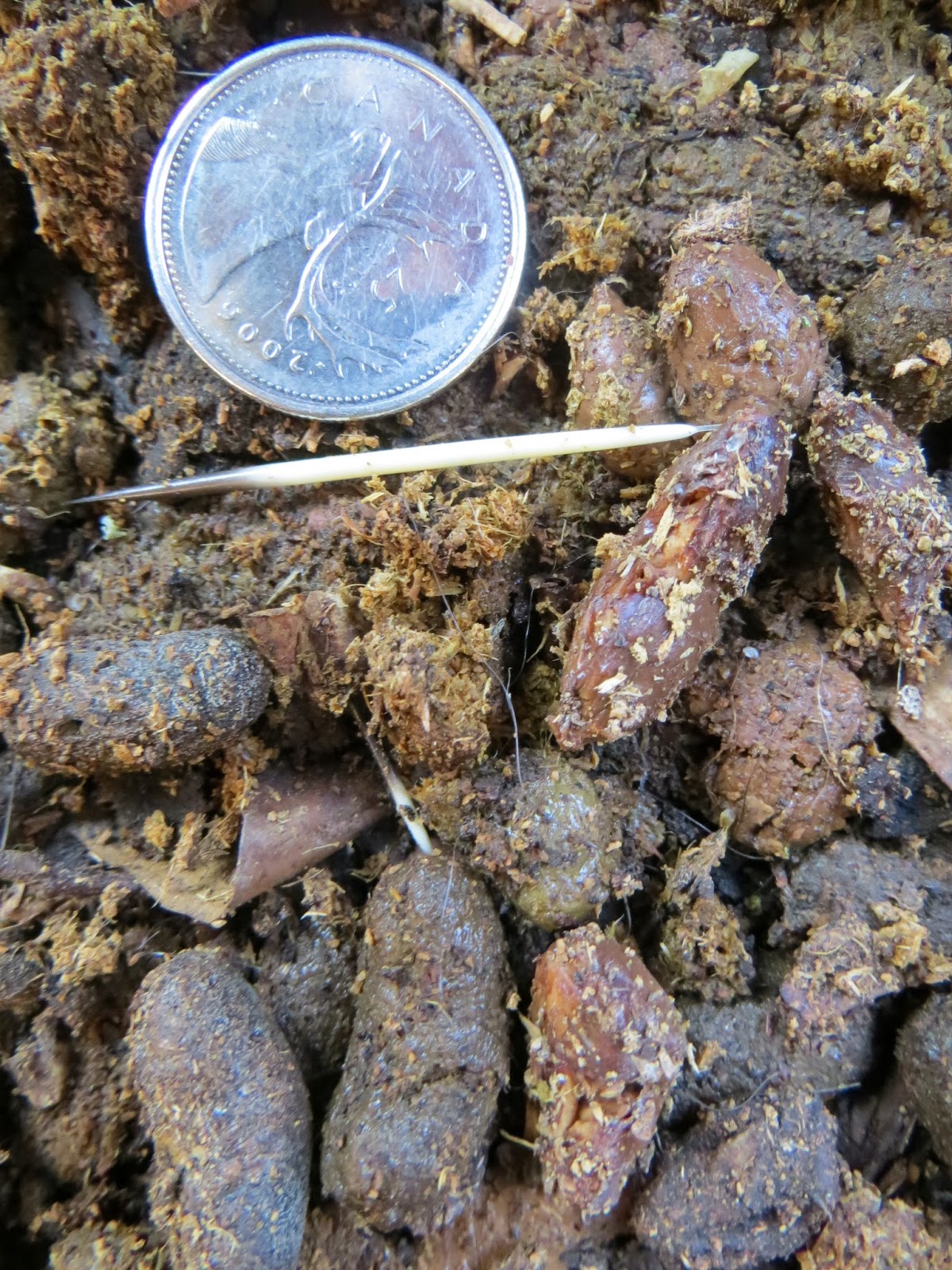
Porcupine scat and quill

Following the trails, we found an old porcupine den, piles of fresh raccoon scat, signs from various woodpeckers, flying squirrel scat, and half-eaten apples stashed up in tree limbs. As we worked our way to the apple trees, we saw various animals had been feeding on the huge abundance of fruit. We compared measurements of the incisor marks on some apples, discussed what was possibly eating them and debated what was likely the creature(s) that had left the marks on the specimens in our hands.

Red Squirrel incisor marks
As the day came to an end, we headed back North, slowly, along the Western edge of the field as the sun was beginning to make it's was to the other horizon. Once again, I am filled with gratitude and appreciation for the natural world, and the abundance of gifts, lessons and experiences Nature has to offer.


Always asking questions
Written By:  Lianna Vargas - 2nd Year Wildlife Tracking Apprentice

Tuesday, December 1, 2015

Jedi Tracker Training and Luke Sandwalker


Sunday November 1st, 2015


As the tracking apprentices learned about pressure releases this past weekend, we could almost hear the wise words of Yoda saying, “Patience you must have my young padawans”.  After constructing a 10 foot long by 5 foot wide tracking box on Saturday, we were ready to embark on using the giant sandbox to look at tracks.  Alexis shared his passion and knowledge of pressure releases eloquently and enthusiastically.  We also had “The Science and Art of Tracking” by Tom Brown Jr. in hand.  We learned how turns, changes in direction and sudden stops cause pressure against the wall of a track.  The pressure is released as cliffs, ridges, peaks, caves, plates, fissures and explosions in the substrate.  The second pressure release study looked at what happens to the substrate as a result of a change in forward motion.  The apprentices walked, ran, and jigged across the tracking box to get a better understanding of how speed influences the appearance of a track.  We created waves, disks, dishes and explode-offs in the sand.  We were helped out by both a cat and a dog, who were somewhat obliging in letting us analyze their tracks in the tracking box.  Alexis shared a quote by Stalking Wolf on page 34 of The Science and Art of Tracking, “We first must learn the simple language of the tracks, which teaches us to hear the voice of the animal, and soon, through the voice of the animal, we begin to hear the voice of the Earth.” The day also included a little sand castle construction and much merriment.

Written by Tamara Anderson - 2nd Year Earth Tracks Tracking Apprentice


Wednesday, June 10, 2015

Sign Tracking and an Intro to Wildlife Tracking


Written by Tamara Anderson
Sunday, May 24, 2015
Lockyer Pits, Orangeville

It was sunny and 26°C at the Lockyer Pits in Orangeville.  We began the day by tracking the weather. Wispy cirrus clouds moved across the sky.  Alexis shared his knowledge that cirrus clouds forecast a change in the weather within about 24 hours.  The first set of tracks that we found belonged to a raccoon.  We noted the placement of the front foot beside the rear foot as the procyon lotor ambled south towards the nearby subdivision.  We discussed the various forms of locomotion used by terrestrial mammals; Plantigrade (walking with toes flat on the ground like humans and raccoons), Digitigrade(walking on the toes or digits like dogs and cats), Unguligrade (walking on the nails of the toes (or hoof) like deer).
Next, we observed crow tracks.  We discussed bird foot morphology and how the most common arrangement for birds is anisodactyl, with three toes pointed forward and one backward. The toe that points back is called the hallux.  Ornithologists number the toes of each foot from 1 to 4. Toe 1 is the hallux and the other toes are numbered in sequence, beginning with the inside of the foot and circling out.*  Alexis shared a cool tracking tip for corvids (Crows, Ravens, Jays etc.). In Corvids, toe 2 and 3 are close together. In comparison, toe 3 and 4 are close together for members of the Blackbird family (Cowbirds, Grackles, Blackbirds etc.).
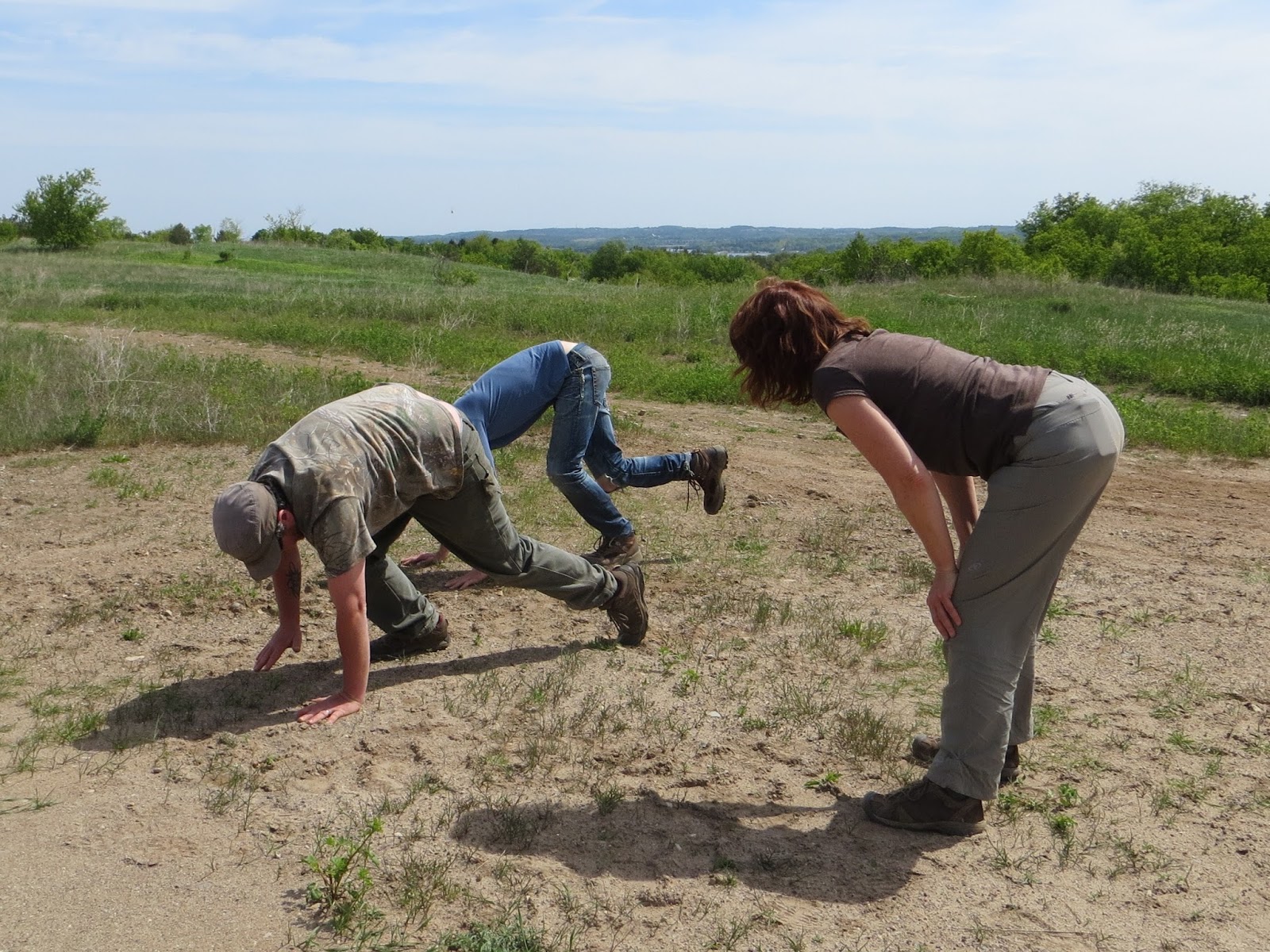
After observing some mystery scat which we later decided was most likely fox, Sue was curious about how to identify different fur-bearing rodents from scat contents.  Do rodents come in different colours? Are certain rodents more delicious than others?  Alexis suggested looking up shrews and voles in Peterson’s Guide to Mammals.  Much of the morning was spent measuring tracks and stride lengths for wild turkey, white-tailed deer, coyote, and skunk.  Aster, Sue and Alexis practiced diagonal walking and moving like the animals that we were tracking.  Aster and Sue were interested in the differences between domestic dog and coyote tracks.  Alexis shared that dog tracks are more splayed than coyote tracks due to a difference in physical fitness.  Dog tracks tend to wander whereas coyote tracks tend to have a straighter trail.  Dogs have kibble waiting for them at the end of the day.  Coyotes do not. 
The sandy, sun-baked, four-runner trails began to feel like a desert.  We ventured down towards the river and found reprieve and lunch in the shade of a cedar forest.  En route, we noticed an ant attempting to carry away a butterfly that was not quite dead yet.  Can ants use their formic acid to predate other insects? 
The afternoon was spent exploring sand pits, locating tracks and comparing the characteristics of coyote and fox tracks.  The question of which would be more valuable, gold or water in a desert came to mind as the contents of my water bottle dwindled in the hot sun.  We began to wonder if Alexis might soon demonstrate one of his revered survival skills and magically find us some water.  Alternatively, I pondered whether I might be able to devine where water was by picking up two sticks in front of me. Aster wondered if there might be water beneath the sandy ground where we could see dogwood growing.  Is dogwood an indicator species for water?  Solitary bees flew into sand tunnels all around us. One 6 mm tunnel had plant debris glued together in a silky turret at the entrance.  I later learned that this tunnel was likely made by a burrowing wolf spider.
One solitary bee made a burrow in a deer track.  What are the bees doing in the burrows?  Are they laying eggs?


Tamara kept a bird list for the day: Red-Eyed Vireo, Savannah Sparrow, Meadowlark, Great Crested Flycatcher, Chickadee, Grasshopper Sparrow, Song Sparrow, Northern Flicker, Northern Cardinal, Red-Winged Blackbirds, American Crows, Red-Tailed Hawk, Rose-Breasted Grosbeak, Blue Jay, Tree Swallow, Cliff Swallow.
It was great to be out tracking in the sandy trails of Lockyer Pits.  Next time, I will remember to bring more waterJ

Written by: Tamara Anderson - 2nd year Tracking Apprentice


*Elbroch, M. & Marks, E. 2001, Bird Tracks and Sign, Stackpole Books, Mechanicsburg, PA.

Thursday, February 5, 2015

Down in the Valley: A focus on snow trailing and animal gaits

 On a cold and windy January Saturday we met in the Beaver Valley to start our weekend of tracking and trailing.  Most of us were on snowshoes, skimming across the layers of snow and able to keep a good pace over the drifts.  First off, we slipped off the road down into a cedar swamp, where we were sheltered from the brisk wind.  The animals might have had the same idea. We immediately encountered deer and coyote trails, occasionally hard to distinguish from each other in the deep snow, and so we spent some time figuring out the features that would help us tell them apart, as well as talking about how each animal was moving through the snow (its gait).  Talking about the weather patterns of the past week helped us with aging the tracks. 

Deer beds were tucked in among the cedars, and fairly fresh coyote tracks across them gave us a glimpse of the ongoing dance across the landscape of predator and prey.  Two patches of urine again spoke to this relationship, the coyote leaving its strongly smelling urine directly over the deer’s milder-scented mark. And now the “it” of the coyote was transformed into a “she”: a patch of blood in the urine told us that the coyote we were following was mostly likely a pre-estrous female, almost ready for the breeding period.  

We were struck, as we have been at other times, with the very high browse line on all the cedars. These were hungry deer, perhaps already running low on resources.  A high browse line on the black spruce nearby was even more surprising.  Spruce is a food of last resort for deer, and we wondered about the population density of deer in this area and their pressure on the forest.

Porcupine Browse Sign
A little past the deer and coyote urine, we found another mark, florescent green and piney in scent, surrounded by clipped branches of spruce that had been dropped to the ground – tell-tale sign of porcupine! Our next clue, a typically trough-like and stained porcupine trail in the snow, led us to more urine and a large pile of scat.  And looking up, in a large cedar, there was the culprit, high up on the trunk.  Not more than fifty feet away, we spotted another of the species in a second cedar.  This tree sported a fresh-looking pileated woodpecker hole. As we looked around at other such holes in surrounding trees, Matt spotted something peculiar above us: a couple of dozen quills sticking upwards from a branch that was broken at the end.  What a strange sight!  What happened here?  Was it a porcupine falling off a higher branch breaking its fall and losing quills?  We found no sign of a body at the base of the tree, even after digging down in the snow. How long had these quills been here?  What happened to their owner?

Did this Porcupine fall from the Tree?
Leaving the porcupine mystery for future wanderers to stumble upon, we headed up to the bridge over the Beaver River. Our next mystery was a clump of black fur, with a bone in the centre of it, half buried in the snow under a large cedar.  Our best guess, most of us agreed, was the tail of an Eastern Grey Squirrel (in its black, or melanistic, colour phase).  What happened here?  Where was the rest of the squirrel?  Why had we found it outside its usual deciduous forest habitat?

We set out to the north over a large snow-covered plain, following the northward course of the river’s current (surprising for those of us used to the ubiquitously south-flowing rivers further south).  A wasp’s nest low to the ground in a small shrub pulled Christina off the trail – what a strange location for it! Who made this nest?  We were pretty sure we knew – do you? Our main clue: the “paper” was plainly lined, unlike other more ornately scalloped nests we had seen of a different species.  Hmmm… 

Checking out Porcupine Tree Trails
Through the open field and back into a cozy grove of cedars on the river’s west bank - with a few of us taking a detour to inspect a sugar maple almost fully stripped of bark by porcupines - we stopped for lunch.  After some rest and refueling, and drying of socks and gloves, we were ready for some trailing practice. Breaking into two smaller groups, we were challenged to find a good trail and follow it for a couple of hours, meeting back at the bridge over the Beaver River in the late afternoon.
 
In the evening, after a shared dinner, we all sat down as a group to review mammal gaits and track patterns, and to map out our day’s adventures. After recording the details of our morning together, we listened to each other’s afternoon trailing stories. Both groups, in the midst of all the visual “noise” of deer trails in the forest had hit upon a coyote trail to follow. We shared the track patterns we had seen, the stops and starts, the steep climb uphill to the west of the valley.


Grey Squirrel Tail 
One group had followed their particular trail a little further than the other, and found it led to a coyote bedding area high up the west slope, with seven coyote beds, many trails leading in and out, and several scats in the beds – showing the animals had recently eaten.  At various points in the day, we had wondered why we were seeing so many walking coyote trails (trotting is their baseline gait when exploring and looking for food).  Had the coyotes been travelling on full stomachs all this time, with no urgency to look for food?  Our learning about the coyote’s gait and its potential connections to the animal’s physical state brought our weekend’s theme into practical focus.
  Written by: Malgosia Halliop - 2nd year Tracking and Apprentice (and Level III Track and Sign - Congratulations Malgosia!)

Nighttime Study Time

Friday, January 9, 2015

What the Raven says . . . and other fortuitous tracking moments

Guess What happened to this guy?
On a snowy December day, we were in the Boyne River area heading up a steep, steep deer trail as we began the morning. Following deer tracks on a slope placed perfectly one after the other is a hilarious thing to try and do as a human. The snow was wet and heavy and there was a tiny layer of water/ice that made us slip, slide, and wonder about the amazing ability of deer hooves to grip this wild substrate - no boots necessary for the creatures of the wild. 

Following the rambling deer through the forest, we came to an interesting little intersection. On one side tracks were leading from a bramble covered thicket with willow and dogwood in the background and then headed towards a cedar grove. What was that little miss-step that happened in the middle of the trail? The stride of the deer grew by almost a third, and as we put together pieces, you could almost see the deer emerging from cover, stopping, looking and quickly moving through the clearing to get to the dense cedars on the other side. How often do we do this when crossing the road? Human nature or deer nature?

Later, after identifying the sex of a deer based on back legs and urine location, we crossed back down the hill and over the road. From a distance, this wet bog held the allure of some exciting beaver evidence. Fresh chews and trails perhaps? As we walked closer, there was an even more exciting find - a shed antler?!?? Looking closer, this antler appeared to be attached to a big lump covered in snow. . .a whole deer! We had found a dead buck, completely covered in snow, with hair that detached from the hide easily, dating it a week or more old we thought. With a beautiful big rack and thick, strong, neck, we puzzled about its death whether through harsh conditions? old age? car accident? This mystery held us in its grip for a while before we moved on to the beaver trail and found a spot to lunch in among the cedars at the edge of the wetland. 

As we munched and chatted, we heard a strange squawk from where we had left our friend the deer. Who was that and was he saying? Squawking/gurgling/shrieking - the raven had come down to announce this bounty of the deer carcass for anyone who was within earshot. Listening to ravens can be tricky business, but in this case it seemed clear to all of us that he said "Yes! look what I have found!"

After lunch, we hiked past the edge of the wetland, trailing deer to see who and how many went which way. We past evidence of grouse life, and insects burrowing and engraving the trees, until we came across another mystery - what were those snails doing on the snow?? As we investigated the live snails laying across the top of the snow, we wondered - how did they get here? Why? There was a tiny mammal tunnel that led to where these snails looked like been tossed out the window of this subnivean creature. Alexis thinks he knows what it was - ask him if you get the chance.
Fisher Tracks

But the deer trails pulled us forward, and we ventured up the hill to find fresh deer beds, and some bounding deer going - you guessed it- right up a steep and slippery slope. 

Porcupine Trail
Almost at the top of the ridge, there was an interesting interloper. This trail led west down and towards the road, and had five perfect toes in each track. A fisher! This was the biggest mustelid we had seen evidence of this wild and crazy weasel weekend. We followed it over hill and dale, up and down, noticing where it had dug a snack from below the snow - old deer bits? - and where it finally disappeared into thin air?! Or perhaps that shadow up overhead in the spruces was where the fisher napped?

After looking on the ground for an arboreal predator grew tiresome, we found some tracks that looked like a tiny cross country skier had come by - a wild turkey in the deep snow can really help one appreciate the dexterity of their toes. 
As we came to the edge of a field, we found a wide porcupine trail and a den underneath a rocky cliff clinging cedar. Slip sliding our way down to walk the road back, I thought about the sleeping fisher, the walking turkey, the cold snails, the dead deer and the hungry raven and I was grateful to have met them all. 

Written by Lee Earl - 2nd Year Earth Tracks Tracking Apprentice
Porcupine Trail to den site


Tuesday, December 16, 2014

The Value of Journaling in Tracking Training


I’ve been spending a lot of time recently working on tracking journals. For the past year and a half or so, I’ve been involved in a tracking apprenticeship program through Earth Tracks Outdoor School. The year before – having  developed a deep curiosity about plants, especially their edible and medicinal uses – I’d signed up for a wild plants apprenticeship with Earth Tracks. I signed up impulsively, but with an instinct I trusted. I had taken a couple of workshops with Alexis and had a really good feeling about his teaching style. I knew I wanted more grounded knowledge of ecology and nature. After many years of education, I was suddenly stunned by my own ignorance about the natural world. I wanted to zoom in on things, see the details, really know what was around me. I wanted to be outside all day, learning cool stuff.
The monthly commitment felt daring and kind of improbable – my younger child was only three, and we had rarely been apart. But sometimes I set my mind to something, and I can’t turn back.

From the first weekend, the time and space and all-day immersion in nature tapped into to something that I had been longing for. As the eight-month plant apprenticeship wound down, I wanted to continue learning in exactly this way. I found out that Alexis was offering a ten-month tracking program, which would start just a week after the plant course finished. As we drove back and forth together the last months of the course, my new friend Lee and I gradually talked each other into it. It was a leap of faith, because at that time I knew little about tracking, but it also felt right, because I knew how much the weekends had nourished me the previous year. I knew also that in nature nothing is separate. Tracking was connected to a huge web of naturalist learning that I wanted to dig into. And I also felt, in a way, that a wave was carrying me that I couldn’t really stop. And didn’t want to.
Now, I am in the second year of tracking apprenticeship with Earth Tracks. Along with a couple of others, I’m participating in a pilot second year program in a work/trade role. I’ve also practiced tracking in other contexts over the same period, in the midst of homeschooling my kids and other responsibilities: a week-long immersion course in Algonquin Park run by Earth Tracks and White Pine Programs; helping run a monthly drop-in tracking program for the PINE Project; and time on my own when possible. And now, I’m also working my way through lots and lots of tracking journals. The ones we use for the apprenticeship are based on the Shikari template, with two pages of more reflective questions added by Alexis. Each journal is six pages long in total, and completing one involves mapping, sketching, measurement, weather observations, ecological observations, species research, observations on one’s own patterns and gaps, and reflection on the more intuitive and personal aspects of tracking. Another set of journal pages, also part of the homework, are focused on species research and field observation. With these, I was initially a bit fixated on making them “complete” and now I’d like to work on making them shorter and more concise instead.


On top of all that are ecological mapping exercises, seasonal nature observations, and tracking exercises of various kinds. Whew! It’s going to take me a while to get through it all. But as with so many things, I’m finding that as I make a habit of it, I’m drawn further in. I’m learning to love my tracking journals, picking away at the homework bit by bit each day. And doing this kind of recording, questioning and puzzle-solving is reinforcing the experiential naturalist learning I’ve been doing the past couple of years. This is field research, but it’s not detached. It’s detailed, but it’s also personal and reflective and connecting. In the past, most of the academic work I did involved writing and more writing: long essays about patterns and theories. I liked making leaps of intuition; I avoided methodical work. This uses a different part of my brain, one which needs to be present to the details. Slowly I can see that paying close attention and recording observations is training me to see better. The more I learn, the more questions I have. I’ve realized that this kind of learning is a life-long commitment.

Here are some more (non-matching) example of individual journal pages. Some of these are finished, some are not quite. They are teaching me the importance of just showing up and doing the work, of slowly bringing small pieces together into something substantial, of creating methodical habits that over time create big changes of perspective. 


By Malgosia Halliop (2nd year Tracking Apprentice)