Showing posts with label wilderness skills. Show all posts

Monday, December 7, 2015

The Twelve Gifts of Tracking


Porcupine Mandibles
 The rolling hills and drumlins of the Bruce Trail inspired this seasonal story of the day:

On the 6th Day of December, my tracking friends shared with me…
Twelve apples cached by squirrels (munched on by rodents, rabbit, deer and grouse)
Eleven animal trails (some serious) made by deer, rabbit, porcupine and raccoons.
Ten deer beds, scrapes and antler rubs.
Nine piles of deer, coyote, raccoon, porcupine and squirrel scat.
Red Squirrel Cache
Eight animal homes lived in by fox, groundhog, red squirrel, porcupine and sparrows.
Seven raven calls above a coyote’s resting place by the creek.
Six pine grosbeaks.
Five mandibles (from porcupine, coyote and meadow vole)
Four gulleys (landforms* and one named Sue)
Three rodent-chewed deer bones
Two grouse exploding into flight (and two ginger chocolate squares)
…and a porcupine in a hemlock tree.

*a water-worn ravine


By Tamara Anderson - 2nd year Tracking Apprentice

Tuesday, December 1, 2015

Jedi Tracker Training and Luke Sandwalker


Sunday November 1st, 2015


As the tracking apprentices learned about pressure releases this past weekend, we could almost hear the wise words of Yoda saying, “Patience you must have my young padawans”.  After constructing a 10 foot long by 5 foot wide tracking box on Saturday, we were ready to embark on using the giant sandbox to look at tracks.  Alexis shared his passion and knowledge of pressure releases eloquently and enthusiastically.  We also had “The Science and Art of Tracking” by Tom Brown Jr. in hand.  We learned how turns, changes in direction and sudden stops cause pressure against the wall of a track.  The pressure is released as cliffs, ridges, peaks, caves, plates, fissures and explosions in the substrate.  The second pressure release study looked at what happens to the substrate as a result of a change in forward motion.  The apprentices walked, ran, and jigged across the tracking box to get a better understanding of how speed influences the appearance of a track.  We created waves, disks, dishes and explode-offs in the sand.  We were helped out by both a cat and a dog, who were somewhat obliging in letting us analyze their tracks in the tracking box.  Alexis shared a quote by Stalking Wolf on page 34 of The Science and Art of Tracking, “We first must learn the simple language of the tracks, which teaches us to hear the voice of the animal, and soon, through the voice of the animal, we begin to hear the voice of the Earth.” The day also included a little sand castle construction and much merriment.

Written by Tamara Anderson - 2nd Year Earth Tracks Tracking Apprentice


A Boyne River Valley Scat Rap


Sunday September 13, 2015
Written by Tamara Anderson
(With help from the Scat Rap, by A. Bennett, M. Keebler, R. Pemble, D. Elliott, and B. Jonas)
It starts with an “s” and it ends with a “t”. It comes out of you and it comes out of me. I know what you’re thinking, don’t call it that. Let’s be scientific and call it scat.
The tracking group met at an old dam and Grist Mill known as Ponton Mills in the Boyne river valley. We set a course northward to a big hill where a fisher’s tracks had been found the previous winter.  Ten degree weather and a forecast of rain added a chill to the morning.  Autumn had arrived in south-western Ontario.

Pausing to observe cedar roots wrapped around limestone, and crayfish under rocks, we clambered along the shore of the Boyne River.  The fragrant smell of mint filled our nostrils and we brushed by groves of horsetails. Old beaver chews and deer trails caught our attention. 

Left by the dozen in piles on the ground; Lots of little pellets are what you’ve found. They look like little chocolates so it is clear. This is the scat of a white tailed deer.

A deer popped up from her day bed while we admired fawn pellets.  She bounded across the river to our East.  We continued up the hill, discovering deer bones and following the course of a spring to its source.  Refreshing, cold water flowed out from the hillside. 

Animal-made switchback trails helped us climb up the steep valley slope.  At the top, there was a scat underneath a Black Cherry tree.    

Up on the hill, under a Black Cherry; Scat full of apple and purple berries. Late last night he was out with the moon; foraging in the forest, it was Mr. Raccoon.

The spruce plantation at the top of the hill revealed porcupine chews and more deer bones.  A logging trail led us to a rolling topography of maple trees.  A wood thrush sat on the forest floor watching us.  Alexis found an interesting limestone rock that had been hollowed out.  Had it been hollowed out by water or maybe by a human?
Tracks showed where a raccoon and a coyote had explored a muddy flat near the edge of the forest.  The forest opened into a clearing.  Deer beds were scattered around the open field.  Lianna found deer hair in one of the beds.  We hiked up to a lookout.  Northern Flickers had probed for ants on the steep hill.  We found an opened apple covered in ants in the middle of the trail.  Iwonder if the flicker placed the apple to attract a buffet of ants?

The hilltop overlooked the Boyne Valley.  Sharp-shinned hawks, Turkey Vultures, a Swan, Blue Jays and Northern Flickers performed aerial feats as we discussed the landscape, noting colourful pockets of different tree species.  On the way back to the car, we encountered a muskrat making trails in the marsh and dinner out of cattails.  

In closing,
Down the trail something’s lying on the ground; Nature’s Tootsie Roll all long and brown. Don’t wrinkle your nose, don’t lose your lunch. Break it apart, you might learn a bunch
:)

Written by Tamara Anderson - 2nd Year Earth Tracks Tracking Apprentice


Tuesday, August 11, 2015

The Wisdom of the Marks

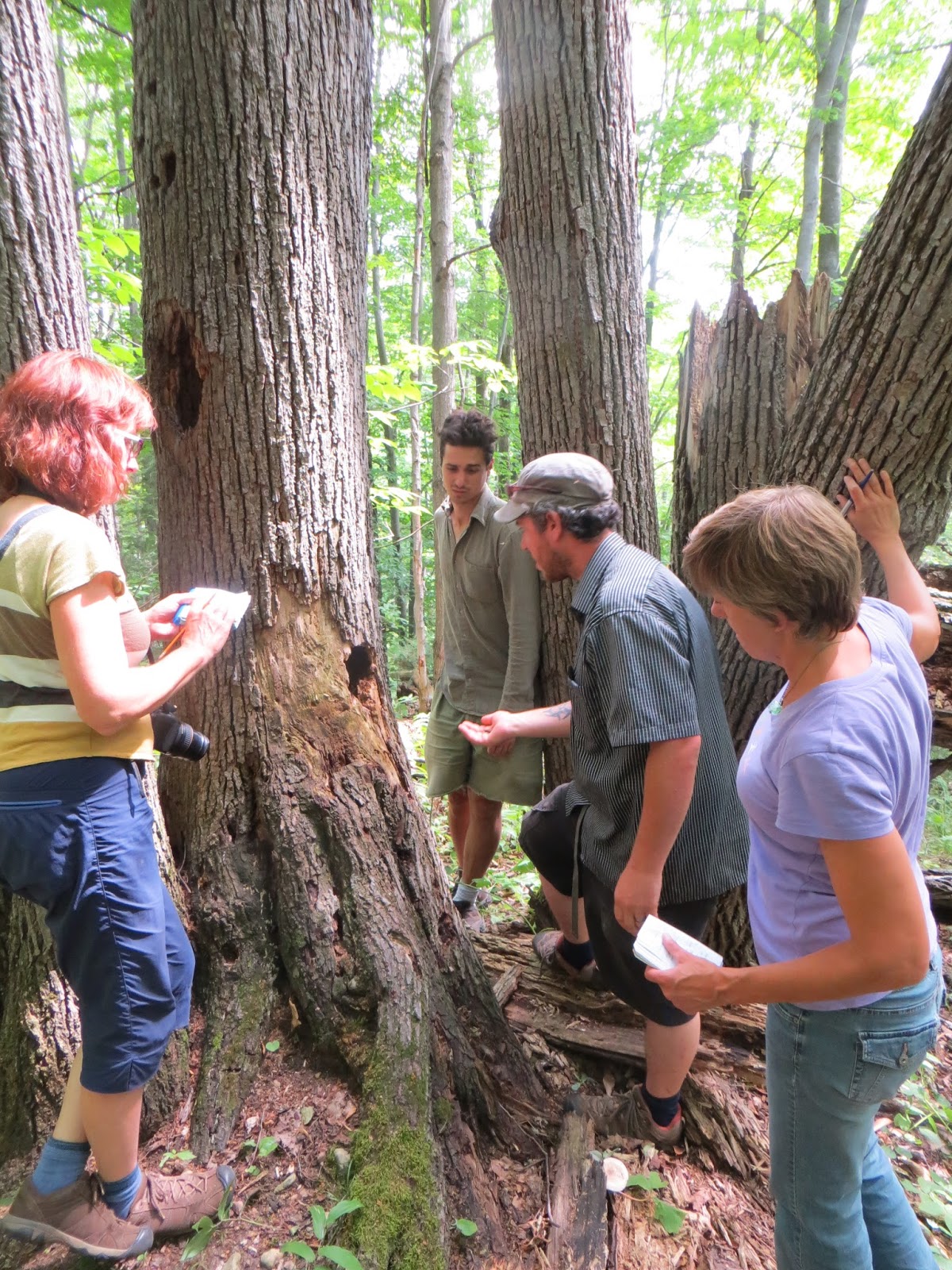
The site of a porcupine, raccoon and flying squirrel holes in this big old Basswood tree


Saturday and Sunday, July 26th, 2015
Written by Tamara Anderson - 2nd year Tracking Apprentice

In his book Nature Observation and Tracking, Tom Brown Jr. writes; “The earth tries to be flat.” He was referring to how weather and gravity “conspire to erase tracks”.  This past July, the tracking apprentices observed the subtle traces of summer tracks at Allan Park near Durham. We also created tracks and signs at Alexis’ house and watched how they changed over two days.  Lately, I have been tracking the landscape just as much as I have been following the footprints of animals.  Approximately 10,000 years ago, a receding glacier scraped the surface of the land that is now Allan Park and deposited material from the Canadian Shield.  Some of the material was ground into sand, silt and clay. A huge chunk of ice from the glacier dropped onto the landscape and a kettle lake was formed.  Allan Park is part of the Horseshoe Moraine. It includes a trail system that reaches an elevation of 30 metres in some places. 

Fawn Tracks
On Saturday, we wandered the rolling, forested pine, spruce and cedar hills beside the glacier-made trout pond.  The sandy edge of the pond revealed the opened shells of snapping turtle eggs.  This prompted a few questions:  How does temperature affect turtle egg incubation? Do predators leave different signs when they predate turtle nests?  I learned that the “J” shape of the Jack pine cone is a helpful way to remember the cone-makers identity.  Sue asked about whether any local species of rats are native to North America and which snakes have live birth?

Watching Tracks Age
On Sunday morning we were enchanted by the purling rattle of a Sandhill crane in a field near Alexis and Bobbi’s place.  Sandhill Cranes beckon my attention in an ancient way. After reading about Sandhill cranes, I discovered that they are the oldest known surviving North American bird species.  That morning, we returned to Allan Park and found a trail on a steep hill that led to different interpretations.  It is amazing how the track of a sliding deer can look similar to the five toes of a barefoot, feral child;)  After following a doe and her fawn’s tracks along a sun-baked, sandy trail, we ventured into a cool, deciduous forest of Hickory, Basswood and Maple.  The tracking apprentices used tracking sticks to track each other in leafy debris.  Luke and Miriam discovered a vole tunnel and burrow network at the forest edge.  We lightheartedly discussed how best to classify this trail.  If vole trails under the snow are called “subnivean” then would this trail under the leaf-litter be called sub-humusean?  We also wondered whether the trail was from a red-backed or a meadow vole.  Do meadow voles occasionally lives in forests?  What is the range of the red-backed vole? Alexis located a flying squirrel latrine in a basswood tree. Flying squirrel scat accumulates in areas where the squirrels nest and cache food. The scat often flows out of tree cavities, low to the ground. 

I will end this post with a continuation of Tom Brown’s tracker wisdom; “There is hardly a square foot of ground that is absolutely flat. Every depression, every bump, every fissure, and every scratch on the landscape was made by something. Whether it was made by a rabbit, mouse, bulldozer, fish, frog, or volcano, it is the tracker’s job to notice and interpret it.” (Tom Brown Jr., Nature Observation and Tracking)

Tuesday, May 5, 2015

Majestic Trees and the first Spring Ephemerals

On Sunday, Along the Niagara Escarpment,  we continued to learn about trees, and found several spring ephemerals poking through the leaves on the forest floor. There were tiny Spring Beauties with whitish pink flowers and Trout Lilies whose bell-shaped yellow flowers were yet to bloom. Tiny purple Violet flowers were growing in a sunny spot near Blue Cohosh's with their stems still purple as they emerge from the earth. We paused to harvest some Trout Lily corms, a sweet treat in the spring and in the summer and fall they have a taste more like potatoes. These early spring wildflowers grow, flower and go to seed in a forest before the leaf canopy grows thick enough to block out the sun.

We focused on identifying hardwood trees today, especially opposite branching ashes and maples.  We also found Ironwood, Trembling Aspens, White Birch, Black Birch, some Willows, Balsam Fir, and Common Elderberry shrub. We talked about forest succession when we came across Indian Pipe, a plant that gets it’s energy not from the sun, but from the fungus under the ground growing on the roots of trees. Also known as Monotropa uniflora, this plant has the coolest latin name of the many we learned today.


The Trail took us down the cliffs along a set of stairs. We paused for lunch near a pond and several folks sang some beautiful songs as we ate.  We tasted a thin slice of Wild Ginger root just before lunch, the unique maroon flowers should be coming out soon.  In the afternoon, we made tinctures.


Bright yellow Coltsfoot, has several features that distinguish it from dandelion, including purplish alternating scales on the stem, and heart-shaped leaves that don’t come out until after the flower does. We sat by the water, harvested some Coltsfoot and made a tincture in a mason jar.  Coltstfoot has demulcent properties, which means it can soothe a throat sore from a cough or a cold.  It’s expectorant properties mean that it can thin out mucous so that it is more easily expelled by coughing. We stopped by the creek to harvest some bark from a White Birch that had been cut down recently- it would make great baskets and other natural crafts.      
 
The Willows sat by the water; a small pond with some geese asserting themselves for a prime nesting ground.  Nine Painted Turtles basked on a log, they seemed to be unfazed by the geese’s loud honking battles.  A bat and several birds, sparrows and Red-Winged Blackbirds also inhabit this wetland.  As the clouds rolled in, the spring peepers started their mating song. We tinctured some Willow here, to be used to help with pain and inflammation.

Heading home, we stopped along another pond making up the headwaters of the Sheldon Creek.  We filled up our water bottles at a nearby spring. The path turned south and got steeper.  As we climbed through the cliffs we stopped to take a group photo!

 
The trail took us to a lookout at the top of the Escarpment. Looking out over the forest, we watched the turkey vultures soaring in the cliff’s updrafts and listened to some stories of Alexis’ adventures in this place many years ago. A closing circle was held at the top of the cliff.  We shared some gratitude and anticipation for the months to come before heading to the cars.

Written By:  Alex Thomson - 2nd Year Plants Apprentice