Showing posts with label animal gaits. Show all posts

Monday, December 7, 2015

How Do You Like Them Apples?


 Approaching our meeting location for the day, the veil of fog I had been driving in for an hour seemed to be lifting with the rising sun that had began peaking through the clouds, just up over the treeline in the horizon. I was taken by the beauty of the first rays of light hitting the frosty landscape of rolling hills and tree lines. The fine layer of ice that had developed overnight, covering the autumn vegetation, was reflecting the rays of the rising sun in a way that makes you really feel grateful to be alive. Everything on the landscape was glistening sunlight.
Deer Track in debris

We met up on the side of the dirt road and promptly decided we should tuck into the other side of the Cedars to escape the chill of the wind. This brought a first lesson in starting to think more like an animal, seeking natural forms of cover to conserve energy and help provide cover. The winds were strong and blowing from the North-West so we made a plan to head over to the eastern edge of the cliffs and along southward so our scent would be blowing away from our target destination as we approached.

We were focusing on trailing today so we needed to be especially quiet. We agreed to travel in scout formation, travelling as quietly as possible and communicating with hand signals.
As we began, the morning frost was just starting to thaw, making the deer trails stand out with an amazing clarity. The leaf litter was moist, helping to soften the sound of our footsteps, and the winds blowing the melting ice of the trees provided gusts of dripping sounds that help muffle our noise. Alexis got us started on the first trail, pointing out various tracks, lays, scrapings, browse and fresh scat. We switched leads, and I began following whatever trails seemed to stand out most to me. I felt in a different mode following a trail silently and focused. At some point I heard the snap of a branch to the East of me, and I remembered that I was in a group. Two small deer scampered out in front of me and took off ahead as Tamara, the eastern wing, emerged from the ridge just behind them.

We circled up to share and make a plan of action. We continued to follow the trails southward to the edge of the habitat and we began feeling like the deer were Eastward. We switched leads again and headed East and within minutes, I knew something was up as the lead froze and slowly lowered. Miriam had spotted a group of 5-6 deer heading South-East. We waited before following the trails along silently for some time, until we came to a sunny spot just along the ridge that a few deer trails passed near and we thought, “this would be a sweet spot to bed down and soak up the warmth of the sun, if we were deer.” Naturally, we decided to break there.

Porcupine Den Site
After sitting in the sun for a while, I realized the leaves were no longer damp, the frost had melted and the sun had begun to dry out the leaf litter of the forest floor. It would be a lot harder to travel as quietly now. Alexis reminded us to try to think like a deer. How we walk is important. When deer break a branch as they are walking, they freeze and check their surroundings before they take another step. Although we couldn't be completely silent, we could change the rhythm of our footsteps to be more like the deer, careful, with intermittent pauses.
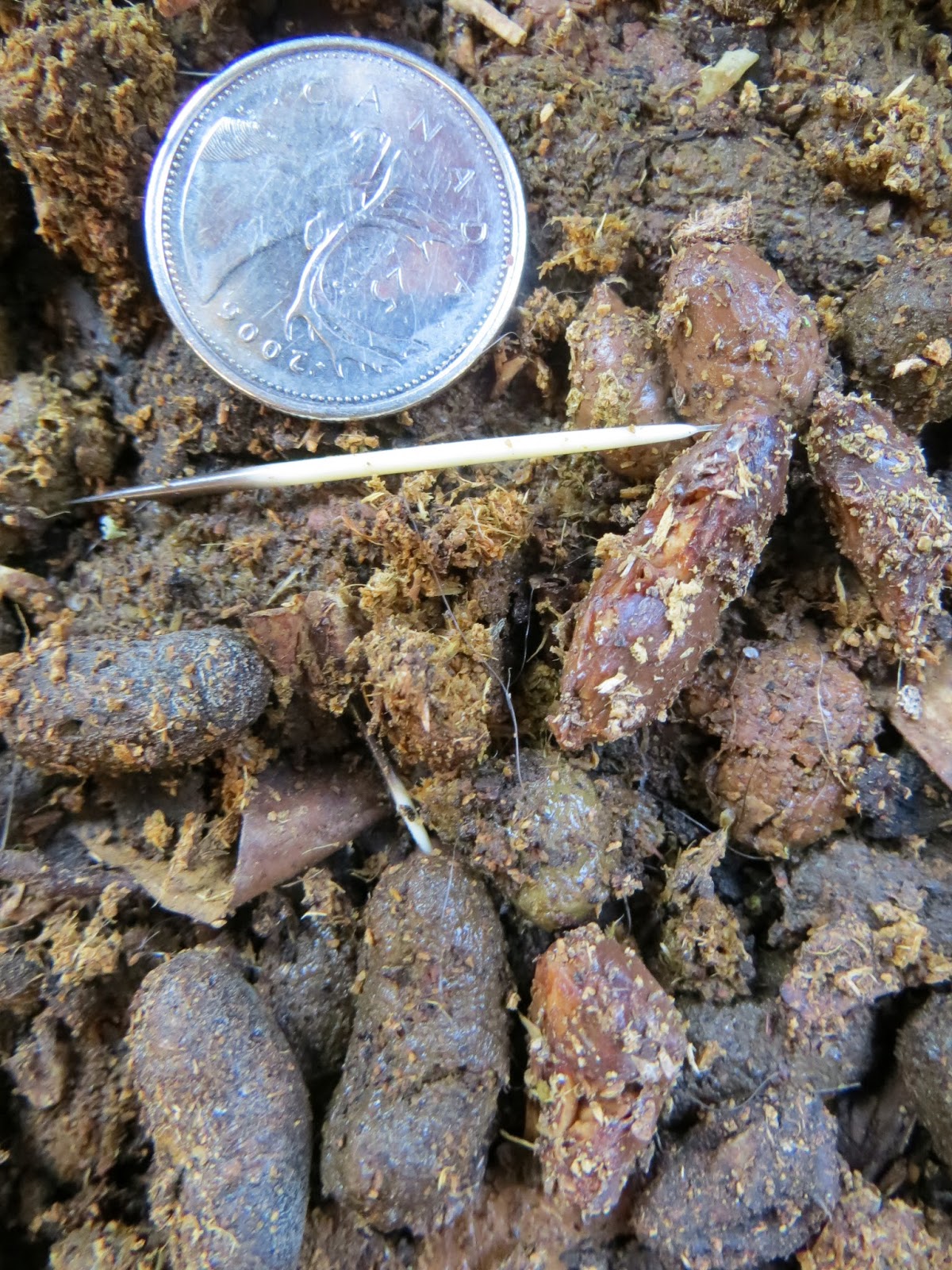
Porcupine scat and quill

Following the trails, we found an old porcupine den, piles of fresh raccoon scat, signs from various woodpeckers, flying squirrel scat, and half-eaten apples stashed up in tree limbs. As we worked our way to the apple trees, we saw various animals had been feeding on the huge abundance of fruit. We compared measurements of the incisor marks on some apples, discussed what was possibly eating them and debated what was likely the creature(s) that had left the marks on the specimens in our hands.

Red Squirrel incisor marks
As the day came to an end, we headed back North, slowly, along the Western edge of the field as the sun was beginning to make it's was to the other horizon. Once again, I am filled with gratitude and appreciation for the natural world, and the abundance of gifts, lessons and experiences Nature has to offer.


Always asking questions
Written By:  Lianna Vargas - 2nd Year Wildlife Tracking Apprentice

Tuesday, December 1, 2015

A Boyne River Valley Scat Rap


Sunday September 13, 2015
Written by Tamara Anderson
(With help from the Scat Rap, by A. Bennett, M. Keebler, R. Pemble, D. Elliott, and B. Jonas)
It starts with an “s” and it ends with a “t”. It comes out of you and it comes out of me. I know what you’re thinking, don’t call it that. Let’s be scientific and call it scat.
The tracking group met at an old dam and Grist Mill known as Ponton Mills in the Boyne river valley. We set a course northward to a big hill where a fisher’s tracks had been found the previous winter.  Ten degree weather and a forecast of rain added a chill to the morning.  Autumn had arrived in south-western Ontario.

Pausing to observe cedar roots wrapped around limestone, and crayfish under rocks, we clambered along the shore of the Boyne River.  The fragrant smell of mint filled our nostrils and we brushed by groves of horsetails. Old beaver chews and deer trails caught our attention. 

Left by the dozen in piles on the ground; Lots of little pellets are what you’ve found. They look like little chocolates so it is clear. This is the scat of a white tailed deer.

A deer popped up from her day bed while we admired fawn pellets.  She bounded across the river to our East.  We continued up the hill, discovering deer bones and following the course of a spring to its source.  Refreshing, cold water flowed out from the hillside. 

Animal-made switchback trails helped us climb up the steep valley slope.  At the top, there was a scat underneath a Black Cherry tree.    

Up on the hill, under a Black Cherry; Scat full of apple and purple berries. Late last night he was out with the moon; foraging in the forest, it was Mr. Raccoon.

The spruce plantation at the top of the hill revealed porcupine chews and more deer bones.  A logging trail led us to a rolling topography of maple trees.  A wood thrush sat on the forest floor watching us.  Alexis found an interesting limestone rock that had been hollowed out.  Had it been hollowed out by water or maybe by a human?
Tracks showed where a raccoon and a coyote had explored a muddy flat near the edge of the forest.  The forest opened into a clearing.  Deer beds were scattered around the open field.  Lianna found deer hair in one of the beds.  We hiked up to a lookout.  Northern Flickers had probed for ants on the steep hill.  We found an opened apple covered in ants in the middle of the trail.  Iwonder if the flicker placed the apple to attract a buffet of ants?

The hilltop overlooked the Boyne Valley.  Sharp-shinned hawks, Turkey Vultures, a Swan, Blue Jays and Northern Flickers performed aerial feats as we discussed the landscape, noting colourful pockets of different tree species.  On the way back to the car, we encountered a muskrat making trails in the marsh and dinner out of cattails.  

In closing,
Down the trail something’s lying on the ground; Nature’s Tootsie Roll all long and brown. Don’t wrinkle your nose, don’t lose your lunch. Break it apart, you might learn a bunch
:)

Written by Tamara Anderson - 2nd Year Earth Tracks Tracking Apprentice


Thursday, July 2, 2015

Tracking on the Sauble River


Sunday June 14th, 2015 - Story of the Day
 Written by Tamara Anderson


Bob Marley wrote, “Some people feel the rain and others just get wet.”  The rain reminds us of mindfulness - to live in the moment and welcome whatever it brings.  We were immersed in rain and mindfulness for most of Sunday’s outing to the Sauble River.  The Sauble River flows through Bruce and Grey County into Lake Huron.  The river was named “Rivière aux Saubles” or Sandy River by the French explorers in 1759.  I wonder if the local Saugeen First Nation has a different name for this river?

The maple forest revealed a few gems, like a brave garter snake.  The snake patiently let us hold him/her.  Beaver, coyote, raccoon and muskrat tracks were also spotted along the silty shoreline of the river.  Nearby, Alexis found an otter latrine site with a freshly killed garter snake.  Had the garter snake fallen out of the grasping talons of a bird of prey?  The otter scat contained scales from fish and the rusty-coloured remains of crayfish.  A Red-Eyed Vireo serenaded us once again while we ate lunch beside the river.  After lunch, we found Giant Hogweed, an invasive plant whose sap can cause intense blistering and even blindness.  Strangely enough, we noted deer browse on the tips of the Hogweed. Deer never cease to amaze me with their ability to eat noxious plants.  My impression of them as adrenaline-seeking risk takers continues to evolve. 


We were soon on a quest for Kingfisher holes after seeing a steep, sandy river bank on the south shoreline.  Success!  A square-looking hole was found near the top of the bluff.      The Belted Kingfisher excavates a nesting burrow that is two to three metres long in a vertical sand bank.  The blue and white lightning bird digs the tunnel with its beak and feet.  We wandered south towards a colourful, alvar-looking landscape.  Sandy trails revealed coyote scat and mystery tracks.   We debated the track-maker’s identity and finally resolved to call the animal a fox-walking raccoon.  A short drive to Sauble beach on Lake Huron completed the day.  In our closing circle, each person shared their focal species for the next 8 months.  Aster chose the beaver.  Sue is learning more about deer.  Miriam is also studying deer.  Luke is thinking about lagomorphs.  Alexis is going to learn more about the European hare.  I am choosing to focus on the black coyotes that live around my place.  Strangely, no one chose the fox-walking raccoon?

Wednesday, June 10, 2015

Spring Time Tracking at Mono Cliffs

Saturday, May 23, 2015 - Day 1

Mono Cliffs Provincial Park

Our group gathered into a circle under the shade of an old Sugar Maple at the edge of an open sunny field. We shared our goals, intentions and gratitude as we watched the wind blowing through the landscape, passing over the tall grasses and through the aspen/poplar leaves in a playful fashion. We watched a couple of Northern Harriers fly over the field, triggering a discussion on sexual dimorphism and hawk ID features, followed later by a Wild Turkey hen cautiously wandering out from her nest to feed.

After our sharing, we got up to prepare to head out into the field for our first day of tracking but right beside where we had been sitting, we noticed some really neat tent caterpillar webs on some young cherry trees! What type of cherry where they; black, choke or pin? We spoke a bit on how to tell cherry species from the shape, size and spacing of their flower clusters.

As we headed into the field, we looked back to our shady spot and saw just how much our own impressions on the land (where we had sat) resembled deer beds.
We didn't get more than 15 or 20 meters into the field before we stopped to look at some of our first animal sign. Alexis crouched down and pushed some grass aside, revealing a tiny trail carved into the ground underneath the tall grasses. He showed us a tiny piece of grass stalk cut on a 45 degree angle, indicating vole feeding sign. We spent the next while unveiling the intricate network of vole trails through the field. We wondered how large the territory range was for these tiny creatures, which according to Mark Elbroch, is 1/10 to 1 acre!
We saw plenty of large holes scattered over the field around some of the vole holes going down into the ground. Had someone like a fox or coyote been digging here to feed on the voles?

We stopped around a rock cropping looking for signs of weasel activity and talked about defining features of various local members of the weasel family.

Then we pushed towards the edge of the field along the tree line where we found some huge scars on the younger aspens from past deer antler rubbing. We stepped into the wooded area and began to travel along a deer trail that ran South, just a few feet into the forest. We took a look at some of the claw and teeth marks on various trees. Showing signs of porcupine and raccoons who had climbed these trees in the past.

We soon came to a spot where we noticed someone had been eating the trout lily greens. Who was the culprit, turkey, deer, rabbit? We took note that the greens were cut flat and sometimes slightly frayed. Then we found another clue, a hair that kinks when it is bent, indicating the eater's hair had a hollow core. A clear track then confirmed our suspicions.  White-Tail Deer.

We found some holes carved out of dead wood, triggering a lesson on how to differentiate between local woodpecker species from the signs. We were really able to bring home this lesson as theory was confirmed as we found examples in the field of signs from nearly each type of woodpecker throughout the course of the day!
In the afternoon, we made our way along some beautiful cliff ridges carved out around 11 000 years ago by some great glacier melts, providing breathtaking views of the valley below. We sat watching and listening to the birds together,  sighting some rose-breasted grosbeaks, red-eyed vireos, chickadees, turkey vultures, ravens and a few different warblers. We split up for some grounding sit-spot time long the cliffs before embarking on the descent back down towards our meeting point.

Throughout the remainder of the day, we wandered through the woods, talking about trees and plant ID, deer rutting behaviour, predators of ant hills, grouse vs wild turkey dust baths, what the deer have been eating and how to assess the age of forests based on the plants and trees growing there. It was truly a day full of many lessons, tying academic information in beautifully with experiential learning in the field.


Written by:  Lianna Vargas - 2nd year Tracking Apprentice


Monday, February 23, 2015

Reading the Stories in the Snow: Tracking Evaluation in Algonquin Park

I spent this past weekend at the Wildlife Research Station in Algonquin Park, standing around in below -20C temperatures, poring over indentations in the snow, snowed-in trails of all sizes, mysterious scrapes and holes in trees, pungent urine marks, and other clues of animal presence. I do this kind of thing for fun as often as I can, but this time I was participating in a Track and Sign Evaluation to test my skills. I've been working on tracking skills in a focused way for about two years now, perhaps peripherally for a year or two before that. I've written previously about what drew me to this learning, and why I find it so compelling and beautiful and important, both on this blog and at Sense of Story. And so you might know that for the past two years I've been involved in an apprenticeship program with Earth Tracks, spending many inspiring weekends hiking around forests, swamps, cliffs and fields in every possible kind of weather, learning about the ecology of this land that I live in and about the creatures who inhabit it with me. I've learned to measure, sketch tracks, journal, draw maps, do species research, observe weather patterns, and tease out the stories left behind on the land.
When the evaluation was first scheduled, I hesitated to sign up. I had some nerves and doubt and plenty of ego to untangle when I considered being put on the spot for my skills in this way, skills that seemed so emergent and fragile to me. I didn't know what it would look like and how it would feel to be required to move from wonder and speculation to firmly committing to an answer, my own answer, to each puzzle pointed out to me. What did I actually know? But specific goals are motivating, and risk is a powerful teacher.
Our humble but cozy accommodations.
So I found myself on a late January Friday bunking with three other women, fortunately all of them friends, in a tiny cabin in the woods of Algonquin Park. In between sleeping and evaluation time out in the field, our group of ten or so participants gathered together in the Director’s Cabin at the Wildlife Research Centre to warm up, cook our meals, and socialize.
One of my bunkmates, Tamara, had made up study notes for herself, and we lay in our beds on Friday evening as she read tidbits out loud by headlamp, all of us easing our nerves with raucous laughter.
The next morning, with feet already freezing from the cold cabin floors (note to self: bring slippers next time!), we gathered with snowshoes and notebooks to start the evaluation. George, the evaluator – who had come up from the U. S. – had scouted out some tracks and sign the day before. But nature is always in motion, and recently fallen snow and new tracks meant that many of the questions he ultimately gave us were spontaneously found or had already changed slightly by the time our group reached them. With each new track, trail or sign we might be asked: “Who made this?” “What gait is this?” “Which foot is this?” or the all encompassing “What happened here?” Ecology, habitat, behaviour, as well as our knowledge of track and trail patterns and typical animal sign all informed our answers. We moved from one set of tracks to another, each person taking as long as they needed to decide on an answer, although the bitter cold certainly encouraged closure. Our answers we gave one by one to George or to Alexis – who was assisting – either whispered or written in a notebook (my preference). The evaluator’s job was to hear our answer with a neutral face and record it.
Who made these tracks?
After each group of five or so questions, George took up the answers. Obviously, the evaluator’s tracking skills are put on the spot as well, and there is room for debate and the occasional question thrown out if there is too much disagreement (it is amazing, for example, how much snowed-over moose tracks and human tracks can look alike). After the first group of questions, I knew I would be fine, and I threw myself into the exuberant fun and adrenaline high of it all.
George and Alexis, practicing the poker face. George has an excellent frost beard.
Who made this Trail? 
As I knew, my weak point was bird, insect and mammal sign on trees. On the other hand, I had some strokes of luck, pulling an answer out of nowhere – certainly not from conscious memory – a few times and then discovering it was right. I was struck by how often a seemingly random guess can have a solid deductive process going on behind it. I loved what I learned about my instincts and my reasoning process, how good it felt to follow my intuitions on each question, and how often my mistakes came out of not doing so. I also loved dispensing with the need for measurement – measuring tools weren't allowed – and tuning into my love of patterns and context to summon my answers. I checked off correct and incorrect answers in my notebook, and although the answers are weighted for difficulty, making it difficult to calculate a score ahead of time, I could see as the weekend went on that I was mostly on a roll. I had told myself that what I wanted from the evaluation was a really great workshop – which it was – but I could see quickly that my competitive drive was kicking in.
Among what we saw in the snow were tracks and trails of pine marten, fisher, mink, river otter, short-tailed weasel, shrew, deer mouse or white-footed mouse, grouse, moose, white-tailed deer, red squirrel, red fox, and eastern wolf. On a range of trees, hydro poles and on one plywood shed were marks from black bear, porcupine, pileated woodpecker, and many other smaller creatures.
What happened here?
Our most intense moment was being led to a fresh moose carcass at the bottom of a slope on the side of the highway. The next few questions set the scene: Whose tracks were leading up to it? What did we see at the top of the hill? Was this all related? If so, how? It was potent and moving to visualize the scene of the hunt, what might have happened here and how. To place it within the statistics on wolf on moose predation in the park; to feel the agony of the moose’s death alongside gratitude for the role the wolves play in the health of their ecosystem. In the woods with senses wide open, you can’t avoid the cycle of life and death, its solid and fleshy reality, and the bigger knowledge that every living being, every possible nutrient, is eventually recycled and reabsorbed into others and into the Earth.
A beautiful otter trail.
I was grateful to have been part of this experience and process. Putting myself into a situation where I needed to decipher the clues on my own, to commit to answers and really trust my gut, and the excellent outcome that came out of this for me (Level III Track and Sign) gave me a huge boost of confidence in the skills I've built up over the past few years. The testing situation put a higher stake on using the knowledge I had in contrast to the more relaxed energy of tracking as naturalist learning. It connected me in a deeper way to the instincts my ancestors would have used, that I could still use, in a situation where tracking had a stake in survival. Reflecting on the experience in the week afterwards, I thought a lot about how to apply that intuition, that trust in myself, to other situations in my life. Like any experience where head, heart and body are engaged, it gifted me more than the sum of its parts.
Pine marten at the back window of the Wildlife Research Station. Photo by Lianna Vargas.
A week later, I’m driving up to Algonquin Park again, this time with the apprenticeship program, for a weekend of a different pace, which will be both more relaxed and more physically demanding. We’ll get onto some moose or wolf trails, read the patterns, immerse ourselves in the exhilaration of movement, observation and connection with the more-than-human world. I’m glad not to be tested this time, but I know I’ll bring the energy of last weekend forward into this one. And I suspect that when the evaluation comes around again next year, I will be keen to do it again.
Me, with my usual tracking grin.
Written By: Malgosia Halliop - 2nd Year Tracking Apprentice


Thursday, February 5, 2015

"Here kitty, kitty . . . . Wait - What's that Flesh?"

A study of animal Gaits
Story of the Day for Jan 18

On a snowy Sunday morning, after many icy kilometres, our little tracking crew found itself on the edge of the Kreug Forest. A great piece of land preserved through the years by the Kreug family and then donated as a preserve, some of us reminisced about beautiful native plants we had seen here in other seasons. But top of everyone's mind was the potential for bobcat! Twice over the past year there had been potential bobcat scat spotted on the scrubby edge of the wetland. Now, with snow all around, we were excited to see if we could find evidence of those beautiful tracks!

Snowshoeing through the cedars on the edge of a pond, there was lots of evidence of deer walking, feeding and sleeping. An old cedar stump held the claw marks of a squirrel and maybe a raccoon. Claw marks reminiscent of tiny hieroglyphics in an obscure forest language - hard to say how long they have stood there.

As we head out carefully across the ice (a foot went through on more than occasion that day:) ), we find an aged trail of what looks like a starfish? With splayed toes at all angles, and a regular rhythm, this animal had crossed the pond to the shore. Although difficult to see individual toes, the wild shape of these tracks could only be attributed to Ontario's only marsupial - Virginia Opossum!

What track pattern do you see here?
Sticking to brushy, covered edges of the wetland, we came to a crossing where multiple deer had gone from forest to forest, changing gaits in rapid succession as they crossed the open ice. The thin layer of slush on under the snow, provided great contrast for this in-depth analysis of cervid movement. After Saturday nights in-depth whiteboard studying, we were able to pick out an individual deer as it moved from a transverse gallop to a bound to a rotary gallop (the fastest gait I know of). Using the tracking text from Elbroch, we drew out fronts and hinds, and compared the lightning bolt shape of a transverse placement of feet to a rotary placement which is more C - shaped.

Picking up the pace to get out of our heads, we came across a tiny least weasel trail over the ice, so snowed in we couldn't count toes, but saw the characteristic 3x4 lope that this family loves. On land, a tiny ironwood sapling showed signs of fresh browse. On a little island in the snow, someone found what looked like a rib bone.

Porcupine Den Site
After lunch and snow fight with a conifer (wherein said tree suddenly dumped snow all over unsuspecting snacking adults), we headed towards some fresh porcupine chews. We found a little "snow plow" trail of the porcupine leading into an active den at the base of a beautiful old sugar maple.

What is that up there?
Our group dispersed a little amongst the open hardwoods and saw little shrew and potential short-tailed weasel trails. Wait - what is that? A little 2x2 loping trail with a tiny piece of scat? Ropy scat and little further down a piece of flesh? As we trailed this tiny predator, we found another and then another scrap of flesh. Under a log, over the snow, across the hill until it seemingly disappeared. The worn trail told of us the tiny weasel hunter who must patrol this patch of forest. Although he (presuming from track size) was not the cute and fluffy cat we had hoped for, we were all left with the wonder of this carnivorous creature . .

Written by Lee Earl - 2nd year Tracking Apprentice - (also certified  Level III Track and Sign!  Whoo-hoooo!)