Tuesday, December 1, 2015

A Boyne River Valley Scat Rap


Sunday September 13, 2015
Written by Tamara Anderson
(With help from the Scat Rap, by A. Bennett, M. Keebler, R. Pemble, D. Elliott, and B. Jonas)
It starts with an “s” and it ends with a “t”. It comes out of you and it comes out of me. I know what you’re thinking, don’t call it that. Let’s be scientific and call it scat.
The tracking group met at an old dam and Grist Mill known as Ponton Mills in the Boyne river valley. We set a course northward to a big hill where a fisher’s tracks had been found the previous winter.  Ten degree weather and a forecast of rain added a chill to the morning.  Autumn had arrived in south-western Ontario.

Pausing to observe cedar roots wrapped around limestone, and crayfish under rocks, we clambered along the shore of the Boyne River.  The fragrant smell of mint filled our nostrils and we brushed by groves of horsetails. Old beaver chews and deer trails caught our attention. 

Left by the dozen in piles on the ground; Lots of little pellets are what you’ve found. They look like little chocolates so it is clear. This is the scat of a white tailed deer.

A deer popped up from her day bed while we admired fawn pellets.  She bounded across the river to our East.  We continued up the hill, discovering deer bones and following the course of a spring to its source.  Refreshing, cold water flowed out from the hillside. 

Animal-made switchback trails helped us climb up the steep valley slope.  At the top, there was a scat underneath a Black Cherry tree.    

Up on the hill, under a Black Cherry; Scat full of apple and purple berries. Late last night he was out with the moon; foraging in the forest, it was Mr. Raccoon.

The spruce plantation at the top of the hill revealed porcupine chews and more deer bones.  A logging trail led us to a rolling topography of maple trees.  A wood thrush sat on the forest floor watching us.  Alexis found an interesting limestone rock that had been hollowed out.  Had it been hollowed out by water or maybe by a human?
Tracks showed where a raccoon and a coyote had explored a muddy flat near the edge of the forest.  The forest opened into a clearing.  Deer beds were scattered around the open field.  Lianna found deer hair in one of the beds.  We hiked up to a lookout.  Northern Flickers had probed for ants on the steep hill.  We found an opened apple covered in ants in the middle of the trail.  Iwonder if the flicker placed the apple to attract a buffet of ants?

The hilltop overlooked the Boyne Valley.  Sharp-shinned hawks, Turkey Vultures, a Swan, Blue Jays and Northern Flickers performed aerial feats as we discussed the landscape, noting colourful pockets of different tree species.  On the way back to the car, we encountered a muskrat making trails in the marsh and dinner out of cattails.  

In closing,
Down the trail something’s lying on the ground; Nature’s Tootsie Roll all long and brown. Don’t wrinkle your nose, don’t lose your lunch. Break it apart, you might learn a bunch
:)

Written by Tamara Anderson - 2nd Year Earth Tracks Tracking Apprentice


Thursday, October 1, 2015

Tracking in Algonquin - Part 2


First thing in the morning, we recapped on the harvest of yesterday's exploration, reviewing on a map where we had come across some of our favourite discoveries.

We headed out for the day and stopped at a bent and broken chokecherry tree that Alexis pointed out, asking us what we noticed about this tree. We saw all the cherries had been picked off the tree and following some looking around, we noticed bear claw marks on the trunk of the tree, and how the branches had been broken. We had suspected the pits in the bear scat from yesterday, had possibly been cherries, but now we had proof!

The remains of a calf moose
We then headed down to the water and canoed out to a point of interest where half of the group had come across the remains of a moose calf the following evening on our return back to camp. We checked out the site, finding many chewed up bones scattered around the area. The area was filled with tons of wolf activity, mossy ground and the trail of a mourning mother moose. We scouted around and spent most of the day following bear trails, looking, feeling and measuring the tracks we were following.
Wolf Chew
Later we cracked open a bone to investigate what had been going on with the moose calf through assessing it's bone marrow– had it starved to death? had it died of disease? It was a little too late to tell, but the inside of the bone did have a surprise for us!

Maggot feeding on Marrow!
Bear Bite marks
Alexis then had us try an awareness exercise – envisioning the animals through sensory touch of the tracks, which proved a potent experience to many in the group. We shared our experience as we canoed back. Once back at the rendezvous site, we checked out some moose bones the park researchers had gathered, a good opportunity for comparing them with the ones of the calf we had seen earlier. After checking out some signs of porcupines eating plywood and taking a look at some fresh territorial bear markings on a hydro pole, we finished the day with a quiet sit spot out on the land.

Feeling the Tracks

Getting down on a bear trail!


 At the end of the weekend, I was filled with a whole new pile of information to let sink in and a deep sense of amazement and gratitude for the depth and experience of life.

Sunday, August 30, 2015 - Written by:  Lianna Vargas - 2nd year Tracking Apprentice

Tracking Algonquin Wildlife

Saturday, August 29, 2015
Written by Tamara Anderson - 2nd Year Tracking Apprentice


 There are forty seven species of mammals that call Algonquin Park “home”.  The world-renowned park includes 7,725 square km of mixed coniferous and deciduous forest.  On our latest tracking weekend, we observed the tracks and sign of Algonquin wildlife living along the shores of Lake Sasejewun near the Wildlife Research Centre.


Saturday morning was overcast as we made our way to the canoe launch.  A stop near the dam revealed Northern Flicker tracks in pursuit of ants along the dusty road.  A pile of black bear scat presented our first mystery.  There were large seeds in the bear scat.  What was the bear eating?  The answer would reveal itself (with Alexis’ help) the next day. 

We followed the bear’s trail to the edge of the lake and noted that the bear had grazed on sedges along the course of his/her travels.  Being the Park’s largest mammal, male black bears generally weigh between 70 and 150kg and females weigh between 45 and 70kg.
Bear feeding on sedges

We boarded the canoes and headed west across the lake.  The group paused along the opposite shore as Tamara and Rhonda made a quick dash across the lake to return a leaky vessel.  These sink-chronistic circumstances proved serendipitous as the shoreline revealed a formidable bear bite on a pine tree, a bear trail through soft moss, grouse scat (fibrous and cecal), snowshoe hare sign and a myriad of moose and white-tailed deer trails. 

After lunch in the boats, we journeyed to the Northwest corner of the lake where Luke and Sue had seen a moose named “Misty” the night before.  Along this shoreline, we discovered wolf tracks and a beaver lodge that had been marked with skunky urine by a fox.  Nearby, Lianna and Tamara noticed that a red squirrel had cached piles of balsam fir cones beside purple mushrooms.  Prepare yourself for a challenging tongue twister; Did the squirrel purposefully place the purple-coloured cones beside the purple mushroom?  Did she intend to camouflage the cones or perhaps organize a “balanced mushroom and cone on the cob” meal for another day?

Bear Cub Track
Other highlights of the afternoon included seeing a bear cub track beside a beaver-chewed birch tree.  A mama bear track was nearby. Everyone had a chance to jump on a fresh bear or moose trail or take time for a sit spot.  Alexis pointed out Rattlesnake plantain, one of Ontario’s orchids.  Rhonda found the bottom of a beaver skull.  A mystery brown snake appeared and went down a hole.  What are the ID characteristics of a red-bellied snake versus a brown snake without seeing the belly?  Or could it be a young Garter Snake?
On the paddle back to the station, we found the bones of a moose calf on the shore and signs of wolf feeding and rolling.  We learned that the wolves took five days to find the dead moose calf and two days to eat it.  This led to questions about how many wolves are in the park and where is the nearest rendezvous site?

Rattlesnake Plantain
The next day, Alexis showed us a chokecherry tree near the bear scat that had been pulled down.  Bear claw marks were evident on the bark.  Most of the chokecherries had been eaten, except for a few left on the branches.  We opened one up and found the matching mystery seed that had been in the bear scat.  It was a berry good find.  Bear with me as I close this story of the day with one more pun; I hope that you found this write-up amoosingJ


The Spirit of Plants

The Spirit of Plants

Our August plants apprenticeship weekend took us deeper into some questions we had dipped into in previous months, questions on engaging with the spiritual aspects of the plant world, and exploring how we could tune into understanding the gifts that plants bring to us with our hearts and intuitions, as well as our minds and hands.

The energy of the weekend was quiet and receptive, quite different from our previous weekends of adventurous exploring, meeting plants in new locations, researching species, and working with ethically-harvested wild plants and farmed plants in medicinal and culinary ways. This time we stayed on site at the home of Earth Tracks and Rebel Roots Herb Farm, and spent much of our two days under a large black walnut tree that sheltered us against the bright August sun.

The weekend was primarily composed of a series of deepening meditations that worked on our abilities to open up to intuition and deeply listen to the energies of the living beings all around us. We were encouraged to keep our minds and hearts open to visualize, imagine, dream, find metaphors, listen to our inner voices, and engage in the unseen world in whatever way worked for each of us. We made space to speak of our personal experiences of the sacred, and a container of trust and respect was created that honoured each participant’s individual beliefs and experiences.
 
To set the tone and bring us into a quieter frame of awareness and connection, we wove in elements of ceremony and ritual into the weekend.  Alexis incorporated some good context on the lineage of the rituals we were using, and we had opportunities for questions and dialogue on how to incorporate ceremony into our own lives in ways that felt authentic to each of us.

Along with group meditations, we had time to sit individually with plants and trees on the landscape to deepen our relationships with them, as well as to practice meditation and visualization techniques on our own. We spoke of dreams and how to find meaning in them – in a personal, intuitive, non-formulaic way - to help guide us in waking life, and we learned a useful word-association exercise for dream recall and interpretation. We also did a number of playful paired and group exercises on reading energy from each other, from plants, and from objects that we were deeply connected to.

The atmosphere of the weekend was open, exploratory, curious and connecting.
It was also nourishing and relaxed. And above all, it introduced us to a set of approaches, tools and possibilities for engaging with the natural world through spirit, and engaging with spirit through the natural world.


Written By: Malgosia Halliop - 2nd Year Plants Apprentice


Sunday, August 16, 2015

Medicinal Plants Walk with Laura and Alexis –and a special plant!

 On Sunday July 19th, we left the Rebel Roots Herb Farm land and headed
to the Krug Forest, a beautifully preserved tract of land near
Dornoch, Ontario.
Introducing us to the many medicinal plants we saw today was Alexis
Burnett, head instructor of Earth Tracks and guest instructor, Laura
Gilmour of Wild Muskoka Botanicals.

We stopped along the edge of a wetland and found many plants and
creatures along the way. Blue Flag Iris and Boneset grew near the
marsh along with many Cattails.  As we discussed harvesting the pollen
of the cattails we spotted a frog. This wasn’t just a regular frog but
was two-toned! The frog was half blue and half grey-brown and was
patient with us and let us photograph and look at kin.

We found a rarer Skullcap flower and learned about it’s medicinal
properties and then found both False and True Solomon’s Seal right
next to each other.  We had a thoughtful discussion about these two
plants, including their roots, young shoots and their berries-a
grizzly bear’s favourite fruit.

Another wetland along the trail had bright red Cardinal Flowers, so
tall and stately and the brightest, deep red you have ever seen.  One
of the most beautiful of our local wildflowers, at least according to
this apprentice!  You can also see a picture of White Snakeroot, a
plant that has many healing properties but is also quite toxic.  It
can affect humans who eat the plant, but is also transmitted from the
milk of cows that consume the plant!

After a lunch off-trail, we changed gears.  We did a quiet walk
through the forest in fox walk and owl eyes.  Walking separately but
in a line, we had a neat experience of feeling the forest with our
feet, hearing the sounds, and smelling all the scents on the breeze.
After the walk we each found quiet spot and did a sit spot with a
particular plant. We connected with the plant while at our quiet spot,
with the intention of learning what we can from kin. We each harvested
a few leaves from our plant and put them in a cup with some boiling
water to make a tea.  We spent quiet time with our tea as we drank it,
and then gathered together to share our experience.

Walking back, we caught sight of a baby raccoon in a tree that we had
passed in the morning.  This time, ki was having an afternoon nap and
didn’t even notice us pass underneath kin!

*As per Robin Wall Kimmerer’s article, the pronouns for animals have
been changed, instead of “he” or “she” I’ve used “ki” and instead of
“him” or “her” I’ve used “kin”.
http://www.theecologist.org/blogs_and_comments/commentators/2842875/living_beings_as_our_kith_and_kin_we_need_a_new_pronoun_for_nature.html


Written by:  Alex Thomson - 2nd year Wild Plants Apprentice

Tuesday, August 11, 2015

Thistles, Bitters and Life's Simple Pleasures


Saturday July 18 2015 - Varney, Ontario

It was a beautiful mid-summer morning in July, and we plant apprentices were getting ready to learn about medicinal plants. Weaving a thread through from last weekend of stewardship though, we started by going out to sit with some of the amazing medicinal plants that we had planted over a month ago. The changes were staggering, as I went to sit by a beautiful milk thistle that grown over four feet since I had last seen it. With white and green spotted leaves that spiralled where attaching to the stem, and a bright purple blossom facing this sky - the milk thistle was a sight to behold. Some others sat with astragalus or hops or calendula, reflecting upon the growth of plants, the bounty of summer, and the beauty of sitting still. After some time, we gathered together to share a few quick reflections before jumping into a session with special guest - Laura Gilmour!
 
Crafting a bitters formula to help with digestion, we discussed all the cultural food practices that would allow for invisible bitters, like eating bitter salad greens or certain pickles to prime our digestive tracts in advance of meals.  True bitters are the best way to "tell digestion to take up the challenge of the food we are about to eat".  There are even sneaky ways to incorporate bitters into meals like having a bitter aperitif to toast with before a holiday meal! 
We followed a rough formula to blend our own special bitters formula
Bitters
- 10% Super bitter (ex. gentian root)
- 30-50% Mild to medium bitters (ex. chamomile)
- 30% Aromatic (ex. cardamom)
- 10% Harmonizer or catalyst (ex. licorice root)

After blending our own unique bitters formula that included some great plant tinctures like angelica, tulsi basil and dandelion root, we were all excited and ready for lunch and a fruit full picnic on the lawn commenced!

After lunch, we split our group of 17 into two rotations of some tasting and making activities. Alexis led us through the process of making a healing oil which was infused with St John's Wort and then a cold and flu tincture made with yarrow, elderflower and peppermint. It's hard to imagine on a hot summer's day that in the deep of winter, you may have a rattling cough that needs that tincture - o the changing seasons!

After looking into St John's Wort more mythical properties - like it can help guard your soul from phantasms! - we made some plant journals on the SJW.

Leaving our semi-finished homework behind, we worked with Laura Gilmour, an amazing community herbalist, naturalist and small business owner of Wild Muskoka Botanicals, to learn about flavours and tastes and how that can tell us about the properties of the herbs. We tasted hot horseradish, and yummy, sweet astragalus and salty nettles. Depending on your body's inclinations and the type of condition you may have, we played around with the types of flavours and remedies that could help. The highlight was definitely nibbling on Schisandra berries - the five-flavoured fruit! So wild to have every flavour in your mouth!

As the more official workshops wound down, we celebrated our medicinal plants weekend by sharing a delicious potluck meal with salads, meats, cheeses and so much more - only to top off the evening with a cocktail party! Although cocktail tinctures really are for fun rather than medicine, everyone definitely felt great!


Written by:  Lee Earl 2nd Year Wild Plants Apprentice

The Wisdom of the Marks

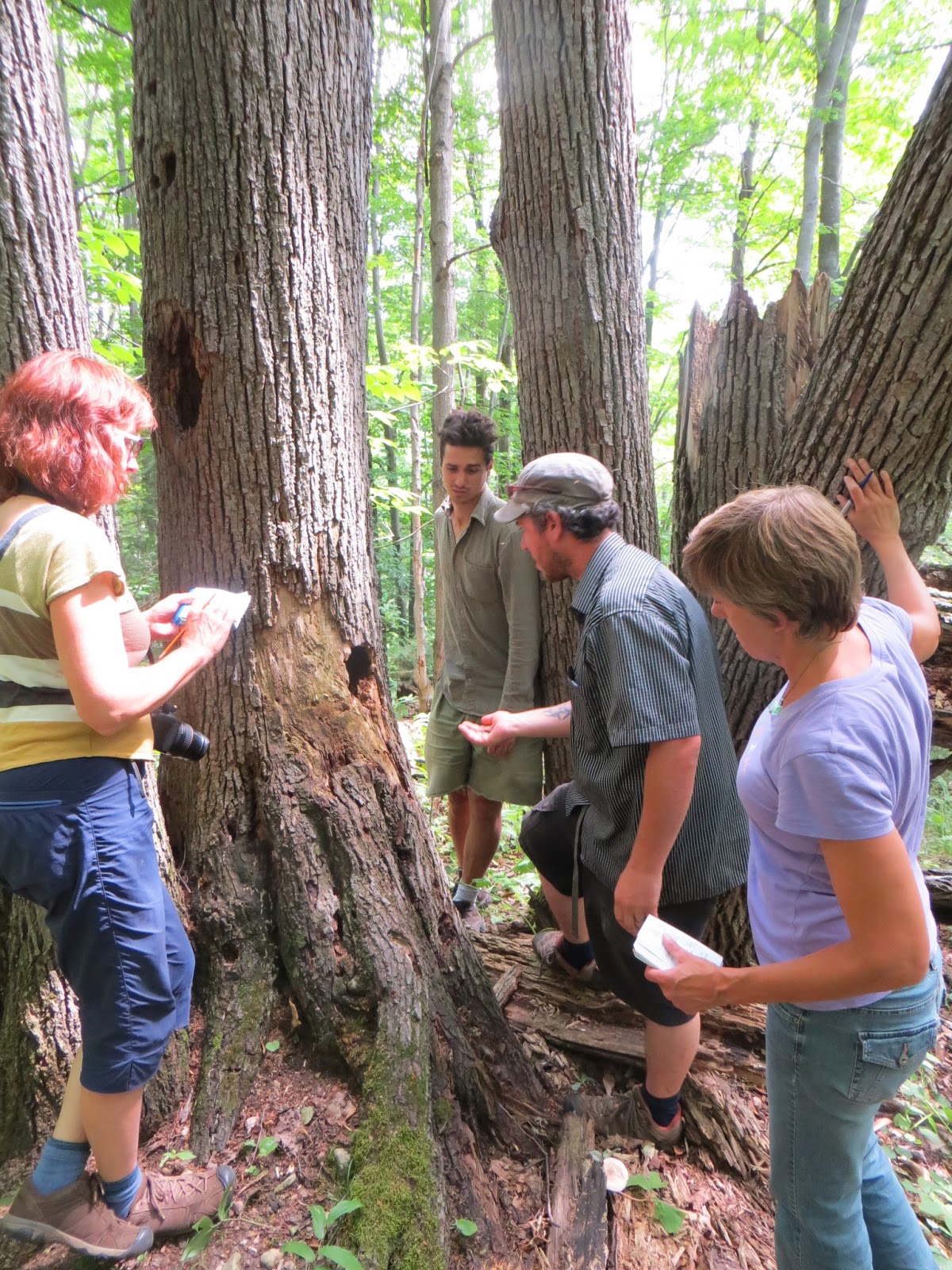
The site of a porcupine, raccoon and flying squirrel holes in this big old Basswood tree


Saturday and Sunday, July 26th, 2015
Written by Tamara Anderson - 2nd year Tracking Apprentice

In his book Nature Observation and Tracking, Tom Brown Jr. writes; “The earth tries to be flat.” He was referring to how weather and gravity “conspire to erase tracks”.  This past July, the tracking apprentices observed the subtle traces of summer tracks at Allan Park near Durham. We also created tracks and signs at Alexis’ house and watched how they changed over two days.  Lately, I have been tracking the landscape just as much as I have been following the footprints of animals.  Approximately 10,000 years ago, a receding glacier scraped the surface of the land that is now Allan Park and deposited material from the Canadian Shield.  Some of the material was ground into sand, silt and clay. A huge chunk of ice from the glacier dropped onto the landscape and a kettle lake was formed.  Allan Park is part of the Horseshoe Moraine. It includes a trail system that reaches an elevation of 30 metres in some places. 

Fawn Tracks
On Saturday, we wandered the rolling, forested pine, spruce and cedar hills beside the glacier-made trout pond.  The sandy edge of the pond revealed the opened shells of snapping turtle eggs.  This prompted a few questions:  How does temperature affect turtle egg incubation? Do predators leave different signs when they predate turtle nests?  I learned that the “J” shape of the Jack pine cone is a helpful way to remember the cone-makers identity.  Sue asked about whether any local species of rats are native to North America and which snakes have live birth?

Watching Tracks Age
On Sunday morning we were enchanted by the purling rattle of a Sandhill crane in a field near Alexis and Bobbi’s place.  Sandhill Cranes beckon my attention in an ancient way. After reading about Sandhill cranes, I discovered that they are the oldest known surviving North American bird species.  That morning, we returned to Allan Park and found a trail on a steep hill that led to different interpretations.  It is amazing how the track of a sliding deer can look similar to the five toes of a barefoot, feral child;)  After following a doe and her fawn’s tracks along a sun-baked, sandy trail, we ventured into a cool, deciduous forest of Hickory, Basswood and Maple.  The tracking apprentices used tracking sticks to track each other in leafy debris.  Luke and Miriam discovered a vole tunnel and burrow network at the forest edge.  We lightheartedly discussed how best to classify this trail.  If vole trails under the snow are called “subnivean” then would this trail under the leaf-litter be called sub-humusean?  We also wondered whether the trail was from a red-backed or a meadow vole.  Do meadow voles occasionally lives in forests?  What is the range of the red-backed vole? Alexis located a flying squirrel latrine in a basswood tree. Flying squirrel scat accumulates in areas where the squirrels nest and cache food. The scat often flows out of tree cavities, low to the ground. 

I will end this post with a continuation of Tom Brown’s tracker wisdom; “There is hardly a square foot of ground that is absolutely flat. Every depression, every bump, every fissure, and every scratch on the landscape was made by something. Whether it was made by a rabbit, mouse, bulldozer, fish, frog, or volcano, it is the tracker’s job to notice and interpret it.” (Tom Brown Jr., Nature Observation and Tracking)