Showing posts with label Mentoring. Show all posts

Monday, December 7, 2015

The Twelve Gifts of Tracking


Porcupine Mandibles
 The rolling hills and drumlins of the Bruce Trail inspired this seasonal story of the day:

On the 6th Day of December, my tracking friends shared with me…
Twelve apples cached by squirrels (munched on by rodents, rabbit, deer and grouse)
Eleven animal trails (some serious) made by deer, rabbit, porcupine and raccoons.
Ten deer beds, scrapes and antler rubs.
Nine piles of deer, coyote, raccoon, porcupine and squirrel scat.
Red Squirrel Cache
Eight animal homes lived in by fox, groundhog, red squirrel, porcupine and sparrows.
Seven raven calls above a coyote’s resting place by the creek.
Six pine grosbeaks.
Five mandibles (from porcupine, coyote and meadow vole)
Four gulleys (landforms* and one named Sue)
Three rodent-chewed deer bones
Two grouse exploding into flight (and two ginger chocolate squares)
…and a porcupine in a hemlock tree.

*a water-worn ravine


By Tamara Anderson - 2nd year Tracking Apprentice

Tuesday, December 1, 2015

A Boyne River Valley Scat Rap


Sunday September 13, 2015
Written by Tamara Anderson
(With help from the Scat Rap, by A. Bennett, M. Keebler, R. Pemble, D. Elliott, and B. Jonas)
It starts with an “s” and it ends with a “t”. It comes out of you and it comes out of me. I know what you’re thinking, don’t call it that. Let’s be scientific and call it scat.
The tracking group met at an old dam and Grist Mill known as Ponton Mills in the Boyne river valley. We set a course northward to a big hill where a fisher’s tracks had been found the previous winter.  Ten degree weather and a forecast of rain added a chill to the morning.  Autumn had arrived in south-western Ontario.

Pausing to observe cedar roots wrapped around limestone, and crayfish under rocks, we clambered along the shore of the Boyne River.  The fragrant smell of mint filled our nostrils and we brushed by groves of horsetails. Old beaver chews and deer trails caught our attention. 

Left by the dozen in piles on the ground; Lots of little pellets are what you’ve found. They look like little chocolates so it is clear. This is the scat of a white tailed deer.

A deer popped up from her day bed while we admired fawn pellets.  She bounded across the river to our East.  We continued up the hill, discovering deer bones and following the course of a spring to its source.  Refreshing, cold water flowed out from the hillside. 

Animal-made switchback trails helped us climb up the steep valley slope.  At the top, there was a scat underneath a Black Cherry tree.    

Up on the hill, under a Black Cherry; Scat full of apple and purple berries. Late last night he was out with the moon; foraging in the forest, it was Mr. Raccoon.

The spruce plantation at the top of the hill revealed porcupine chews and more deer bones.  A logging trail led us to a rolling topography of maple trees.  A wood thrush sat on the forest floor watching us.  Alexis found an interesting limestone rock that had been hollowed out.  Had it been hollowed out by water or maybe by a human?
Tracks showed where a raccoon and a coyote had explored a muddy flat near the edge of the forest.  The forest opened into a clearing.  Deer beds were scattered around the open field.  Lianna found deer hair in one of the beds.  We hiked up to a lookout.  Northern Flickers had probed for ants on the steep hill.  We found an opened apple covered in ants in the middle of the trail.  Iwonder if the flicker placed the apple to attract a buffet of ants?

The hilltop overlooked the Boyne Valley.  Sharp-shinned hawks, Turkey Vultures, a Swan, Blue Jays and Northern Flickers performed aerial feats as we discussed the landscape, noting colourful pockets of different tree species.  On the way back to the car, we encountered a muskrat making trails in the marsh and dinner out of cattails.  

In closing,
Down the trail something’s lying on the ground; Nature’s Tootsie Roll all long and brown. Don’t wrinkle your nose, don’t lose your lunch. Break it apart, you might learn a bunch
:)

Written by Tamara Anderson - 2nd Year Earth Tracks Tracking Apprentice


Thursday, October 1, 2015

Tracking in Algonquin - Part 2


First thing in the morning, we recapped on the harvest of yesterday's exploration, reviewing on a map where we had come across some of our favourite discoveries.

We headed out for the day and stopped at a bent and broken chokecherry tree that Alexis pointed out, asking us what we noticed about this tree. We saw all the cherries had been picked off the tree and following some looking around, we noticed bear claw marks on the trunk of the tree, and how the branches had been broken. We had suspected the pits in the bear scat from yesterday, had possibly been cherries, but now we had proof!

The remains of a calf moose
We then headed down to the water and canoed out to a point of interest where half of the group had come across the remains of a moose calf the following evening on our return back to camp. We checked out the site, finding many chewed up bones scattered around the area. The area was filled with tons of wolf activity, mossy ground and the trail of a mourning mother moose. We scouted around and spent most of the day following bear trails, looking, feeling and measuring the tracks we were following.
Wolf Chew
Later we cracked open a bone to investigate what had been going on with the moose calf through assessing it's bone marrow– had it starved to death? had it died of disease? It was a little too late to tell, but the inside of the bone did have a surprise for us!

Maggot feeding on Marrow!
Bear Bite marks
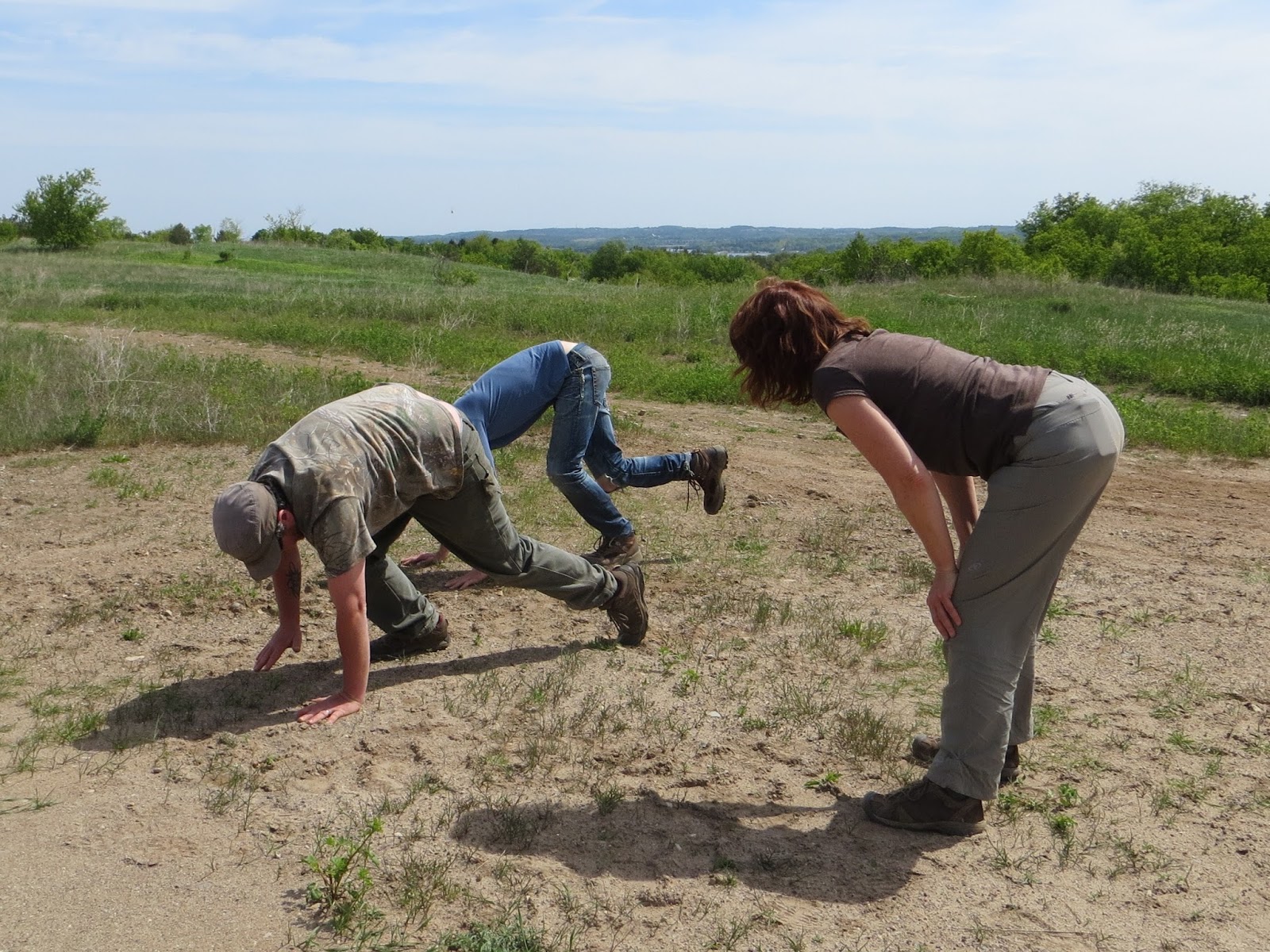
Alexis then had us try an awareness exercise – envisioning the animals through sensory touch of the tracks, which proved a potent experience to many in the group. We shared our experience as we canoed back. Once back at the rendezvous site, we checked out some moose bones the park researchers had gathered, a good opportunity for comparing them with the ones of the calf we had seen earlier. After checking out some signs of porcupines eating plywood and taking a look at some fresh territorial bear markings on a hydro pole, we finished the day with a quiet sit spot out on the land.

Feeling the Tracks

Getting down on a bear trail!


 At the end of the weekend, I was filled with a whole new pile of information to let sink in and a deep sense of amazement and gratitude for the depth and experience of life.

Sunday, August 30, 2015 - Written by:  Lianna Vargas - 2nd year Tracking Apprentice

Sunday, August 16, 2015

Medicinal Plants Walk with Laura and Alexis –and a special plant!

 On Sunday July 19th, we left the Rebel Roots Herb Farm land and headed
to the Krug Forest, a beautifully preserved tract of land near
Dornoch, Ontario.
Introducing us to the many medicinal plants we saw today was Alexis
Burnett, head instructor of Earth Tracks and guest instructor, Laura
Gilmour of Wild Muskoka Botanicals.

We stopped along the edge of a wetland and found many plants and
creatures along the way. Blue Flag Iris and Boneset grew near the
marsh along with many Cattails.  As we discussed harvesting the pollen
of the cattails we spotted a frog. This wasn’t just a regular frog but
was two-toned! The frog was half blue and half grey-brown and was
patient with us and let us photograph and look at kin.

We found a rarer Skullcap flower and learned about it’s medicinal
properties and then found both False and True Solomon’s Seal right
next to each other.  We had a thoughtful discussion about these two
plants, including their roots, young shoots and their berries-a
grizzly bear’s favourite fruit.

Another wetland along the trail had bright red Cardinal Flowers, so
tall and stately and the brightest, deep red you have ever seen.  One
of the most beautiful of our local wildflowers, at least according to
this apprentice!  You can also see a picture of White Snakeroot, a
plant that has many healing properties but is also quite toxic.  It
can affect humans who eat the plant, but is also transmitted from the
milk of cows that consume the plant!

After a lunch off-trail, we changed gears.  We did a quiet walk
through the forest in fox walk and owl eyes.  Walking separately but
in a line, we had a neat experience of feeling the forest with our
feet, hearing the sounds, and smelling all the scents on the breeze.
After the walk we each found quiet spot and did a sit spot with a
particular plant. We connected with the plant while at our quiet spot,
with the intention of learning what we can from kin. We each harvested
a few leaves from our plant and put them in a cup with some boiling
water to make a tea.  We spent quiet time with our tea as we drank it,
and then gathered together to share our experience.

Walking back, we caught sight of a baby raccoon in a tree that we had
passed in the morning.  This time, ki was having an afternoon nap and
didn’t even notice us pass underneath kin!

*As per Robin Wall Kimmerer’s article, the pronouns for animals have
been changed, instead of “he” or “she” I’ve used “ki” and instead of
“him” or “her” I’ve used “kin”.
http://www.theecologist.org/blogs_and_comments/commentators/2842875/living_beings_as_our_kith_and_kin_we_need_a_new_pronoun_for_nature.html


Written by:  Alex Thomson - 2nd year Wild Plants Apprentice

Tuesday, August 11, 2015

The Wisdom of the Marks

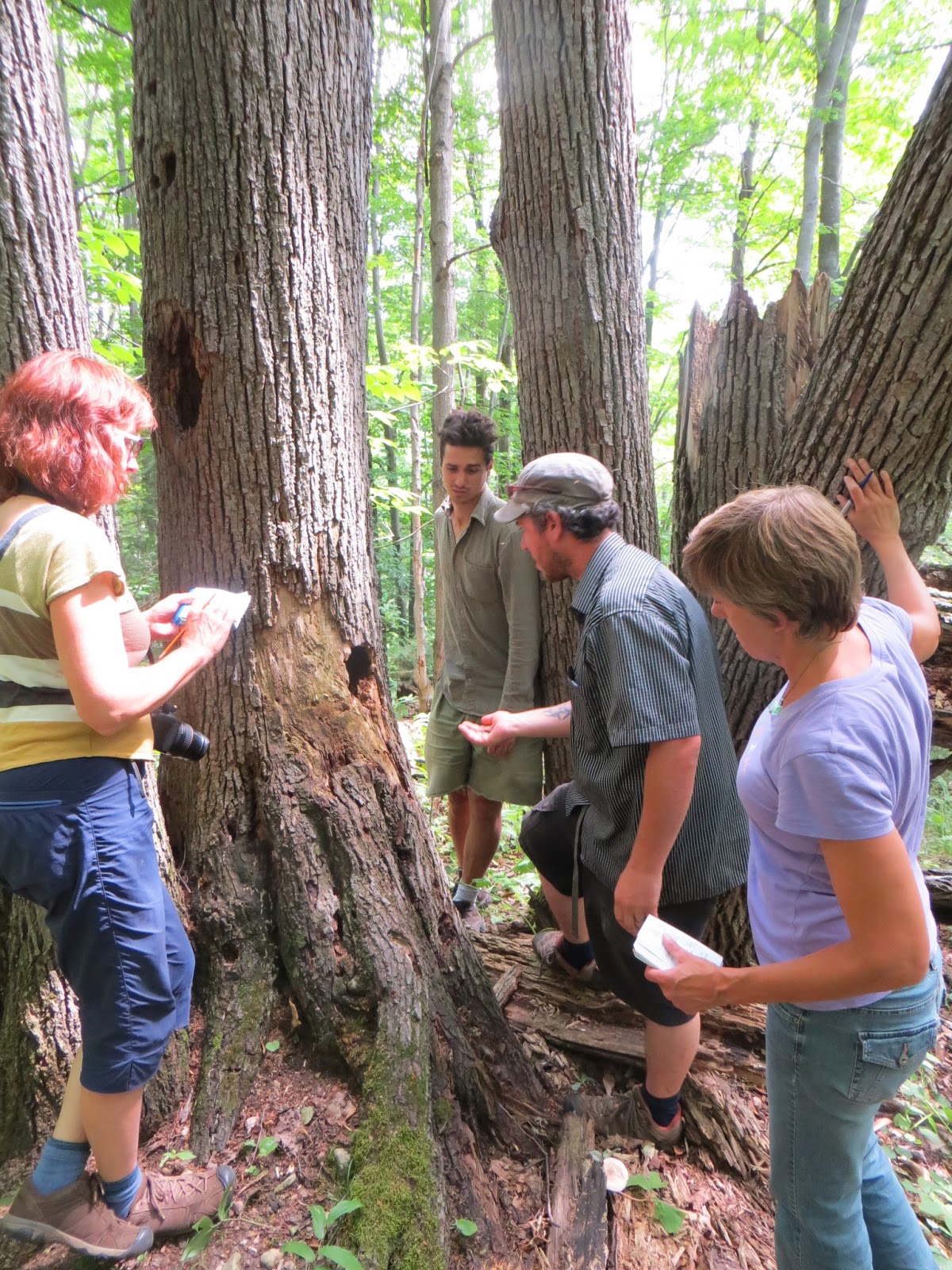
The site of a porcupine, raccoon and flying squirrel holes in this big old Basswood tree


Saturday and Sunday, July 26th, 2015
Written by Tamara Anderson - 2nd year Tracking Apprentice

In his book Nature Observation and Tracking, Tom Brown Jr. writes; “The earth tries to be flat.” He was referring to how weather and gravity “conspire to erase tracks”.  This past July, the tracking apprentices observed the subtle traces of summer tracks at Allan Park near Durham. We also created tracks and signs at Alexis’ house and watched how they changed over two days.  Lately, I have been tracking the landscape just as much as I have been following the footprints of animals.  Approximately 10,000 years ago, a receding glacier scraped the surface of the land that is now Allan Park and deposited material from the Canadian Shield.  Some of the material was ground into sand, silt and clay. A huge chunk of ice from the glacier dropped onto the landscape and a kettle lake was formed.  Allan Park is part of the Horseshoe Moraine. It includes a trail system that reaches an elevation of 30 metres in some places. 

Fawn Tracks
On Saturday, we wandered the rolling, forested pine, spruce and cedar hills beside the glacier-made trout pond.  The sandy edge of the pond revealed the opened shells of snapping turtle eggs.  This prompted a few questions:  How does temperature affect turtle egg incubation? Do predators leave different signs when they predate turtle nests?  I learned that the “J” shape of the Jack pine cone is a helpful way to remember the cone-makers identity.  Sue asked about whether any local species of rats are native to North America and which snakes have live birth?

Watching Tracks Age
On Sunday morning we were enchanted by the purling rattle of a Sandhill crane in a field near Alexis and Bobbi’s place.  Sandhill Cranes beckon my attention in an ancient way. After reading about Sandhill cranes, I discovered that they are the oldest known surviving North American bird species.  That morning, we returned to Allan Park and found a trail on a steep hill that led to different interpretations.  It is amazing how the track of a sliding deer can look similar to the five toes of a barefoot, feral child;)  After following a doe and her fawn’s tracks along a sun-baked, sandy trail, we ventured into a cool, deciduous forest of Hickory, Basswood and Maple.  The tracking apprentices used tracking sticks to track each other in leafy debris.  Luke and Miriam discovered a vole tunnel and burrow network at the forest edge.  We lightheartedly discussed how best to classify this trail.  If vole trails under the snow are called “subnivean” then would this trail under the leaf-litter be called sub-humusean?  We also wondered whether the trail was from a red-backed or a meadow vole.  Do meadow voles occasionally lives in forests?  What is the range of the red-backed vole? Alexis located a flying squirrel latrine in a basswood tree. Flying squirrel scat accumulates in areas where the squirrels nest and cache food. The scat often flows out of tree cavities, low to the ground. 

I will end this post with a continuation of Tom Brown’s tracker wisdom; “There is hardly a square foot of ground that is absolutely flat. Every depression, every bump, every fissure, and every scratch on the landscape was made by something. Whether it was made by a rabbit, mouse, bulldozer, fish, frog, or volcano, it is the tracker’s job to notice and interpret it.” (Tom Brown Jr., Nature Observation and Tracking)

Friday, July 24, 2015

Caretaking and Land Stewardship for Future Generations

Friday was a day of stewardship and caretaking on the new Earth Tracks land. 

Getting our hands into the dirt was the priority for the morning.  We each researched a herb that had been brought up in the Rebel Roots greenhouse to learn about its medicinal qualities and where it might grow best.  With flats of classics like nettle, calendula and chamomile we put a lot of seedlings into the ground. There were also some heritage tobacco plants and a strong vermifuge called wormwood. We learned a few growing techniques, like scratching up astragalus seeds to help them sprout. We will check back on our newly planted medicinals next weekend to see how they’re doing.

We worked on some stewardship projects after lunch.  The sugar maple trees that we had potted last weekend were ready to go into the ground.  We planted them along the driveway into the house.  The location we selected was in between the row of pines that shadow the southern edge of the road into the property.  When the red pines have past their peak, these sugar maples will hopefully take on the role of snow and windbreak, provide shelter for the gardens, lawn and thicket on the other side and encourage animal habitat. 

Building animal den/cover sites was another after-lunch project. We made these structures to encourage small mammals like voles, mice, rabbits and hares to live on the property.  These included spheres we made called “mouse houses” or “vole domes”.  Made of tree branches and shrub bows, these homes have a soft, grassy interior and would be a welcome place for any small mammal on a winter’s night! Even a chipmunk or red squirrel might want to move in.  More small mammals means more diversity in the ecosystem and can attract predators like foxes, hawks and coyotes to visit the farm.  We also built brush piles, a collection of sticks and shrubs that can serve the same purpose. 

A walk around the Earth Tracks property helped to animate our work. We looked at the various permaculture and ecosystem restoration projects that are in store for the land. As we dropped off the vole domes and built brush piles along the way, we were inspired by the many ways that humans can work to improve a landscape.  By being true “caretakers” of a land, we can increase the diversity of species that live there and enhance the richness of life for all the species nearby. 

Several folks took a turn at using the bow drills and Basia got a coal that lit our dinner fire. As we built up the fire, we got ready for the evening and our meal.  We harvested some wild edible leaves for our dinner and finished up our projects. Ox eye daisy, red clovers, lamb’s quarters and more went into our wild salad for the evening. Before we ate, we shared some gratitude and reflected on all of the work, learnings and stewardship that had made up our time together.  We looked forward to tomorrow as we ate.  As night fell, we settled into our tents and listened to the bull frog droning on, calling out each time he saw a mosquito fly by… or so it seemed. J.


Written By: Alex Thomson - 2nd year Earth Tracks Wild Plants Apprentice


Thursday, July 2, 2015

Trillions of trilliums and other adventures in the understory

Story of the Day for Sunday May 17

 After a beautiful Saturday night potluck full of wild foods, and a beautiful fire, our plants group got up on Sunday morning with a transplanting mission. In the long grasses under some pine trees, tiny sugar maple seedlings were trying to grow. Before the mower could reach them, it was our plan to plant some of these maples elsewhere.
Mixing the native soil with some of the potting soil so that the young plants would not be shocked, we each took turns digging out two seedlings and potting them up for our trees and stewardship weekend in June.

We then got into vehicles, and headed to an established hardwood forest on the Niagara Escarpment. Moments after being on the trail, there were little bunches of white flowers and single magenta-pink blossoms lining the way. What were some of the differences between the various types of native cherry we wondered? Choke, Pin and Black Cherry. . . and what (if anything) can be done with their blossoms?

Past honeysuckles, wild strawberries and endless amounts of deer browse, we climbed. Stopping at a Hop Hornbeam, a member of the Birch family, we found out that it has edible seeds that hang in a cluster similar to hops. The maple and ash trees nearby also have edible seeds, which are more palatable before maturing, as the older, the more bitter they seem to get.

Hiking up the slope, we encountered many, many trilliums, varying in colour from bright white to dark maroon, some with a distinctive ripe smell that attracts some of the pollinators (tricked into thinking they will get a carrion meal). There were also some examples of both false and true Solomon's seal, which can be differentiated by the way they flower.

Many spectacular orchids were found, including the Yellow Lady Slipper, whose flower smelled of mango! , and a beautiful patch of pink and white Showy Orchis. After a lunch atop the mountain, we listened to birds and even saw a beautiful Rose-Breasted Grosbeak.

Traversing down the slope, on our way to refill our water bottles from a natural aquifer, we passed the Coffee Plant - a cool find with plenty of further research about how to get that delectable brew from it!

Visiting the "supermarket" of the lowlands, a name Euell Gibbons imparted upon Cattail, we tasted some young shoots and discussed survival uses and foods from all seasons that could be made from this plant. Even the mucous/slime that lines the inner cattail can be useful as a bit of natural topical painkiller.


As we headed back to our starting point, before closing our circle with porcupine browsed poplar buds, we encountered our final member of the Solomon Seal family - Star flowered - with some very young and delectably edible shoots. Our last edible find - a morel! To more  adventures next time!

Written by:  Lee Earl - 2nd Year Plants Apprentice

Wednesday, June 10, 2015

Sign Tracking and an Intro to Wildlife Tracking


Written by Tamara Anderson
Sunday, May 24, 2015
Lockyer Pits, Orangeville

It was sunny and 26°C at the Lockyer Pits in Orangeville.  We began the day by tracking the weather. Wispy cirrus clouds moved across the sky.  Alexis shared his knowledge that cirrus clouds forecast a change in the weather within about 24 hours.  The first set of tracks that we found belonged to a raccoon.  We noted the placement of the front foot beside the rear foot as the procyon lotor ambled south towards the nearby subdivision.  We discussed the various forms of locomotion used by terrestrial mammals; Plantigrade (walking with toes flat on the ground like humans and raccoons), Digitigrade(walking on the toes or digits like dogs and cats), Unguligrade (walking on the nails of the toes (or hoof) like deer).
Next, we observed crow tracks.  We discussed bird foot morphology and how the most common arrangement for birds is anisodactyl, with three toes pointed forward and one backward. The toe that points back is called the hallux.  Ornithologists number the toes of each foot from 1 to 4. Toe 1 is the hallux and the other toes are numbered in sequence, beginning with the inside of the foot and circling out.*  Alexis shared a cool tracking tip for corvids (Crows, Ravens, Jays etc.). In Corvids, toe 2 and 3 are close together. In comparison, toe 3 and 4 are close together for members of the Blackbird family (Cowbirds, Grackles, Blackbirds etc.).
After observing some mystery scat which we later decided was most likely fox, Sue was curious about how to identify different fur-bearing rodents from scat contents.  Do rodents come in different colours? Are certain rodents more delicious than others?  Alexis suggested looking up shrews and voles in Peterson’s Guide to Mammals.  Much of the morning was spent measuring tracks and stride lengths for wild turkey, white-tailed deer, coyote, and skunk.  Aster, Sue and Alexis practiced diagonal walking and moving like the animals that we were tracking.  Aster and Sue were interested in the differences between domestic dog and coyote tracks.  Alexis shared that dog tracks are more splayed than coyote tracks due to a difference in physical fitness.  Dog tracks tend to wander whereas coyote tracks tend to have a straighter trail.  Dogs have kibble waiting for them at the end of the day.  Coyotes do not. 
The sandy, sun-baked, four-runner trails began to feel like a desert.  We ventured down towards the river and found reprieve and lunch in the shade of a cedar forest.  En route, we noticed an ant attempting to carry away a butterfly that was not quite dead yet.  Can ants use their formic acid to predate other insects? 
The afternoon was spent exploring sand pits, locating tracks and comparing the characteristics of coyote and fox tracks.  The question of which would be more valuable, gold or water in a desert came to mind as the contents of my water bottle dwindled in the hot sun.  We began to wonder if Alexis might soon demonstrate one of his revered survival skills and magically find us some water.  Alternatively, I pondered whether I might be able to devine where water was by picking up two sticks in front of me. Aster wondered if there might be water beneath the sandy ground where we could see dogwood growing.  Is dogwood an indicator species for water?  Solitary bees flew into sand tunnels all around us. One 6 mm tunnel had plant debris glued together in a silky turret at the entrance.  I later learned that this tunnel was likely made by a burrowing wolf spider.
One solitary bee made a burrow in a deer track.  What are the bees doing in the burrows?  Are they laying eggs?


Tamara kept a bird list for the day: Red-Eyed Vireo, Savannah Sparrow, Meadowlark, Great Crested Flycatcher, Chickadee, Grasshopper Sparrow, Song Sparrow, Northern Flicker, Northern Cardinal, Red-Winged Blackbirds, American Crows, Red-Tailed Hawk, Rose-Breasted Grosbeak, Blue Jay, Tree Swallow, Cliff Swallow.
It was great to be out tracking in the sandy trails of Lockyer Pits.  Next time, I will remember to bring more waterJ

Written by: Tamara Anderson - 2nd year Tracking Apprentice


*Elbroch, M. & Marks, E. 2001, Bird Tracks and Sign, Stackpole Books, Mechanicsburg, PA.