Showing posts with label nature. Show all posts

Tuesday, December 1, 2015

Jedi Tracker Training and Luke Sandwalker


Sunday November 1st, 2015


As the tracking apprentices learned about pressure releases this past weekend, we could almost hear the wise words of Yoda saying, “Patience you must have my young padawans”.  After constructing a 10 foot long by 5 foot wide tracking box on Saturday, we were ready to embark on using the giant sandbox to look at tracks.  Alexis shared his passion and knowledge of pressure releases eloquently and enthusiastically.  We also had “The Science and Art of Tracking” by Tom Brown Jr. in hand.  We learned how turns, changes in direction and sudden stops cause pressure against the wall of a track.  The pressure is released as cliffs, ridges, peaks, caves, plates, fissures and explosions in the substrate.  The second pressure release study looked at what happens to the substrate as a result of a change in forward motion.  The apprentices walked, ran, and jigged across the tracking box to get a better understanding of how speed influences the appearance of a track.  We created waves, disks, dishes and explode-offs in the sand.  We were helped out by both a cat and a dog, who were somewhat obliging in letting us analyze their tracks in the tracking box.  Alexis shared a quote by Stalking Wolf on page 34 of The Science and Art of Tracking, “We first must learn the simple language of the tracks, which teaches us to hear the voice of the animal, and soon, through the voice of the animal, we begin to hear the voice of the Earth.” The day also included a little sand castle construction and much merriment.

Written by Tamara Anderson - 2nd Year Earth Tracks Tracking Apprentice


Thursday, October 1, 2015

Tracking in Algonquin - Part 2


First thing in the morning, we recapped on the harvest of yesterday's exploration, reviewing on a map where we had come across some of our favourite discoveries.

We headed out for the day and stopped at a bent and broken chokecherry tree that Alexis pointed out, asking us what we noticed about this tree. We saw all the cherries had been picked off the tree and following some looking around, we noticed bear claw marks on the trunk of the tree, and how the branches had been broken. We had suspected the pits in the bear scat from yesterday, had possibly been cherries, but now we had proof!

The remains of a calf moose
We then headed down to the water and canoed out to a point of interest where half of the group had come across the remains of a moose calf the following evening on our return back to camp. We checked out the site, finding many chewed up bones scattered around the area. The area was filled with tons of wolf activity, mossy ground and the trail of a mourning mother moose. We scouted around and spent most of the day following bear trails, looking, feeling and measuring the tracks we were following.
Wolf Chew
Later we cracked open a bone to investigate what had been going on with the moose calf through assessing it's bone marrow– had it starved to death? had it died of disease? It was a little too late to tell, but the inside of the bone did have a surprise for us!

Maggot feeding on Marrow!
Bear Bite marks
Alexis then had us try an awareness exercise – envisioning the animals through sensory touch of the tracks, which proved a potent experience to many in the group. We shared our experience as we canoed back. Once back at the rendezvous site, we checked out some moose bones the park researchers had gathered, a good opportunity for comparing them with the ones of the calf we had seen earlier. After checking out some signs of porcupines eating plywood and taking a look at some fresh territorial bear markings on a hydro pole, we finished the day with a quiet sit spot out on the land.

Feeling the Tracks

Getting down on a bear trail!


 At the end of the weekend, I was filled with a whole new pile of information to let sink in and a deep sense of amazement and gratitude for the depth and experience of life.

Sunday, August 30, 2015 - Written by:  Lianna Vargas - 2nd year Tracking Apprentice

Tuesday, August 11, 2015

The Wisdom of the Marks

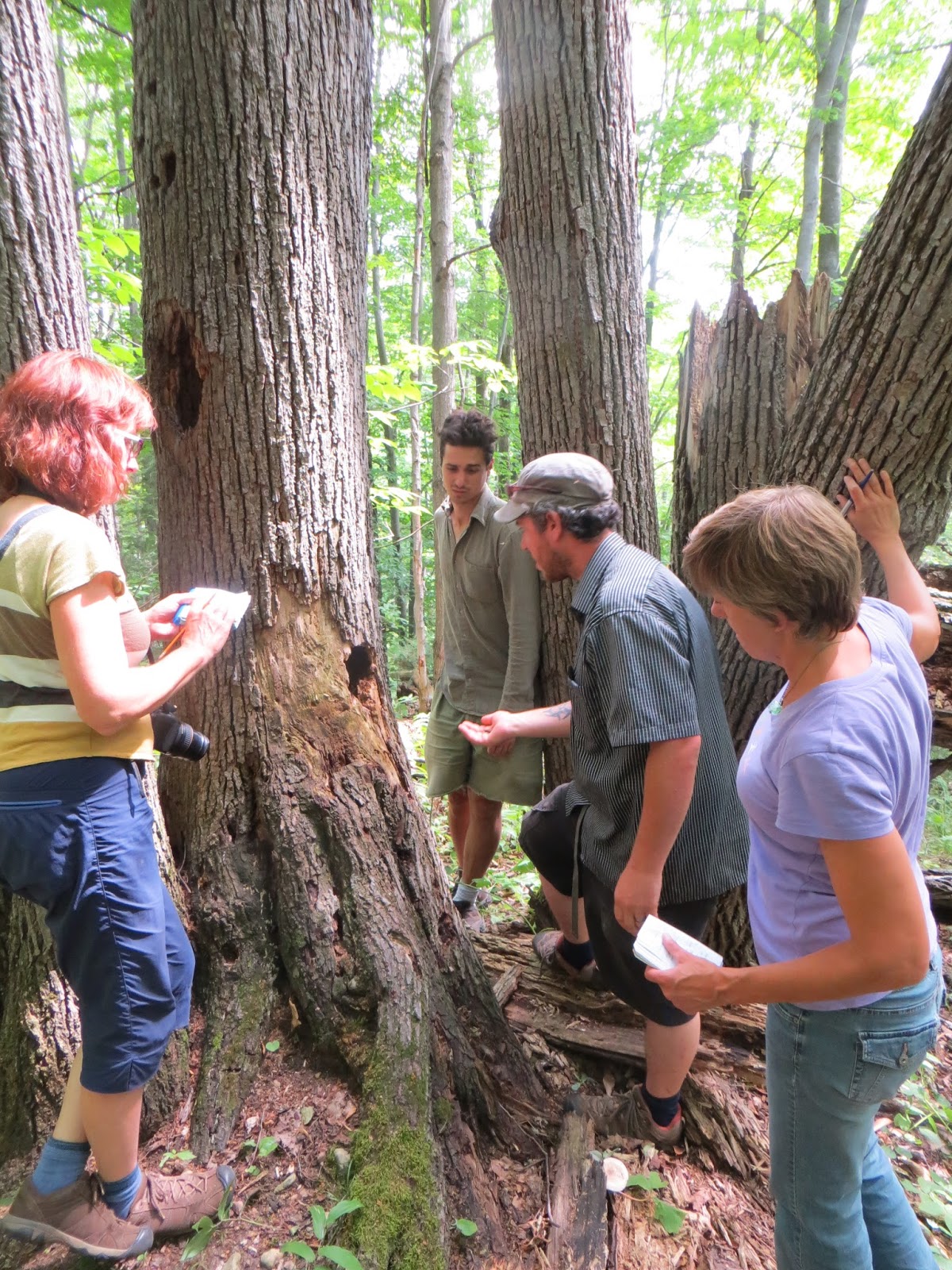
The site of a porcupine, raccoon and flying squirrel holes in this big old Basswood tree


Saturday and Sunday, July 26th, 2015
Written by Tamara Anderson - 2nd year Tracking Apprentice

In his book Nature Observation and Tracking, Tom Brown Jr. writes; “The earth tries to be flat.” He was referring to how weather and gravity “conspire to erase tracks”.  This past July, the tracking apprentices observed the subtle traces of summer tracks at Allan Park near Durham. We also created tracks and signs at Alexis’ house and watched how they changed over two days.  Lately, I have been tracking the landscape just as much as I have been following the footprints of animals.  Approximately 10,000 years ago, a receding glacier scraped the surface of the land that is now Allan Park and deposited material from the Canadian Shield.  Some of the material was ground into sand, silt and clay. A huge chunk of ice from the glacier dropped onto the landscape and a kettle lake was formed.  Allan Park is part of the Horseshoe Moraine. It includes a trail system that reaches an elevation of 30 metres in some places. 

Fawn Tracks
On Saturday, we wandered the rolling, forested pine, spruce and cedar hills beside the glacier-made trout pond.  The sandy edge of the pond revealed the opened shells of snapping turtle eggs.  This prompted a few questions:  How does temperature affect turtle egg incubation? Do predators leave different signs when they predate turtle nests?  I learned that the “J” shape of the Jack pine cone is a helpful way to remember the cone-makers identity.  Sue asked about whether any local species of rats are native to North America and which snakes have live birth?

Watching Tracks Age
On Sunday morning we were enchanted by the purling rattle of a Sandhill crane in a field near Alexis and Bobbi’s place.  Sandhill Cranes beckon my attention in an ancient way. After reading about Sandhill cranes, I discovered that they are the oldest known surviving North American bird species.  That morning, we returned to Allan Park and found a trail on a steep hill that led to different interpretations.  It is amazing how the track of a sliding deer can look similar to the five toes of a barefoot, feral child;)  After following a doe and her fawn’s tracks along a sun-baked, sandy trail, we ventured into a cool, deciduous forest of Hickory, Basswood and Maple.  The tracking apprentices used tracking sticks to track each other in leafy debris.  Luke and Miriam discovered a vole tunnel and burrow network at the forest edge.  We lightheartedly discussed how best to classify this trail.  If vole trails under the snow are called “subnivean” then would this trail under the leaf-litter be called sub-humusean?  We also wondered whether the trail was from a red-backed or a meadow vole.  Do meadow voles occasionally lives in forests?  What is the range of the red-backed vole? Alexis located a flying squirrel latrine in a basswood tree. Flying squirrel scat accumulates in areas where the squirrels nest and cache food. The scat often flows out of tree cavities, low to the ground. 

I will end this post with a continuation of Tom Brown’s tracker wisdom; “There is hardly a square foot of ground that is absolutely flat. Every depression, every bump, every fissure, and every scratch on the landscape was made by something. Whether it was made by a rabbit, mouse, bulldozer, fish, frog, or volcano, it is the tracker’s job to notice and interpret it.” (Tom Brown Jr., Nature Observation and Tracking)

Wednesday, June 10, 2015

Spring Time Tracking at Mono Cliffs

Saturday, May 23, 2015 - Day 1

Mono Cliffs Provincial Park

Our group gathered into a circle under the shade of an old Sugar Maple at the edge of an open sunny field. We shared our goals, intentions and gratitude as we watched the wind blowing through the landscape, passing over the tall grasses and through the aspen/poplar leaves in a playful fashion. We watched a couple of Northern Harriers fly over the field, triggering a discussion on sexual dimorphism and hawk ID features, followed later by a Wild Turkey hen cautiously wandering out from her nest to feed.

After our sharing, we got up to prepare to head out into the field for our first day of tracking but right beside where we had been sitting, we noticed some really neat tent caterpillar webs on some young cherry trees! What type of cherry where they; black, choke or pin? We spoke a bit on how to tell cherry species from the shape, size and spacing of their flower clusters.

As we headed into the field, we looked back to our shady spot and saw just how much our own impressions on the land (where we had sat) resembled deer beds.
We didn't get more than 15 or 20 meters into the field before we stopped to look at some of our first animal sign. Alexis crouched down and pushed some grass aside, revealing a tiny trail carved into the ground underneath the tall grasses. He showed us a tiny piece of grass stalk cut on a 45 degree angle, indicating vole feeding sign. We spent the next while unveiling the intricate network of vole trails through the field. We wondered how large the territory range was for these tiny creatures, which according to Mark Elbroch, is 1/10 to 1 acre!
We saw plenty of large holes scattered over the field around some of the vole holes going down into the ground. Had someone like a fox or coyote been digging here to feed on the voles?

We stopped around a rock cropping looking for signs of weasel activity and talked about defining features of various local members of the weasel family.

Then we pushed towards the edge of the field along the tree line where we found some huge scars on the younger aspens from past deer antler rubbing. We stepped into the wooded area and began to travel along a deer trail that ran South, just a few feet into the forest. We took a look at some of the claw and teeth marks on various trees. Showing signs of porcupine and raccoons who had climbed these trees in the past.

We soon came to a spot where we noticed someone had been eating the trout lily greens. Who was the culprit, turkey, deer, rabbit? We took note that the greens were cut flat and sometimes slightly frayed. Then we found another clue, a hair that kinks when it is bent, indicating the eater's hair had a hollow core. A clear track then confirmed our suspicions.  White-Tail Deer.

We found some holes carved out of dead wood, triggering a lesson on how to differentiate between local woodpecker species from the signs. We were really able to bring home this lesson as theory was confirmed as we found examples in the field of signs from nearly each type of woodpecker throughout the course of the day!
In the afternoon, we made our way along some beautiful cliff ridges carved out around 11 000 years ago by some great glacier melts, providing breathtaking views of the valley below. We sat watching and listening to the birds together,  sighting some rose-breasted grosbeaks, red-eyed vireos, chickadees, turkey vultures, ravens and a few different warblers. We split up for some grounding sit-spot time long the cliffs before embarking on the descent back down towards our meeting point.

Throughout the remainder of the day, we wandered through the woods, talking about trees and plant ID, deer rutting behaviour, predators of ant hills, grouse vs wild turkey dust baths, what the deer have been eating and how to assess the age of forests based on the plants and trees growing there. It was truly a day full of many lessons, tying academic information in beautifully with experiential learning in the field.


Written by:  Lianna Vargas - 2nd year Tracking Apprentice


Friday, May 22, 2015

Of spring flowers, forest nibbles and an edible feast…


Of spring flowers, forest nibbles and an edible feast…

Our May plants apprenticeship weekend got off to an early start for those of us who were able to camp out at Alexis and Bobbi’s place on Friday evening.  Falling asleep to the sound of spring peepers and the pattering of rain on our tents and waking up to the sounds and smells of a glorious spring morning in the country was a great way to get into the groove of the weekend.  Saturday morning, woken by a chorus of birds, cows and frogs, we had a relaxed outdoor breakfast and waited for the rest of the group to assemble.  After a quick welcome and opening, and a chance to meet a couple of new participants to the course, we were on our way to a beautiful Grey County forest.  

Our first encounter was with a patch of wild ginger, which prompted some good words from Alexis to add to our ongoing conversation about ethical harvesting.  Wild ginger has some powerful medicinal properties to help with fever, respiratory ailments and indigestion, but it is a plant to be treated sensitively.  With ongoing habitat encroachment, we learned that it is best to harvest wild ginger very lightly or not at all.  Sometimes using a cultivated equivalent or a more common wild substitute is the best medicine!  We also noticed that the ginger, normally a hardwood species, was growing among pines, and that other hardwood flowers were also present here.  A fascinating example of tracking the human effect on the landscape: this colony is a remnant of a former maple forest that was logged for many years. We could see that the ginger was not as happy in the acidic soil of the pines as it would have been nestled among the maples that once covered this area.

We moved on to some more widespread and common species with large edible roots: dandelion and burdock. Again, Alexis prefaced the harvest with some wisdom on caretaking and ethics. Harvesting roots means taking a plant’s life, and so even more than taking other plant parts requires sensitivity and reciprocity: tuning in to the health of the plant and listening to whether it is ready to be harvested; and giving thanks, as is the time-honored practice of all cultures living close to the land.

Roots are best harvested before or after flowering: usually in fall, but potentially in spring.  Dandelion is a liver and kidney tonic and a diuretic, meaning it helps move fluid through the body.  It is particularly valued for this purpose because while it moves urine out of the body it also replenishes potassium.  The bitter flavour of the leaves is also great for the body, stimulating digestion, and adding nutrients often lacking in a modern western diet high in sugar and salt.  Burdock similarly has very bitter leaves, and its deep taproots are high in food energy, ideal for adding calories in any survival situation.

We moved along the trail and stopped to harvest some of the tiniest leaves of a basswood tree, and noted its multiple trunks and heart-shaped leaves.  In the same area, we selectively picked some tender bright-green spruce tips to infuse in apple cider vinegar.  At the foot of the basswood was a patch of daylilies, not yet flowering, adding another landscape tracking clue to the former homestead that was once tucked into this forest.  We talked about the edible parts of the daylily and the importance of distinguishing them from non-edible species.
 
We moved out the forest into a small clearing, which held the crumbled stone foundation of another old homestead surrounded by more useful plants.  As Lee and I slipped off to make a small fire, the others harvested catnip to brew for an after-lunch tea.  Nestled among a grove of cedars, we ate a companionable lunch and later sipped the musky-smelling and relaxing tea. 

Refreshed, we packed up and continued on our way, stopping to spend time with some bloodroot along the way – another beautiful native spring plant. We cut off the trail to find our way into a hardwood forest, and stumbled upon a small but incredibly diverse patch of native spring plants: blue cohosh, wild leeks, red and white trilliums, wild ginger, baneberry, Solomon’s seal, Canada mayflower.  A group of us spent some time with our Newcomb’s guides and an interesting plant with its stem growing straight through its leaves, and a dangling yellow flower missing some of its petals: quite a challenge since the number of petals is integral to the book’s classification key!  But with some persistence and intuition, we stumbled upon the identity of our mystery plant: bellwort.  Other sub-groups spent time carefully harvesting some plants for our dinner, as well as checking out a patch of poison ivy, for future avoidance!  Slightly down the trail, we found another beautiful plant with a white flower and spent more time with our Newcomb’s guides to discover that the plant was toothwort.  We read about the plants’ delicious and pungent roots and dug up a few to add to our dinner.  One of the roots was passed around for sampling, and was generally agreed to taste a lot like horseradish, with many exclamations of “so spicy!  But so delicious!”
 
As we headed back to our cars, we had one final stop at a red elder to discuss the differences between this species and sambucus Canadensis, the edible black variety, which was not yet in flower.  The name sambucus racimosa refers to the shape of the flower clusters on the red elder, which grow in rounded racemes instead of the flatter clusters of the Canadensis species. 

We were done our time in the field, but our day wasn’t over yet!  We headed back to Alexis’ place with our edible treasures, and spent a lovely evening together preparing and eating food, connecting, chatting about plants, and singing around the fire under a star-studded sky before heading off to our tents to rest up for what promised to be another full and exciting day on Sunday.

Written By:  Malgosia Halliop - 2nd year Plants Apprentice


Tuesday, May 5, 2015

Majestic Trees and the first Spring Ephemerals

On Sunday, Along the Niagara Escarpment,  we continued to learn about trees, and found several spring ephemerals poking through the leaves on the forest floor. There were tiny Spring Beauties with whitish pink flowers and Trout Lilies whose bell-shaped yellow flowers were yet to bloom. Tiny purple Violet flowers were growing in a sunny spot near Blue Cohosh's with their stems still purple as they emerge from the earth. We paused to harvest some Trout Lily corms, a sweet treat in the spring and in the summer and fall they have a taste more like potatoes. These early spring wildflowers grow, flower and go to seed in a forest before the leaf canopy grows thick enough to block out the sun.

We focused on identifying hardwood trees today, especially opposite branching ashes and maples.  We also found Ironwood, Trembling Aspens, White Birch, Black Birch, some Willows, Balsam Fir, and Common Elderberry shrub. We talked about forest succession when we came across Indian Pipe, a plant that gets it’s energy not from the sun, but from the fungus under the ground growing on the roots of trees. Also known as Monotropa uniflora, this plant has the coolest latin name of the many we learned today.


The Trail took us down the cliffs along a set of stairs. We paused for lunch near a pond and several folks sang some beautiful songs as we ate.  We tasted a thin slice of Wild Ginger root just before lunch, the unique maroon flowers should be coming out soon.  In the afternoon, we made tinctures.


Bright yellow Coltsfoot, has several features that distinguish it from dandelion, including purplish alternating scales on the stem, and heart-shaped leaves that don’t come out until after the flower does. We sat by the water, harvested some Coltsfoot and made a tincture in a mason jar.  Coltstfoot has demulcent properties, which means it can soothe a throat sore from a cough or a cold.  It’s expectorant properties mean that it can thin out mucous so that it is more easily expelled by coughing. We stopped by the creek to harvest some bark from a White Birch that had been cut down recently- it would make great baskets and other natural crafts.      
 
The Willows sat by the water; a small pond with some geese asserting themselves for a prime nesting ground.  Nine Painted Turtles basked on a log, they seemed to be unfazed by the geese’s loud honking battles.  A bat and several birds, sparrows and Red-Winged Blackbirds also inhabit this wetland.  As the clouds rolled in, the spring peepers started their mating song. We tinctured some Willow here, to be used to help with pain and inflammation.

Heading home, we stopped along another pond making up the headwaters of the Sheldon Creek.  We filled up our water bottles at a nearby spring. The path turned south and got steeper.  As we climbed through the cliffs we stopped to take a group photo!

 
The trail took us to a lookout at the top of the Escarpment. Looking out over the forest, we watched the turkey vultures soaring in the cliff’s updrafts and listened to some stories of Alexis’ adventures in this place many years ago. A closing circle was held at the top of the cliff.  We shared some gratitude and anticipation for the months to come before heading to the cars.

Written By:  Alex Thomson - 2nd Year Plants Apprentice


Friday, April 10, 2015

Landscape Tracking - Learning from the Land

This weekend’s theme was landscape tracking! We met at the Hockley Valley Nature Reserve near Orangeville. Few of us had been to the area, so we were keen to go exploring.
After a quick gratitude circle, we followed the trail west for a few minutes, then out into a grassy lowland next to a treed slope. All the grass had been pushed down and there were trails cutting through. Was it the work of deer? Was it people? Or had someone’s enthusiastic dog rolled all over? Jeff noted that the goldenrod was still standing. Could that be a clue about the perpetrator? We bent down and looked at the green carpet more carefully. It was green on top, but brown underneath. This grass had been pushed down for quite a while.
Alexis decided that we should follow the deer trail up the slope and into the trees just to see where it would take us. By observing the trail, we could see how they shaped the landscape. The deer had worn a rut into the earth, and when we stepped off-trail, we sank into the soft pine needle carpet. Punky logs in the path of the deer had been pulverized by their hooves.
Were the deer going uphill or downhill? Was the trail only used to go one way or both? We tried to imagine when the deer would go down to water or up to higher ground and what would influence them to go in either direction. For example, hot air rises during the day and sinks at night. Where would they go to be able to smell a predator? Where would they go to stay cool?
The group spent some time walking in silence. Such a heavily used trail could yield a wild animal sighting if we were careful. Soon, our main trail branched off left, then right, then uphill and downhill. Before long, three separate groups were stalking along deer trails, trying to spot the animals that had made them.
The slope and the top of the ridge were full of red pines. Those had thinned out, their place taken by beeches, ironwoods, oaks, maples, aspens and birch. The understorey had changed, too. We were seeing leatherwood and forest goldenrod. What would attract the deer to this area? Most likely the acorns and beech nuts, especially in fall and winter.
Alexis called us over to investigate a depression in the hillside and asked, what happened here? There were several such depressions, usually close to trees. Some of us thought they were caused by erosion. Others thought they were burrows. But Victor guessed that they were created when a tree had fallen over long ago, its roots pulling up all the surrounding dirt. It had happened so long ago that the trunk had disintegrated. He had guessed right, and we were shown where the signs of what happened could be found: the canopy. Surrounding the hummock were fast-growing aspens and birch, pioneer species that had grown up to take advantage of the sunlight that had been blocked by the big tree’s leaves before it had come down. If we could age those aspens, we might get an idea of when the tree fell – though a good guess would be 1954, the year of Hurricane Hazel.
Back to the deer trails: The main trail led out into another grassy field, so out we went to see where the deer had gone. The field was full of goldenrod, yarrow and asters, typical late summer forbs, and trails criss-crossed through the grass. Each of us tried to follow one, but it wasn’t clear where they were going or even if we were following deer anymore. We remembered an earlier lesson about what trails made by animals low to the ground look like when compared to trails made by animals with long legs. Maybe there were rabbits or raccoons in the area?
A few anthills dotted the field and before long, we were standing around one that had attracted Alexis’ attention. At over a foot wide and about 10” tall, it wasn’t the biggest one we had seen, but it wasn’t the size that warranted investigation; it was the accumulation of tiny, tubular scats on top. We were looking at a vole latrine. Why did the vole latrine here? Wouldn’t the ants bite the vole? Do voles eat ants, or are they strict vegetarians? We had lots of questions, and a flash of insight into small-scale landscape tracking.
Once we reached the other side of the field, we entered a lowland area of cedars bisected by a tributary. As we sat and had lunch, we discussed how deforestation in the upland areas had led to erosion, which meant silt running into the river. A siltier, shallower river in turn led to increased flooding and fewer salmon spawning, and that may have impacted an important food source for mammals in the area -- and a potential source of nitrogen for the plants and trees. They say our forestry practices have changed a great deal over the last decades. I wonder how.
Now that we were in the mindset of cause-and-effect, we were asked to go quietly out around the area and sit and observe. “What happened here?” was the question we were to ask ourselves over and over again as we looked at the landscape, the flora and the fauna. At the end of our exercise, we came together again and shared some of our key observations. Steve, a second-year tracking apprentice, said that he was looking at the water and thinking about how fallen trees might have changed the river’s path. Did some of the little islands have tree trunk foundations?

It was time to get moving. We climbed up gradually then climbed down very quickly into a valley carved by a creek long, long ago. As we climbed back up the other side, we stopped to marvel at a beautiful, fiery-orange salamander. Not long afterwards, we found another vireo’s nest at almost the same height we had found the first one in July. Alexis said he liked seeing so much bloodroot in one place. You don’t often see so much at one time.
In no time, it seemed we had returned to a well-worn deer trail like the one we had found at the beginning of our day. We walked in a line all the way back to the trail head. Mark said he could tell we were close to the meadow where we began because he could hear the crickets chirping. After another quick closing circle, we were done for the day.
What eye-opening lessons! Who knew that the anthill to the vole is as important as the ridge is to the deer? If you’re interested in learning more, here are a few books you might be interested in:
Reading the Forested Landscape by Tom Wessels

The Peterson Field Guide to Eastern Forests, by John C. Kricher

Written By: Christina Yu - 2nd Year Tracking Apprentice


Monday, February 23, 2015

Reading the Stories in the Snow: Tracking Evaluation in Algonquin Park

I spent this past weekend at the Wildlife Research Station in Algonquin Park, standing around in below -20C temperatures, poring over indentations in the snow, snowed-in trails of all sizes, mysterious scrapes and holes in trees, pungent urine marks, and other clues of animal presence. I do this kind of thing for fun as often as I can, but this time I was participating in a Track and Sign Evaluation to test my skills. I've been working on tracking skills in a focused way for about two years now, perhaps peripherally for a year or two before that. I've written previously about what drew me to this learning, and why I find it so compelling and beautiful and important, both on this blog and at Sense of Story. And so you might know that for the past two years I've been involved in an apprenticeship program with Earth Tracks, spending many inspiring weekends hiking around forests, swamps, cliffs and fields in every possible kind of weather, learning about the ecology of this land that I live in and about the creatures who inhabit it with me. I've learned to measure, sketch tracks, journal, draw maps, do species research, observe weather patterns, and tease out the stories left behind on the land.
When the evaluation was first scheduled, I hesitated to sign up. I had some nerves and doubt and plenty of ego to untangle when I considered being put on the spot for my skills in this way, skills that seemed so emergent and fragile to me. I didn't know what it would look like and how it would feel to be required to move from wonder and speculation to firmly committing to an answer, my own answer, to each puzzle pointed out to me. What did I actually know? But specific goals are motivating, and risk is a powerful teacher.
Our humble but cozy accommodations.
So I found myself on a late January Friday bunking with three other women, fortunately all of them friends, in a tiny cabin in the woods of Algonquin Park. In between sleeping and evaluation time out in the field, our group of ten or so participants gathered together in the Director’s Cabin at the Wildlife Research Centre to warm up, cook our meals, and socialize.
One of my bunkmates, Tamara, had made up study notes for herself, and we lay in our beds on Friday evening as she read tidbits out loud by headlamp, all of us easing our nerves with raucous laughter.
The next morning, with feet already freezing from the cold cabin floors (note to self: bring slippers next time!), we gathered with snowshoes and notebooks to start the evaluation. George, the evaluator – who had come up from the U. S. – had scouted out some tracks and sign the day before. But nature is always in motion, and recently fallen snow and new tracks meant that many of the questions he ultimately gave us were spontaneously found or had already changed slightly by the time our group reached them. With each new track, trail or sign we might be asked: “Who made this?” “What gait is this?” “Which foot is this?” or the all encompassing “What happened here?” Ecology, habitat, behaviour, as well as our knowledge of track and trail patterns and typical animal sign all informed our answers. We moved from one set of tracks to another, each person taking as long as they needed to decide on an answer, although the bitter cold certainly encouraged closure. Our answers we gave one by one to George or to Alexis – who was assisting – either whispered or written in a notebook (my preference). The evaluator’s job was to hear our answer with a neutral face and record it.
Who made these tracks?
After each group of five or so questions, George took up the answers. Obviously, the evaluator’s tracking skills are put on the spot as well, and there is room for debate and the occasional question thrown out if there is too much disagreement (it is amazing, for example, how much snowed-over moose tracks and human tracks can look alike). After the first group of questions, I knew I would be fine, and I threw myself into the exuberant fun and adrenaline high of it all.
George and Alexis, practicing the poker face. George has an excellent frost beard.
Who made this Trail? 
As I knew, my weak point was bird, insect and mammal sign on trees. On the other hand, I had some strokes of luck, pulling an answer out of nowhere – certainly not from conscious memory – a few times and then discovering it was right. I was struck by how often a seemingly random guess can have a solid deductive process going on behind it. I loved what I learned about my instincts and my reasoning process, how good it felt to follow my intuitions on each question, and how often my mistakes came out of not doing so. I also loved dispensing with the need for measurement – measuring tools weren't allowed – and tuning into my love of patterns and context to summon my answers. I checked off correct and incorrect answers in my notebook, and although the answers are weighted for difficulty, making it difficult to calculate a score ahead of time, I could see as the weekend went on that I was mostly on a roll. I had told myself that what I wanted from the evaluation was a really great workshop – which it was – but I could see quickly that my competitive drive was kicking in.
Among what we saw in the snow were tracks and trails of pine marten, fisher, mink, river otter, short-tailed weasel, shrew, deer mouse or white-footed mouse, grouse, moose, white-tailed deer, red squirrel, red fox, and eastern wolf. On a range of trees, hydro poles and on one plywood shed were marks from black bear, porcupine, pileated woodpecker, and many other smaller creatures.
What happened here?
Our most intense moment was being led to a fresh moose carcass at the bottom of a slope on the side of the highway. The next few questions set the scene: Whose tracks were leading up to it? What did we see at the top of the hill? Was this all related? If so, how? It was potent and moving to visualize the scene of the hunt, what might have happened here and how. To place it within the statistics on wolf on moose predation in the park; to feel the agony of the moose’s death alongside gratitude for the role the wolves play in the health of their ecosystem. In the woods with senses wide open, you can’t avoid the cycle of life and death, its solid and fleshy reality, and the bigger knowledge that every living being, every possible nutrient, is eventually recycled and reabsorbed into others and into the Earth.
A beautiful otter trail.
I was grateful to have been part of this experience and process. Putting myself into a situation where I needed to decipher the clues on my own, to commit to answers and really trust my gut, and the excellent outcome that came out of this for me (Level III Track and Sign) gave me a huge boost of confidence in the skills I've built up over the past few years. The testing situation put a higher stake on using the knowledge I had in contrast to the more relaxed energy of tracking as naturalist learning. It connected me in a deeper way to the instincts my ancestors would have used, that I could still use, in a situation where tracking had a stake in survival. Reflecting on the experience in the week afterwards, I thought a lot about how to apply that intuition, that trust in myself, to other situations in my life. Like any experience where head, heart and body are engaged, it gifted me more than the sum of its parts.
Pine marten at the back window of the Wildlife Research Station. Photo by Lianna Vargas.
A week later, I’m driving up to Algonquin Park again, this time with the apprenticeship program, for a weekend of a different pace, which will be both more relaxed and more physically demanding. We’ll get onto some moose or wolf trails, read the patterns, immerse ourselves in the exhilaration of movement, observation and connection with the more-than-human world. I’m glad not to be tested this time, but I know I’ll bring the energy of last weekend forward into this one. And I suspect that when the evaluation comes around again next year, I will be keen to do it again.
Me, with my usual tracking grin.
Written By: Malgosia Halliop - 2nd Year Tracking Apprentice