Written by Tamara Anderson
Sunday, May 24, 2015
Lockyer Pits, Orangeville
It was sunny and 26°C at the Lockyer
Pits in Orangeville. We began the day by tracking the weather. Wispy
cirrus clouds moved across the sky. Alexis shared his knowledge that
cirrus clouds forecast a change in the weather within about 24 hours. The
first set of tracks that we found belonged to a raccoon. We noted
the placement of the front foot beside the rear foot as the procyon
lotor ambled south towards the nearby subdivision. We
discussed the various forms of locomotion used by terrestrial mammals; Plantigrade (walking
with toes flat on the ground like humans and raccoons), Digitigrade(walking
on the toes or digits like dogs and cats), Unguligrade (walking
on the nails of the toes (or hoof) like deer).
Next, we
observed crow tracks. We discussed bird foot morphology and how the most common
arrangement for birds is anisodactyl, with three toes pointed
forward and one backward. The toe that points back is called the hallux. Ornithologists
number the toes of each foot from 1 to 4. Toe 1 is the hallux and the other
toes are numbered in sequence, beginning with the inside of the foot and
circling out.* Alexis shared a cool
tracking tip for corvids (Crows, Ravens, Jays etc.). In Corvids, toe 2 and 3
are close together. In comparison, toe 3 and 4 are close together for members
of the Blackbird family (Cowbirds, Grackles, Blackbirds etc.).

After observing some mystery scat which we later decided was most likely
fox, Sue was curious about how to identify different fur-bearing rodents from
scat contents. Do rodents come in different colours? Are
certain rodents more delicious than others? Alexis suggested
looking up shrews and voles in Peterson’s Guide to Mammals. Much of
the morning was spent measuring tracks and stride lengths for wild turkey,
white-tailed deer, coyote, and skunk. Aster, Sue and Alexis
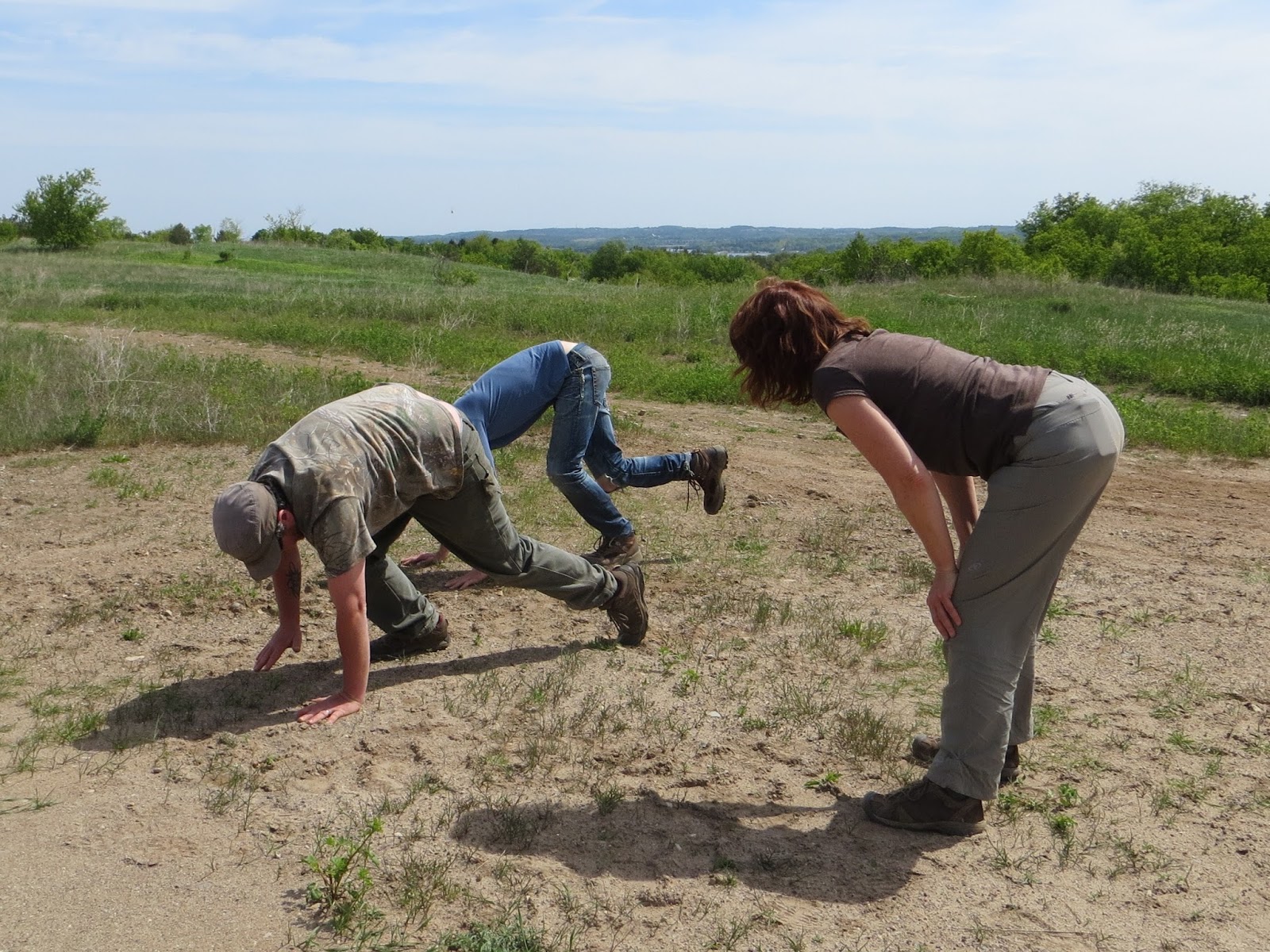
practiced diagonal walking and moving like the animals that we were
tracking. Aster and Sue were interested in the differences between
domestic dog and coyote tracks. Alexis shared that dog tracks are
more splayed than coyote tracks due to a difference in physical fitness. Dog
tracks tend to wander whereas coyote tracks tend to have a straighter
trail. Dogs have kibble waiting for them at the end of the
day. Coyotes do not.
 The sandy, sun-baked, four-runner trails began to feel like a
desert. We ventured down towards the river and found reprieve and
lunch in the shade of a cedar forest. En route, we noticed an ant
attempting to carry away a butterfly that was not quite dead yet. Can
ants use their formic acid to predate other insects?
The sandy, sun-baked, four-runner trails began to feel like a
desert. We ventured down towards the river and found reprieve and
lunch in the shade of a cedar forest. En route, we noticed an ant
attempting to carry away a butterfly that was not quite dead yet. Can
ants use their formic acid to predate other insects?
The afternoon was spent exploring sand pits, locating tracks and
comparing the characteristics of coyote and fox tracks. The question
of which would be more valuable, gold or water in a desert came to mind as the
contents of my water bottle dwindled in the hot sun. We began to
wonder if Alexis might soon demonstrate one of his revered survival skills and
magically find us some water. Alternatively, I pondered whether I
might be able to devine where water was by picking up two sticks in front of
me. Aster wondered if there might be water beneath the sandy ground where
we could see dogwood growing. Is dogwood an indicator species for
water? Solitary bees flew into sand tunnels all around
us. One 6 mm tunnel had plant debris glued together in a silky turret at
the entrance. I later learned that this tunnel was likely made by a
burrowing wolf spider.
One solitary bee made a burrow in a deer track. What are
the bees doing in the burrows? Are they laying eggs?
 Tamara kept a bird list for the day: Red-Eyed Vireo, Savannah Sparrow,
Meadowlark, Great Crested Flycatcher, Chickadee, Grasshopper Sparrow, Song
Sparrow, Northern Flicker, Northern Cardinal, Red-Winged Blackbirds, American
Crows, Red-Tailed Hawk, Rose-Breasted Grosbeak, Blue Jay, Tree Swallow, Cliff Swallow.
Tamara kept a bird list for the day: Red-Eyed Vireo, Savannah Sparrow,
Meadowlark, Great Crested Flycatcher, Chickadee, Grasshopper Sparrow, Song
Sparrow, Northern Flicker, Northern Cardinal, Red-Winged Blackbirds, American
Crows, Red-Tailed Hawk, Rose-Breasted Grosbeak, Blue Jay, Tree Swallow, Cliff Swallow.
It was great to be out tracking in the sandy trails of Lockyer
Pits. Next time, I will remember to bring more waterJ
Written
by: Tamara Anderson - 2nd year Tracking Apprentice
*Elbroch, M. & Marks, E. 2001, Bird Tracks and Sign, Stackpole
Books, Mechanicsburg, PA.


 As the tracking apprentices learned about pressure releases this past
weekend, we could almost hear the wise words of Yoda saying, “Patience you must
have my young padawans”. After constructing a 10 foot long by 5 foot
wide tracking box on Saturday, we were ready to embark on using the giant
sandbox to look at tracks. Alexis shared his passion and knowledge of
pressure releases eloquently and enthusiastically. We also had “The
Science and Art of Tracking” by Tom Brown Jr. in hand. We learned
how turns, changes in direction and sudden stops cause pressure against the
wall of a track. The pressure is released as cliffs, ridges, peaks,
caves, plates, fissures and explosions in the substrate. The second
pressure release study looked at what happens to the substrate as a result of a
change in forward motion. The apprentices walked, ran, and jigged
across the tracking box to get a better understanding of how speed influences
the appearance of a track. We created waves, disks, dishes and
explode-offs in the sand. We were helped out by both a cat and a
dog, who were somewhat obliging in letting us analyze their tracks in the
tracking box. Alexis shared a quote by Stalking Wolf on page 34 of
The Science and Art of Tracking, “We first must learn the simple language of
the tracks, which teaches us to hear the voice of the animal, and soon, through
the voice of the animal, we begin to hear the voice of the Earth.” The day also
included a little sand castle construction and much merriment.
As the tracking apprentices learned about pressure releases this past
weekend, we could almost hear the wise words of Yoda saying, “Patience you must
have my young padawans”. After constructing a 10 foot long by 5 foot
wide tracking box on Saturday, we were ready to embark on using the giant
sandbox to look at tracks. Alexis shared his passion and knowledge of
pressure releases eloquently and enthusiastically. We also had “The
Science and Art of Tracking” by Tom Brown Jr. in hand. We learned
how turns, changes in direction and sudden stops cause pressure against the
wall of a track. The pressure is released as cliffs, ridges, peaks,
caves, plates, fissures and explosions in the substrate. The second
pressure release study looked at what happens to the substrate as a result of a
change in forward motion. The apprentices walked, ran, and jigged
across the tracking box to get a better understanding of how speed influences
the appearance of a track. We created waves, disks, dishes and
explode-offs in the sand. We were helped out by both a cat and a
dog, who were somewhat obliging in letting us analyze their tracks in the
tracking box. Alexis shared a quote by Stalking Wolf on page 34 of
The Science and Art of Tracking, “We first must learn the simple language of
the tracks, which teaches us to hear the voice of the animal, and soon, through
the voice of the animal, we begin to hear the voice of the Earth.” The day also
included a little sand castle construction and much merriment.