Showing posts with label wildlife. Show all posts

Monday, December 7, 2015

The Twelve Gifts of Tracking


Porcupine Mandibles
 The rolling hills and drumlins of the Bruce Trail inspired this seasonal story of the day:

On the 6th Day of December, my tracking friends shared with me…
Twelve apples cached by squirrels (munched on by rodents, rabbit, deer and grouse)
Eleven animal trails (some serious) made by deer, rabbit, porcupine and raccoons.
Ten deer beds, scrapes and antler rubs.
Nine piles of deer, coyote, raccoon, porcupine and squirrel scat.
Red Squirrel Cache
Eight animal homes lived in by fox, groundhog, red squirrel, porcupine and sparrows.
Seven raven calls above a coyote’s resting place by the creek.
Six pine grosbeaks.
Five mandibles (from porcupine, coyote and meadow vole)
Four gulleys (landforms* and one named Sue)
Three rodent-chewed deer bones
Two grouse exploding into flight (and two ginger chocolate squares)
…and a porcupine in a hemlock tree.

*a water-worn ravine


By Tamara Anderson - 2nd year Tracking Apprentice

Thursday, July 2, 2015

Tracking in the Sauble Beach Area


Saturday, June 13th, 2015 - Story of the Day

Congregating at Alexis’s place before starting our drive to Sauble, we travellers arrived with stories of our adventures.  Sue, Aster and Luke had stopped to investigate some road kill, get hair samples and pull the bodies to a more peaceful resting place. Miriam shared her experience watching the fireflies come out the night before and was grateful for the peaceful misty morning drive. Following a quick tour of the beautiful place we’d call home for the weekend, we set out.
Arriving at our destination we headed to the sandy areas to look for tracks.  We passed some yellow lady slippers that grew just off the path – a cheery welcome. A chance meeting with a grandfather and his grandson concerned about the debris being dumped in the area made us mindful of how important stewardship is to our interaction with this land.
How rewarding it is to find an animal at the end of the track you are following…and so it was with one of our first finds….a millipede (North American maybe?) A close look afforded a view of the tiny leg tracks. Close by was a curious raised line that when uncovered exposed a wee round tunnel a mere 1/8th of an inch in diameter.  Clearly the makings of a creature much smaller than the millipede.

Off at the edge of the wooded area Luke and Sue located what they suspected might be lagomorph signs. Investigating further we discovered more clues including prints, a small enchanting opening into the cedars we crouched to look through, and some intriguing scat. Lagomorphs are “coprophagous” which means they eat their first scat to glean nutrients from the undigested material contained therein. By comparing two scat samples we think we might have found some uneaten first scats. Is there a story behind this? Might the nearby fox scat, though older, be a clue?
Back onto the sand we found more lagomorph tracks. Cottontail or  Snowshoe Hare? Careful measurement of trail width, track size and stride length helped us to place our bets on cottontail. Drawn by the activity of the egrets and crows in the distance we set off to see what we might find of bird tracks, and of course anything else of interest…bear tracks were on all of our wish lists.
Lunch at the point was a lovely time of spectacular views, ideal weather (Alexis wished he’d brought his bathing suit), and happy companionship. After lunch Luke went to look for frogs, Miriam and Aster investigated the area barefooted in the cool water, and Sue and Alexis went looking for the nest of the killdeer we’d sighted. Though the nest was never located, when we all joined up again to move inland we suspected we must have come pretty close to the nest because the killdeer performed its characteristic broken wing diversion trick. A female redstart sighting led us on a journey into the woods in search of more bird sightings…male redstarts? and if we were lucky maybe a redstart nest. Alexis drew our attention to a tree rising proud above its neighbours, spreading its almost leaf-bare arm-like branches out to the side. An attractive perch for large birds? Binoculars allowed us to see the worn bark in places and confirmed our suspicions. The base of the tree beckoned…what treasures might be found? Luke found a skull that remained a mystery even after consulting the skull book later on. Lots of white wash. A green feather! Heading back came across a few egg shells – of a similar mottled colouring but of a much smaller bird than the killdeer eggshell we found earlier.
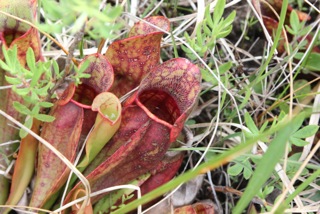
Out in the open again we encountered clusters of pitcher plants. Like all carnivorous plants, pitcher plants grow in locations where the soil is too poor in minerals, especially nitrogen and phosphorous, and/or too acidic for most plants to survive. The digested insects, and sometimes larger creatures like mice and frogs! provide the pitcher plants their needed mineral nutrition. More bird prints. Having encountered a number of prints throughout our journey we were able to compare and contrast our findings and use these comparisons and our resource guides to help us distinguish, in particular, sandhill crane and great egret tracks. Noting the toe positioning was helpful identifying some smaller prints as likely corvid tracks. What a treat to then come across some turtle tracks! A fun experience trying to identify them…the penny dropped for all of us when Alexis gave us the hint that he didn’t think they were mammal tracks.  The drag marks and ambling gait finally made sense if it was a turtle!  While inspecting the turtle track we encountered tiny frog and vole tracks too. What day filled with richness.  From the tiny millipede tracks to the grand wingspan of the great egret in flight passing overhead. From the close inspections of the finest details of our finds to the expansive vistas out over the land and water.

Back at Alexis’ place we enjoyed a potluck dinner of delicious food and story sharing. Under a starlit sky we ended the day spending time together around the campfire before heading to sleep to the sound of the night creatures.


Written by Miriam Snell - 1st year Tracking Apprentice

Wednesday, June 10, 2015

Spring Time Tracking at Mono Cliffs

Saturday, May 23, 2015 - Day 1

Mono Cliffs Provincial Park

Our group gathered into a circle under the shade of an old Sugar Maple at the edge of an open sunny field. We shared our goals, intentions and gratitude as we watched the wind blowing through the landscape, passing over the tall grasses and through the aspen/poplar leaves in a playful fashion. We watched a couple of Northern Harriers fly over the field, triggering a discussion on sexual dimorphism and hawk ID features, followed later by a Wild Turkey hen cautiously wandering out from her nest to feed.

After our sharing, we got up to prepare to head out into the field for our first day of tracking but right beside where we had been sitting, we noticed some really neat tent caterpillar webs on some young cherry trees! What type of cherry where they; black, choke or pin? We spoke a bit on how to tell cherry species from the shape, size and spacing of their flower clusters.

As we headed into the field, we looked back to our shady spot and saw just how much our own impressions on the land (where we had sat) resembled deer beds.
We didn't get more than 15 or 20 meters into the field before we stopped to look at some of our first animal sign. Alexis crouched down and pushed some grass aside, revealing a tiny trail carved into the ground underneath the tall grasses. He showed us a tiny piece of grass stalk cut on a 45 degree angle, indicating vole feeding sign. We spent the next while unveiling the intricate network of vole trails through the field. We wondered how large the territory range was for these tiny creatures, which according to Mark Elbroch, is 1/10 to 1 acre!
We saw plenty of large holes scattered over the field around some of the vole holes going down into the ground. Had someone like a fox or coyote been digging here to feed on the voles?

We stopped around a rock cropping looking for signs of weasel activity and talked about defining features of various local members of the weasel family.

Then we pushed towards the edge of the field along the tree line where we found some huge scars on the younger aspens from past deer antler rubbing. We stepped into the wooded area and began to travel along a deer trail that ran South, just a few feet into the forest. We took a look at some of the claw and teeth marks on various trees. Showing signs of porcupine and raccoons who had climbed these trees in the past.

We soon came to a spot where we noticed someone had been eating the trout lily greens. Who was the culprit, turkey, deer, rabbit? We took note that the greens were cut flat and sometimes slightly frayed. Then we found another clue, a hair that kinks when it is bent, indicating the eater's hair had a hollow core. A clear track then confirmed our suspicions.  White-Tail Deer.

We found some holes carved out of dead wood, triggering a lesson on how to differentiate between local woodpecker species from the signs. We were really able to bring home this lesson as theory was confirmed as we found examples in the field of signs from nearly each type of woodpecker throughout the course of the day!
In the afternoon, we made our way along some beautiful cliff ridges carved out around 11 000 years ago by some great glacier melts, providing breathtaking views of the valley below. We sat watching and listening to the birds together,  sighting some rose-breasted grosbeaks, red-eyed vireos, chickadees, turkey vultures, ravens and a few different warblers. We split up for some grounding sit-spot time long the cliffs before embarking on the descent back down towards our meeting point.

Throughout the remainder of the day, we wandered through the woods, talking about trees and plant ID, deer rutting behaviour, predators of ant hills, grouse vs wild turkey dust baths, what the deer have been eating and how to assess the age of forests based on the plants and trees growing there. It was truly a day full of many lessons, tying academic information in beautifully with experiential learning in the field.


Written by:  Lianna Vargas - 2nd year Tracking Apprentice


Friday, April 10, 2015

Landscape Tracking - Learning from the Land

This weekend’s theme was landscape tracking! We met at the Hockley Valley Nature Reserve near Orangeville. Few of us had been to the area, so we were keen to go exploring.
After a quick gratitude circle, we followed the trail west for a few minutes, then out into a grassy lowland next to a treed slope. All the grass had been pushed down and there were trails cutting through. Was it the work of deer? Was it people? Or had someone’s enthusiastic dog rolled all over? Jeff noted that the goldenrod was still standing. Could that be a clue about the perpetrator? We bent down and looked at the green carpet more carefully. It was green on top, but brown underneath. This grass had been pushed down for quite a while.
Alexis decided that we should follow the deer trail up the slope and into the trees just to see where it would take us. By observing the trail, we could see how they shaped the landscape. The deer had worn a rut into the earth, and when we stepped off-trail, we sank into the soft pine needle carpet. Punky logs in the path of the deer had been pulverized by their hooves.
Were the deer going uphill or downhill? Was the trail only used to go one way or both? We tried to imagine when the deer would go down to water or up to higher ground and what would influence them to go in either direction. For example, hot air rises during the day and sinks at night. Where would they go to be able to smell a predator? Where would they go to stay cool?
The group spent some time walking in silence. Such a heavily used trail could yield a wild animal sighting if we were careful. Soon, our main trail branched off left, then right, then uphill and downhill. Before long, three separate groups were stalking along deer trails, trying to spot the animals that had made them.
The slope and the top of the ridge were full of red pines. Those had thinned out, their place taken by beeches, ironwoods, oaks, maples, aspens and birch. The understorey had changed, too. We were seeing leatherwood and forest goldenrod. What would attract the deer to this area? Most likely the acorns and beech nuts, especially in fall and winter.
Alexis called us over to investigate a depression in the hillside and asked, what happened here? There were several such depressions, usually close to trees. Some of us thought they were caused by erosion. Others thought they were burrows. But Victor guessed that they were created when a tree had fallen over long ago, its roots pulling up all the surrounding dirt. It had happened so long ago that the trunk had disintegrated. He had guessed right, and we were shown where the signs of what happened could be found: the canopy. Surrounding the hummock were fast-growing aspens and birch, pioneer species that had grown up to take advantage of the sunlight that had been blocked by the big tree’s leaves before it had come down. If we could age those aspens, we might get an idea of when the tree fell – though a good guess would be 1954, the year of Hurricane Hazel.
Back to the deer trails: The main trail led out into another grassy field, so out we went to see where the deer had gone. The field was full of goldenrod, yarrow and asters, typical late summer forbs, and trails criss-crossed through the grass. Each of us tried to follow one, but it wasn’t clear where they were going or even if we were following deer anymore. We remembered an earlier lesson about what trails made by animals low to the ground look like when compared to trails made by animals with long legs. Maybe there were rabbits or raccoons in the area?
A few anthills dotted the field and before long, we were standing around one that had attracted Alexis’ attention. At over a foot wide and about 10” tall, it wasn’t the biggest one we had seen, but it wasn’t the size that warranted investigation; it was the accumulation of tiny, tubular scats on top. We were looking at a vole latrine. Why did the vole latrine here? Wouldn’t the ants bite the vole? Do voles eat ants, or are they strict vegetarians? We had lots of questions, and a flash of insight into small-scale landscape tracking.
Once we reached the other side of the field, we entered a lowland area of cedars bisected by a tributary. As we sat and had lunch, we discussed how deforestation in the upland areas had led to erosion, which meant silt running into the river. A siltier, shallower river in turn led to increased flooding and fewer salmon spawning, and that may have impacted an important food source for mammals in the area -- and a potential source of nitrogen for the plants and trees. They say our forestry practices have changed a great deal over the last decades. I wonder how.
Now that we were in the mindset of cause-and-effect, we were asked to go quietly out around the area and sit and observe. “What happened here?” was the question we were to ask ourselves over and over again as we looked at the landscape, the flora and the fauna. At the end of our exercise, we came together again and shared some of our key observations. Steve, a second-year tracking apprentice, said that he was looking at the water and thinking about how fallen trees might have changed the river’s path. Did some of the little islands have tree trunk foundations?

It was time to get moving. We climbed up gradually then climbed down very quickly into a valley carved by a creek long, long ago. As we climbed back up the other side, we stopped to marvel at a beautiful, fiery-orange salamander. Not long afterwards, we found another vireo’s nest at almost the same height we had found the first one in July. Alexis said he liked seeing so much bloodroot in one place. You don’t often see so much at one time.
In no time, it seemed we had returned to a well-worn deer trail like the one we had found at the beginning of our day. We walked in a line all the way back to the trail head. Mark said he could tell we were close to the meadow where we began because he could hear the crickets chirping. After another quick closing circle, we were done for the day.
What eye-opening lessons! Who knew that the anthill to the vole is as important as the ridge is to the deer? If you’re interested in learning more, here are a few books you might be interested in:
Reading the Forested Landscape by Tom Wessels

The Peterson Field Guide to Eastern Forests, by John C. Kricher

Written By: Christina Yu - 2nd Year Tracking Apprentice


Monday, February 23, 2015

Reading the Stories in the Snow: Tracking Evaluation in Algonquin Park

I spent this past weekend at the Wildlife Research Station in Algonquin Park, standing around in below -20C temperatures, poring over indentations in the snow, snowed-in trails of all sizes, mysterious scrapes and holes in trees, pungent urine marks, and other clues of animal presence. I do this kind of thing for fun as often as I can, but this time I was participating in a Track and Sign Evaluation to test my skills. I've been working on tracking skills in a focused way for about two years now, perhaps peripherally for a year or two before that. I've written previously about what drew me to this learning, and why I find it so compelling and beautiful and important, both on this blog and at Sense of Story. And so you might know that for the past two years I've been involved in an apprenticeship program with Earth Tracks, spending many inspiring weekends hiking around forests, swamps, cliffs and fields in every possible kind of weather, learning about the ecology of this land that I live in and about the creatures who inhabit it with me. I've learned to measure, sketch tracks, journal, draw maps, do species research, observe weather patterns, and tease out the stories left behind on the land.
When the evaluation was first scheduled, I hesitated to sign up. I had some nerves and doubt and plenty of ego to untangle when I considered being put on the spot for my skills in this way, skills that seemed so emergent and fragile to me. I didn't know what it would look like and how it would feel to be required to move from wonder and speculation to firmly committing to an answer, my own answer, to each puzzle pointed out to me. What did I actually know? But specific goals are motivating, and risk is a powerful teacher.
Our humble but cozy accommodations.
So I found myself on a late January Friday bunking with three other women, fortunately all of them friends, in a tiny cabin in the woods of Algonquin Park. In between sleeping and evaluation time out in the field, our group of ten or so participants gathered together in the Director’s Cabin at the Wildlife Research Centre to warm up, cook our meals, and socialize.
One of my bunkmates, Tamara, had made up study notes for herself, and we lay in our beds on Friday evening as she read tidbits out loud by headlamp, all of us easing our nerves with raucous laughter.
The next morning, with feet already freezing from the cold cabin floors (note to self: bring slippers next time!), we gathered with snowshoes and notebooks to start the evaluation. George, the evaluator – who had come up from the U. S. – had scouted out some tracks and sign the day before. But nature is always in motion, and recently fallen snow and new tracks meant that many of the questions he ultimately gave us were spontaneously found or had already changed slightly by the time our group reached them. With each new track, trail or sign we might be asked: “Who made this?” “What gait is this?” “Which foot is this?” or the all encompassing “What happened here?” Ecology, habitat, behaviour, as well as our knowledge of track and trail patterns and typical animal sign all informed our answers. We moved from one set of tracks to another, each person taking as long as they needed to decide on an answer, although the bitter cold certainly encouraged closure. Our answers we gave one by one to George or to Alexis – who was assisting – either whispered or written in a notebook (my preference). The evaluator’s job was to hear our answer with a neutral face and record it.
Who made these tracks?
After each group of five or so questions, George took up the answers. Obviously, the evaluator’s tracking skills are put on the spot as well, and there is room for debate and the occasional question thrown out if there is too much disagreement (it is amazing, for example, how much snowed-over moose tracks and human tracks can look alike). After the first group of questions, I knew I would be fine, and I threw myself into the exuberant fun and adrenaline high of it all.
George and Alexis, practicing the poker face. George has an excellent frost beard.
Who made this Trail? 
As I knew, my weak point was bird, insect and mammal sign on trees. On the other hand, I had some strokes of luck, pulling an answer out of nowhere – certainly not from conscious memory – a few times and then discovering it was right. I was struck by how often a seemingly random guess can have a solid deductive process going on behind it. I loved what I learned about my instincts and my reasoning process, how good it felt to follow my intuitions on each question, and how often my mistakes came out of not doing so. I also loved dispensing with the need for measurement – measuring tools weren't allowed – and tuning into my love of patterns and context to summon my answers. I checked off correct and incorrect answers in my notebook, and although the answers are weighted for difficulty, making it difficult to calculate a score ahead of time, I could see as the weekend went on that I was mostly on a roll. I had told myself that what I wanted from the evaluation was a really great workshop – which it was – but I could see quickly that my competitive drive was kicking in.
Among what we saw in the snow were tracks and trails of pine marten, fisher, mink, river otter, short-tailed weasel, shrew, deer mouse or white-footed mouse, grouse, moose, white-tailed deer, red squirrel, red fox, and eastern wolf. On a range of trees, hydro poles and on one plywood shed were marks from black bear, porcupine, pileated woodpecker, and many other smaller creatures.
What happened here?
Our most intense moment was being led to a fresh moose carcass at the bottom of a slope on the side of the highway. The next few questions set the scene: Whose tracks were leading up to it? What did we see at the top of the hill? Was this all related? If so, how? It was potent and moving to visualize the scene of the hunt, what might have happened here and how. To place it within the statistics on wolf on moose predation in the park; to feel the agony of the moose’s death alongside gratitude for the role the wolves play in the health of their ecosystem. In the woods with senses wide open, you can’t avoid the cycle of life and death, its solid and fleshy reality, and the bigger knowledge that every living being, every possible nutrient, is eventually recycled and reabsorbed into others and into the Earth.
A beautiful otter trail.
I was grateful to have been part of this experience and process. Putting myself into a situation where I needed to decipher the clues on my own, to commit to answers and really trust my gut, and the excellent outcome that came out of this for me (Level III Track and Sign) gave me a huge boost of confidence in the skills I've built up over the past few years. The testing situation put a higher stake on using the knowledge I had in contrast to the more relaxed energy of tracking as naturalist learning. It connected me in a deeper way to the instincts my ancestors would have used, that I could still use, in a situation where tracking had a stake in survival. Reflecting on the experience in the week afterwards, I thought a lot about how to apply that intuition, that trust in myself, to other situations in my life. Like any experience where head, heart and body are engaged, it gifted me more than the sum of its parts.
Pine marten at the back window of the Wildlife Research Station. Photo by Lianna Vargas.
A week later, I’m driving up to Algonquin Park again, this time with the apprenticeship program, for a weekend of a different pace, which will be both more relaxed and more physically demanding. We’ll get onto some moose or wolf trails, read the patterns, immerse ourselves in the exhilaration of movement, observation and connection with the more-than-human world. I’m glad not to be tested this time, but I know I’ll bring the energy of last weekend forward into this one. And I suspect that when the evaluation comes around again next year, I will be keen to do it again.
Me, with my usual tracking grin.
Written By: Malgosia Halliop - 2nd Year Tracking Apprentice


Thursday, September 4, 2014

August Algonquin Tracking Weekend

This is the post from our second day in Algonquin......Day one post to come soon.....
 
Heading out for a day of tracking
On our second day in Algonquin, we decided to stay near the research station and explore the area on the far side of Lake Sasajewun. Again, we grabbed our life jackets and paddles and pushed out onto the water, with last night’s moonlit paddle still fresh in our minds. Too bad Alexis got the leaky canoe!

Fortunately, it didn’t take too long to arrive at the northern part of the lake; and in the grassy, boggy shoreline, we found lots and lots of tracks. There were heron, muskrat, raccoon, fox, and moose and wolf – our first of the apprenticeship! For the better part of an hour, we trailed the moose and the wolf, pausing occasionally to ask, “What made the track look this way?” The variation in the substrate – how squishy it was in some places and how firm it was in others – really affected how much of the track we saw, or if we even saw one at all. Several of us stopped to take measurements; this would be a much-journalled set of tracks!


Eastern Wolf Tracks
Both trails led into the trees, and we followed using our eyes and hands, putting our new debris-trailing skills to good use. Now bear tracks were appearing on the same trail; this was a multiple-species highway. And it wasn’t just for the large: Over and over again, we found mustelid scats deposited right in the middle of the trail, a potent reminder that Martens were in the area, too.

But it wasn’t just tracks and scat we were finding. Mark was picking up Blue Jay feathers wherever he went, and on one part of the trail, we found cones from some Red Spruce. Algonquin is on the westernmost edge of the Red Spruce’s range. They are much more common in eastern Canada.

After stopping for lunch on the trail, we doubled back and went uphill into a drier area of the forest. The group was bustling along as only trackers can when Alexis called us to a halt. There was a grouse tail feather on the ground, and nearby, a wing feather! Then another wing feather and some breast feathers! Taking the tail feather, Lee gave a short talk on how to tell if it had come from a male or a female grouse; then she showed us how well the structure of the wing feathers affected airflow. Guest tracker Sue got several feathery souvenirs from that spot!


Even though it wasn’t very late in the day, it was time to start making our way back to the canoes. We cut down across the forest back to the trail we had followed to our lunch spot. It took a little while to recognize it because the sun had changed its angle, and we really were seeing things in a new light. Alexis, Tamara, Ann and Lee found an old wolf scat, and when they dissected it, they pulled out what seemed like a dew claw. When they looked closer, they discovered it was actually the toe of an unborn deer.
Ruffed Grouse Feather Site


It was late afternoon and we had returned to our canoes. We had one last goal before paddling back to the research station: otter scat. Alexis knew from years past that they liked to use the big rocks at the mouth of the narrows as a latrine. He and Christina got out on the rocks to scout, and it proved fruitful. Piles of dried otter scat decorated the rock face, some speckled with reddish-orange crayfish shells. One specimen was placed on a paddle and passed around for the apprentices to examine. What did it smell like? Fishy, of course!

Too soon afterwards, we had put away the canoes and were sitting in the research station. Our gratitudes came quickly: our time in Algonquin, the animals we had seen, the tracks we followed, the moonlight paddle and the moon. Then there was a little packing up, cleaning up, lots of hugs and warm goodbyes. This was a fantastic weekend for us all, and I can’t wait to go back in February!
 
By:  Christina Yu - 2nd year Tracking Student