Wednesday, June 10, 2015

Sign Tracking and an Intro to Wildlife Tracking


Written by Tamara Anderson
Sunday, May 24, 2015
Lockyer Pits, Orangeville

It was sunny and 26°C at the Lockyer Pits in Orangeville.  We began the day by tracking the weather. Wispy cirrus clouds moved across the sky.  Alexis shared his knowledge that cirrus clouds forecast a change in the weather within about 24 hours.  The first set of tracks that we found belonged to a raccoon.  We noted the placement of the front foot beside the rear foot as the procyon lotor ambled south towards the nearby subdivision.  We discussed the various forms of locomotion used by terrestrial mammals; Plantigrade (walking with toes flat on the ground like humans and raccoons), Digitigrade(walking on the toes or digits like dogs and cats), Unguligrade (walking on the nails of the toes (or hoof) like deer).
Next, we observed crow tracks.  We discussed bird foot morphology and how the most common arrangement for birds is anisodactyl, with three toes pointed forward and one backward. The toe that points back is called the hallux.  Ornithologists number the toes of each foot from 1 to 4. Toe 1 is the hallux and the other toes are numbered in sequence, beginning with the inside of the foot and circling out.*  Alexis shared a cool tracking tip for corvids (Crows, Ravens, Jays etc.). In Corvids, toe 2 and 3 are close together. In comparison, toe 3 and 4 are close together for members of the Blackbird family (Cowbirds, Grackles, Blackbirds etc.).
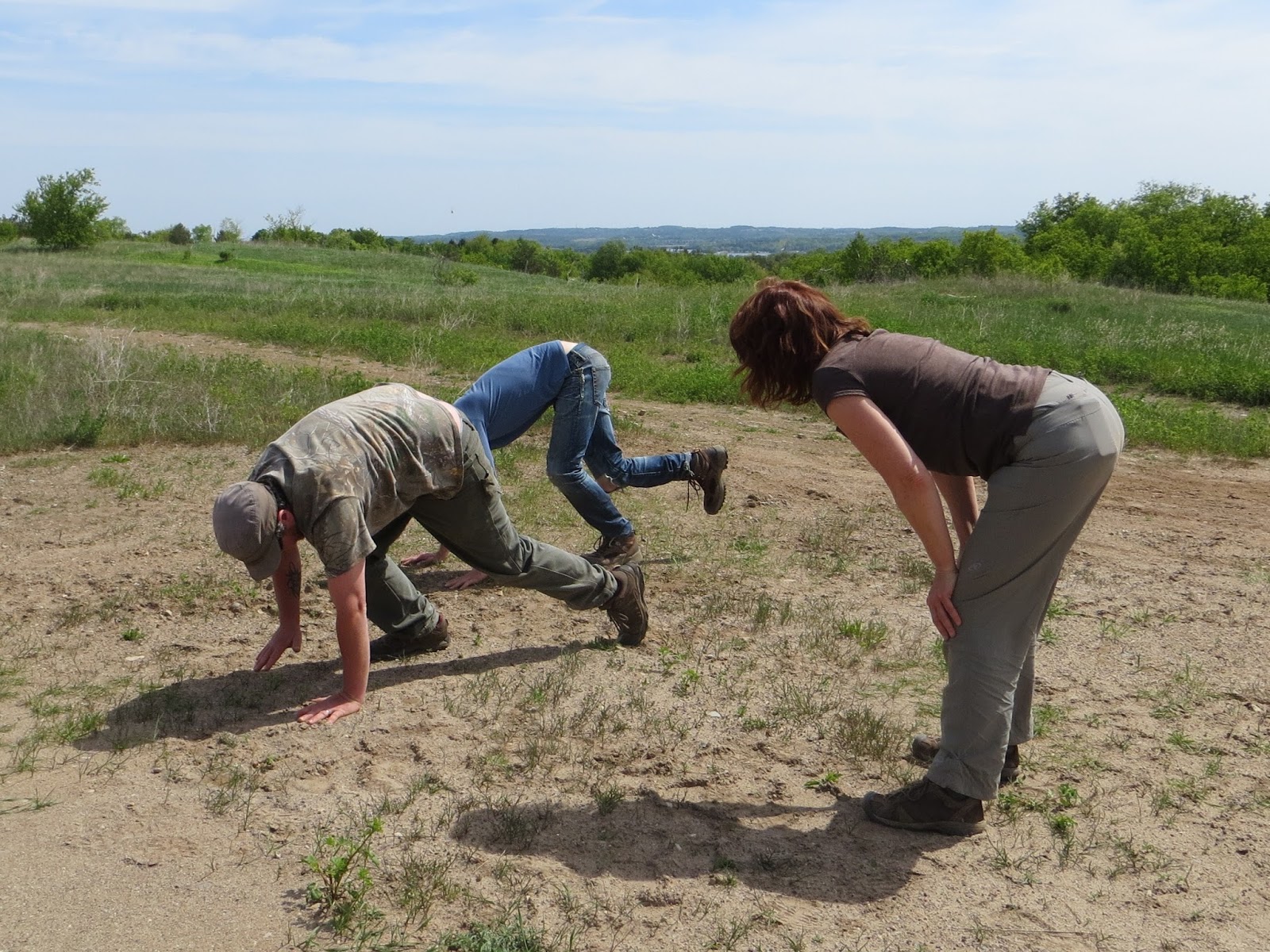
After observing some mystery scat which we later decided was most likely fox, Sue was curious about how to identify different fur-bearing rodents from scat contents.  Do rodents come in different colours? Are certain rodents more delicious than others?  Alexis suggested looking up shrews and voles in Peterson’s Guide to Mammals.  Much of the morning was spent measuring tracks and stride lengths for wild turkey, white-tailed deer, coyote, and skunk.  Aster, Sue and Alexis practiced diagonal walking and moving like the animals that we were tracking.  Aster and Sue were interested in the differences between domestic dog and coyote tracks.  Alexis shared that dog tracks are more splayed than coyote tracks due to a difference in physical fitness.  Dog tracks tend to wander whereas coyote tracks tend to have a straighter trail.  Dogs have kibble waiting for them at the end of the day.  Coyotes do not. 
The sandy, sun-baked, four-runner trails began to feel like a desert.  We ventured down towards the river and found reprieve and lunch in the shade of a cedar forest.  En route, we noticed an ant attempting to carry away a butterfly that was not quite dead yet.  Can ants use their formic acid to predate other insects? 
The afternoon was spent exploring sand pits, locating tracks and comparing the characteristics of coyote and fox tracks.  The question of which would be more valuable, gold or water in a desert came to mind as the contents of my water bottle dwindled in the hot sun.  We began to wonder if Alexis might soon demonstrate one of his revered survival skills and magically find us some water.  Alternatively, I pondered whether I might be able to devine where water was by picking up two sticks in front of me. Aster wondered if there might be water beneath the sandy ground where we could see dogwood growing.  Is dogwood an indicator species for water?  Solitary bees flew into sand tunnels all around us. One 6 mm tunnel had plant debris glued together in a silky turret at the entrance.  I later learned that this tunnel was likely made by a burrowing wolf spider.
One solitary bee made a burrow in a deer track.  What are the bees doing in the burrows?  Are they laying eggs?


Tamara kept a bird list for the day: Red-Eyed Vireo, Savannah Sparrow, Meadowlark, Great Crested Flycatcher, Chickadee, Grasshopper Sparrow, Song Sparrow, Northern Flicker, Northern Cardinal, Red-Winged Blackbirds, American Crows, Red-Tailed Hawk, Rose-Breasted Grosbeak, Blue Jay, Tree Swallow, Cliff Swallow.
It was great to be out tracking in the sandy trails of Lockyer Pits.  Next time, I will remember to bring more waterJ

Written by: Tamara Anderson - 2nd year Tracking Apprentice


*Elbroch, M. & Marks, E. 2001, Bird Tracks and Sign, Stackpole Books, Mechanicsburg, PA.

Spring Time Tracking at Mono Cliffs

Saturday, May 23, 2015 - Day 1

Mono Cliffs Provincial Park

Our group gathered into a circle under the shade of an old Sugar Maple at the edge of an open sunny field. We shared our goals, intentions and gratitude as we watched the wind blowing through the landscape, passing over the tall grasses and through the aspen/poplar leaves in a playful fashion. We watched a couple of Northern Harriers fly over the field, triggering a discussion on sexual dimorphism and hawk ID features, followed later by a Wild Turkey hen cautiously wandering out from her nest to feed.

After our sharing, we got up to prepare to head out into the field for our first day of tracking but right beside where we had been sitting, we noticed some really neat tent caterpillar webs on some young cherry trees! What type of cherry where they; black, choke or pin? We spoke a bit on how to tell cherry species from the shape, size and spacing of their flower clusters.

As we headed into the field, we looked back to our shady spot and saw just how much our own impressions on the land (where we had sat) resembled deer beds.
We didn't get more than 15 or 20 meters into the field before we stopped to look at some of our first animal sign. Alexis crouched down and pushed some grass aside, revealing a tiny trail carved into the ground underneath the tall grasses. He showed us a tiny piece of grass stalk cut on a 45 degree angle, indicating vole feeding sign. We spent the next while unveiling the intricate network of vole trails through the field. We wondered how large the territory range was for these tiny creatures, which according to Mark Elbroch, is 1/10 to 1 acre!
We saw plenty of large holes scattered over the field around some of the vole holes going down into the ground. Had someone like a fox or coyote been digging here to feed on the voles?

We stopped around a rock cropping looking for signs of weasel activity and talked about defining features of various local members of the weasel family.

Then we pushed towards the edge of the field along the tree line where we found some huge scars on the younger aspens from past deer antler rubbing. We stepped into the wooded area and began to travel along a deer trail that ran South, just a few feet into the forest. We took a look at some of the claw and teeth marks on various trees. Showing signs of porcupine and raccoons who had climbed these trees in the past.

We soon came to a spot where we noticed someone had been eating the trout lily greens. Who was the culprit, turkey, deer, rabbit? We took note that the greens were cut flat and sometimes slightly frayed. Then we found another clue, a hair that kinks when it is bent, indicating the eater's hair had a hollow core. A clear track then confirmed our suspicions.  White-Tail Deer.

We found some holes carved out of dead wood, triggering a lesson on how to differentiate between local woodpecker species from the signs. We were really able to bring home this lesson as theory was confirmed as we found examples in the field of signs from nearly each type of woodpecker throughout the course of the day!
In the afternoon, we made our way along some beautiful cliff ridges carved out around 11 000 years ago by some great glacier melts, providing breathtaking views of the valley below. We sat watching and listening to the birds together,  sighting some rose-breasted grosbeaks, red-eyed vireos, chickadees, turkey vultures, ravens and a few different warblers. We split up for some grounding sit-spot time long the cliffs before embarking on the descent back down towards our meeting point.

Throughout the remainder of the day, we wandered through the woods, talking about trees and plant ID, deer rutting behaviour, predators of ant hills, grouse vs wild turkey dust baths, what the deer have been eating and how to assess the age of forests based on the plants and trees growing there. It was truly a day full of many lessons, tying academic information in beautifully with experiential learning in the field.


Written by:  Lianna Vargas - 2nd year Tracking Apprentice


Friday, May 22, 2015

Of spring flowers, forest nibbles and an edible feast…


Of spring flowers, forest nibbles and an edible feast…

Our May plants apprenticeship weekend got off to an early start for those of us who were able to camp out at Alexis and Bobbi’s place on Friday evening.  Falling asleep to the sound of spring peepers and the pattering of rain on our tents and waking up to the sounds and smells of a glorious spring morning in the country was a great way to get into the groove of the weekend.  Saturday morning, woken by a chorus of birds, cows and frogs, we had a relaxed outdoor breakfast and waited for the rest of the group to assemble.  After a quick welcome and opening, and a chance to meet a couple of new participants to the course, we were on our way to a beautiful Grey County forest.  

Our first encounter was with a patch of wild ginger, which prompted some good words from Alexis to add to our ongoing conversation about ethical harvesting.  Wild ginger has some powerful medicinal properties to help with fever, respiratory ailments and indigestion, but it is a plant to be treated sensitively.  With ongoing habitat encroachment, we learned that it is best to harvest wild ginger very lightly or not at all.  Sometimes using a cultivated equivalent or a more common wild substitute is the best medicine!  We also noticed that the ginger, normally a hardwood species, was growing among pines, and that other hardwood flowers were also present here.  A fascinating example of tracking the human effect on the landscape: this colony is a remnant of a former maple forest that was logged for many years. We could see that the ginger was not as happy in the acidic soil of the pines as it would have been nestled among the maples that once covered this area.

We moved on to some more widespread and common species with large edible roots: dandelion and burdock. Again, Alexis prefaced the harvest with some wisdom on caretaking and ethics. Harvesting roots means taking a plant’s life, and so even more than taking other plant parts requires sensitivity and reciprocity: tuning in to the health of the plant and listening to whether it is ready to be harvested; and giving thanks, as is the time-honored practice of all cultures living close to the land.

Roots are best harvested before or after flowering: usually in fall, but potentially in spring.  Dandelion is a liver and kidney tonic and a diuretic, meaning it helps move fluid through the body.  It is particularly valued for this purpose because while it moves urine out of the body it also replenishes potassium.  The bitter flavour of the leaves is also great for the body, stimulating digestion, and adding nutrients often lacking in a modern western diet high in sugar and salt.  Burdock similarly has very bitter leaves, and its deep taproots are high in food energy, ideal for adding calories in any survival situation.

We moved along the trail and stopped to harvest some of the tiniest leaves of a basswood tree, and noted its multiple trunks and heart-shaped leaves.  In the same area, we selectively picked some tender bright-green spruce tips to infuse in apple cider vinegar.  At the foot of the basswood was a patch of daylilies, not yet flowering, adding another landscape tracking clue to the former homestead that was once tucked into this forest.  We talked about the edible parts of the daylily and the importance of distinguishing them from non-edible species.
 
We moved out the forest into a small clearing, which held the crumbled stone foundation of another old homestead surrounded by more useful plants.  As Lee and I slipped off to make a small fire, the others harvested catnip to brew for an after-lunch tea.  Nestled among a grove of cedars, we ate a companionable lunch and later sipped the musky-smelling and relaxing tea. 

Refreshed, we packed up and continued on our way, stopping to spend time with some bloodroot along the way – another beautiful native spring plant. We cut off the trail to find our way into a hardwood forest, and stumbled upon a small but incredibly diverse patch of native spring plants: blue cohosh, wild leeks, red and white trilliums, wild ginger, baneberry, Solomon’s seal, Canada mayflower.  A group of us spent some time with our Newcomb’s guides and an interesting plant with its stem growing straight through its leaves, and a dangling yellow flower missing some of its petals: quite a challenge since the number of petals is integral to the book’s classification key!  But with some persistence and intuition, we stumbled upon the identity of our mystery plant: bellwort.  Other sub-groups spent time carefully harvesting some plants for our dinner, as well as checking out a patch of poison ivy, for future avoidance!  Slightly down the trail, we found another beautiful plant with a white flower and spent more time with our Newcomb’s guides to discover that the plant was toothwort.  We read about the plants’ delicious and pungent roots and dug up a few to add to our dinner.  One of the roots was passed around for sampling, and was generally agreed to taste a lot like horseradish, with many exclamations of “so spicy!  But so delicious!”
 
As we headed back to our cars, we had one final stop at a red elder to discuss the differences between this species and sambucus Canadensis, the edible black variety, which was not yet in flower.  The name sambucus racimosa refers to the shape of the flower clusters on the red elder, which grow in rounded racemes instead of the flatter clusters of the Canadensis species. 

We were done our time in the field, but our day wasn’t over yet!  We headed back to Alexis’ place with our edible treasures, and spent a lovely evening together preparing and eating food, connecting, chatting about plants, and singing around the fire under a star-studded sky before heading off to our tents to rest up for what promised to be another full and exciting day on Sunday.

Written By:  Malgosia Halliop - 2nd year Plants Apprentice


Balm of Gilead Medicinal Oil

Here's a video I did for our Wild Plants Apprentices describing how to use the double boiler method for extracting the resins and medicinal qualities of Balsam Poplar buds.   They make a great infused oil that can then be turned into a salve for its antiseptic, anti bacterial and anti inflammatory qualities.   A very useful salve for use in many remedies.

Tuesday, May 5, 2015

Majestic Trees and the first Spring Ephemerals

On Sunday, Along the Niagara Escarpment,  we continued to learn about trees, and found several spring ephemerals poking through the leaves on the forest floor. There were tiny Spring Beauties with whitish pink flowers and Trout Lilies whose bell-shaped yellow flowers were yet to bloom. Tiny purple Violet flowers were growing in a sunny spot near Blue Cohosh's with their stems still purple as they emerge from the earth. We paused to harvest some Trout Lily corms, a sweet treat in the spring and in the summer and fall they have a taste more like potatoes. These early spring wildflowers grow, flower and go to seed in a forest before the leaf canopy grows thick enough to block out the sun.

We focused on identifying hardwood trees today, especially opposite branching ashes and maples.  We also found Ironwood, Trembling Aspens, White Birch, Black Birch, some Willows, Balsam Fir, and Common Elderberry shrub. We talked about forest succession when we came across Indian Pipe, a plant that gets it’s energy not from the sun, but from the fungus under the ground growing on the roots of trees. Also known as Monotropa uniflora, this plant has the coolest latin name of the many we learned today.


The Trail took us down the cliffs along a set of stairs. We paused for lunch near a pond and several folks sang some beautiful songs as we ate.  We tasted a thin slice of Wild Ginger root just before lunch, the unique maroon flowers should be coming out soon.  In the afternoon, we made tinctures.


Bright yellow Coltsfoot, has several features that distinguish it from dandelion, including purplish alternating scales on the stem, and heart-shaped leaves that don’t come out until after the flower does. We sat by the water, harvested some Coltsfoot and made a tincture in a mason jar.  Coltstfoot has demulcent properties, which means it can soothe a throat sore from a cough or a cold.  It’s expectorant properties mean that it can thin out mucous so that it is more easily expelled by coughing. We stopped by the creek to harvest some bark from a White Birch that had been cut down recently- it would make great baskets and other natural crafts.      
 
The Willows sat by the water; a small pond with some geese asserting themselves for a prime nesting ground.  Nine Painted Turtles basked on a log, they seemed to be unfazed by the geese’s loud honking battles.  A bat and several birds, sparrows and Red-Winged Blackbirds also inhabit this wetland.  As the clouds rolled in, the spring peepers started their mating song. We tinctured some Willow here, to be used to help with pain and inflammation.

Heading home, we stopped along another pond making up the headwaters of the Sheldon Creek.  We filled up our water bottles at a nearby spring. The path turned south and got steeper.  As we climbed through the cliffs we stopped to take a group photo!

 
The trail took us to a lookout at the top of the Escarpment. Looking out over the forest, we watched the turkey vultures soaring in the cliff’s updrafts and listened to some stories of Alexis’ adventures in this place many years ago. A closing circle was held at the top of the cliff.  We shared some gratitude and anticipation for the months to come before heading to the cars.

Written By:  Alex Thomson - 2nd Year Plants Apprentice


Trees, Owl Eyes and Cold Water

Saturday April 18 – Trees, Owl Eyes and Cold Water
 As we sat in our first circle of the 2015 Wild Plants Apprenticeship – the sun was out and so were the birds. In our spot along the Bruce Trail, many hikers passed us quickly as we sat and learned each others names in the cool grass dotted with raspberry canes.

Soon, we stepped a few feet further along the path to discover a tall, flaky barked tree. I scraped a young branch with my fingernail to release the smell of almonds that the black cherry has hidden under its bark. We spent many moments by this tree, harvesting some of its inner bark to make medicine with. Using knives and fingers, we were each able to take some bark with us, while stashing some branches to return to later.

Hiking past the first meadow, we found ourselves in a stand of pines, planted perhaps to break the wind across these fields. “All pines are evergreens, but not all evergreens are pines” was a lesson to remember. With five pine species in this region, we spent some time teasing out which one we were looking, and with five needles in each bundle, this first tree was in fact the official tree of OntarioJ

In a survival situation, pines are a reliable source of safe foods – but we were reminded “Don’t ever ingest anything that you don’t have 100% ID on”. Seems like some words to live by!

Further down the trail, we came upon a velvety-leaved rosette coming through the grasses. This biennial plant is a great medicine to support the lungs and airways, and when the flowers are steeped in oil, can also be a remedy for the common earache.

As we passed another stand of pines and some feeding sign from a porcupine friend, we came out to a south facing hill where some tiny lobed leaves were making an appearance. This new growth of the Ox-eye Daisy is uniquely flavoured and quite lovely in a salad.

Looking at pine cones and pulling needles, we spent much of our day absorbing the details of the conifers that allows us to differentiate them and begin to build relationships with these tall towers of food and medicine that once dominated this landscape.

Through a low cedar wetland, we found yellow birch, and even a wild spring where water can be drunk from the ground! The cool liquid was a great addition to our warm sunny day, and I loved the opportunity to have water that was known to be safe coming directly from the earth to me.

 
After crossing a precarious creek or two, many of us had removed our shoes and were varying levels of muddy. Walking into a hardwood stand, there were some stunning baby blue cohosh plants, and the young leaves of a Garlic Mustard.  With the Garlic Mustard sparking some interesting conversations around native and invasive plants, and sustainable harvesting, there was some excitement building for using and eating some of our more bountiful plants!

After sitting in silence in the late afternoon, we slowly came back together as a group again by the cold creek. With our bare feet on the earth, we were encouraged to spend a little time learning how to feel through our footsteps, and soften our gaze to use all of our peripheral vision. In “owl eyes” we walked slowly around the grasses and saplings, and I was so excited to see some moths and small flies pop into vision. I can’t wait for what I see next!


Written By:  Lee Earl - 2nd Year Plants Apprentice

Friday, April 10, 2015

Landscape Tracking - Learning from the Land

This weekend’s theme was landscape tracking! We met at the Hockley Valley Nature Reserve near Orangeville. Few of us had been to the area, so we were keen to go exploring.
After a quick gratitude circle, we followed the trail west for a few minutes, then out into a grassy lowland next to a treed slope. All the grass had been pushed down and there were trails cutting through. Was it the work of deer? Was it people? Or had someone’s enthusiastic dog rolled all over? Jeff noted that the goldenrod was still standing. Could that be a clue about the perpetrator? We bent down and looked at the green carpet more carefully. It was green on top, but brown underneath. This grass had been pushed down for quite a while.
Alexis decided that we should follow the deer trail up the slope and into the trees just to see where it would take us. By observing the trail, we could see how they shaped the landscape. The deer had worn a rut into the earth, and when we stepped off-trail, we sank into the soft pine needle carpet. Punky logs in the path of the deer had been pulverized by their hooves.
Were the deer going uphill or downhill? Was the trail only used to go one way or both? We tried to imagine when the deer would go down to water or up to higher ground and what would influence them to go in either direction. For example, hot air rises during the day and sinks at night. Where would they go to be able to smell a predator? Where would they go to stay cool?
The group spent some time walking in silence. Such a heavily used trail could yield a wild animal sighting if we were careful. Soon, our main trail branched off left, then right, then uphill and downhill. Before long, three separate groups were stalking along deer trails, trying to spot the animals that had made them.
The slope and the top of the ridge were full of red pines. Those had thinned out, their place taken by beeches, ironwoods, oaks, maples, aspens and birch. The understorey had changed, too. We were seeing leatherwood and forest goldenrod. What would attract the deer to this area? Most likely the acorns and beech nuts, especially in fall and winter.
Alexis called us over to investigate a depression in the hillside and asked, what happened here? There were several such depressions, usually close to trees. Some of us thought they were caused by erosion. Others thought they were burrows. But Victor guessed that they were created when a tree had fallen over long ago, its roots pulling up all the surrounding dirt. It had happened so long ago that the trunk had disintegrated. He had guessed right, and we were shown where the signs of what happened could be found: the canopy. Surrounding the hummock were fast-growing aspens and birch, pioneer species that had grown up to take advantage of the sunlight that had been blocked by the big tree’s leaves before it had come down. If we could age those aspens, we might get an idea of when the tree fell – though a good guess would be 1954, the year of Hurricane Hazel.
Back to the deer trails: The main trail led out into another grassy field, so out we went to see where the deer had gone. The field was full of goldenrod, yarrow and asters, typical late summer forbs, and trails criss-crossed through the grass. Each of us tried to follow one, but it wasn’t clear where they were going or even if we were following deer anymore. We remembered an earlier lesson about what trails made by animals low to the ground look like when compared to trails made by animals with long legs. Maybe there were rabbits or raccoons in the area?
A few anthills dotted the field and before long, we were standing around one that had attracted Alexis’ attention. At over a foot wide and about 10” tall, it wasn’t the biggest one we had seen, but it wasn’t the size that warranted investigation; it was the accumulation of tiny, tubular scats on top. We were looking at a vole latrine. Why did the vole latrine here? Wouldn’t the ants bite the vole? Do voles eat ants, or are they strict vegetarians? We had lots of questions, and a flash of insight into small-scale landscape tracking.
Once we reached the other side of the field, we entered a lowland area of cedars bisected by a tributary. As we sat and had lunch, we discussed how deforestation in the upland areas had led to erosion, which meant silt running into the river. A siltier, shallower river in turn led to increased flooding and fewer salmon spawning, and that may have impacted an important food source for mammals in the area -- and a potential source of nitrogen for the plants and trees. They say our forestry practices have changed a great deal over the last decades. I wonder how.
Now that we were in the mindset of cause-and-effect, we were asked to go quietly out around the area and sit and observe. “What happened here?” was the question we were to ask ourselves over and over again as we looked at the landscape, the flora and the fauna. At the end of our exercise, we came together again and shared some of our key observations. Steve, a second-year tracking apprentice, said that he was looking at the water and thinking about how fallen trees might have changed the river’s path. Did some of the little islands have tree trunk foundations?

It was time to get moving. We climbed up gradually then climbed down very quickly into a valley carved by a creek long, long ago. As we climbed back up the other side, we stopped to marvel at a beautiful, fiery-orange salamander. Not long afterwards, we found another vireo’s nest at almost the same height we had found the first one in July. Alexis said he liked seeing so much bloodroot in one place. You don’t often see so much at one time.
In no time, it seemed we had returned to a well-worn deer trail like the one we had found at the beginning of our day. We walked in a line all the way back to the trail head. Mark said he could tell we were close to the meadow where we began because he could hear the crickets chirping. After another quick closing circle, we were done for the day.
What eye-opening lessons! Who knew that the anthill to the vole is as important as the ridge is to the deer? If you’re interested in learning more, here are a few books you might be interested in:
Reading the Forested Landscape by Tom Wessels

The Peterson Field Guide to Eastern Forests, by John C. Kricher

Written By: Christina Yu - 2nd Year Tracking Apprentice